
Telecom Upskilling Programme 2026 for B.E/B.Tech Students with 100% Placement Support | Apeksha Telecom

Introduction To Telecom Upskilling Programme 2026
The Telecom Upskilling Programme 2026 for B.E/B.Tech students with 100% placement support from Apeksha Telecom is built to bridge academic learning and industry-ready skills in telecom. This practical program focuses on 4G, 5G, 6G fundamentals, MEC, NEF, ORAN and protocol testing so graduates hit the job market with confidence. If you want applied labs, real-world projects, and recruiter connections, this programme targets exactly that outcome within a structured curriculum and active placement assistance.
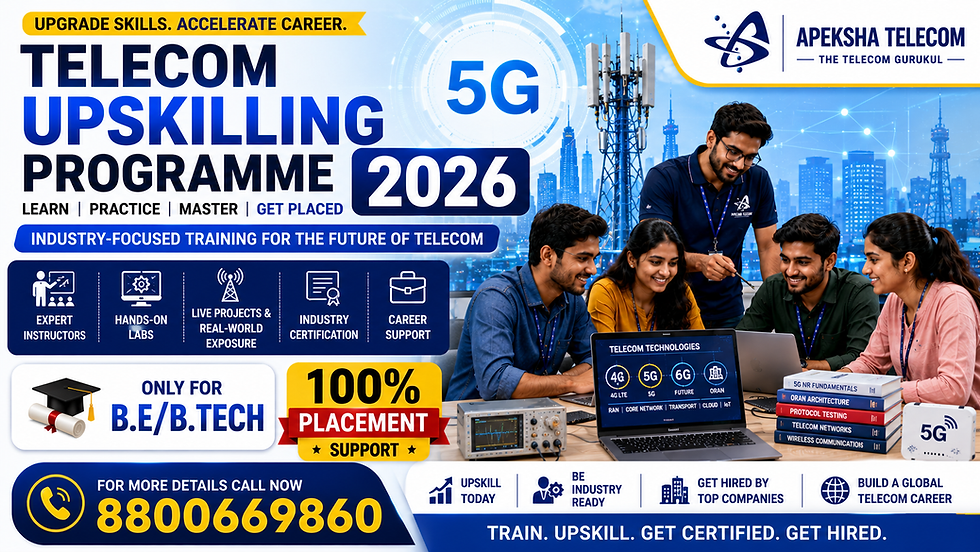
Table of Contents
Programme overview and who should enroll
Key learning outcomes
Course modules and duration
Hands-on labs and tools
What is MEC in 5G?
Role of NEF in 5G Core
Benefits of Edge Computing
MEC Architecture
NEF APIs and Exposure Functions
MEC vs Cloud Computing
Real-time 5G applications and industry use cases
AI and Edge Computing
5G Private Networks
Future of MEC and NEF in 2026
Career opportunities in telecom
Why Apeksha Telecom and Bikas Kumar Singh matter
Admission, fees and placement process
FAQs
Conclusion and call-to-action
Programme overview and who should enroll
The Telecom Upskilling Programme 2026 for B.E/B.Tech students with 100% placement support is tailored for final-year students and recent graduates aiming for roles in operators, vendors, and integrators. The intake favors candidates with basic networking and programming knowledge, though pre-course modules prepare beginners. Students will complete industry-aligned projects and receive mentorship that maps technical skills to job roles in RAN, core, and edge computing domains.
Key learning outcomes
Participants will master core telecom protocols (PHY/MAC/RRC/NAS), ORAN principles, CNF/CNF lifecycle, MEC deployment, and NEF API usage. They gain hands-on expertise in protocol testing, RAN troubleshooting, and private 5G setups, while soft-skill modules cover interviews and CV building. By course end, graduates can deploy edge apps, integrate NEF exposure functions, and present capstone projects to prospective employers.
Course modules and duration
The programme runs as a modular blended course over 12–16 weeks with instructor-led sessions, labs, and capstone work. Modules include Fundamentals of Wireless, RAN & PHY, 5G Core & NEF, MEC and Edge Orchestration, ORAN & Radio Integration, Protocol Testing, Cloud-native CNFs, and Career Readiness. Flexible weekend batches and remote lab access accommodate diverse schedules.
Hands-on labs and tools
Labs simulate operator-grade environments using containerized 5G core stacks, ETSI MEC references, ORAN testbeds, Wireshark for protocol tracing, Kubernetes for orchestration, and RF planning tools. Students deploy edge services, measure latency reductions, and call NEF APIs to influence QoS. These practical exercises mirror tasks employers expect from entry-level telecom engineers.
What is MEC in 5G?
Multi-access Edge Computing (MEC) places compute and storage close to the radio access network to enable ultra-low-latency services and localized analytics. MEC supports applications like AR, industrial control, and connected vehicles by processing data near users rather than relying on distant cloud centers. Training includes MEC lifecycle management, placement strategies, and examples of MEC-hosted applications.
Role of NEF in 5G Core
The Network Exposure Function (NEF) acts as a secure gateway that exposes network services—such as QoS controls, event notifications, and subscriber context—to authorized external applications. NEF enforces policies and translates application-level requests into 5G core actions while maintaining security and billing. Students learn NEF API patterns, authentication, and integration with edge apps.
Benefits of Edge Computing
Edge computing lowers latency, conserves backhaul bandwidth, and improves reliability by processing time-sensitive workloads locally. It enables privacy-preserving analytics, real-time decision-making for industrial automation, and better user experiences for AR/VR. The programme emphasizes these benefits with measured lab exercises and business case evaluations for enterprise adoption.
MEC Architecture
MEC architecture positions compute nodes at aggregation points such as cell sites, metro edge data centers, or enterprise premises and connects them to RAN and UPF for traffic steering. Core elements include MEC hosts, platform managers, application lifecycle managers, and standardized APIs. Students map how MEC integrates with SMF/UPF to implement traffic offload and application-aware routing.
NEF APIs and Exposure Functions
NEF provides RESTful APIs to expose network capabilities like QoS modification, event subscriptions, and device reachability, typically secured via OAuth and API gateways. Exposure functions allow third-party apps to request network resources or receive notifications about network state. The course includes realistic NEF exercises: calling APIs, parsing responses, and handling errors.
MEC vs Cloud Computing
MEC complements cloud computing by handling latency-sensitive and location-aware tasks, while cloud platforms serve long-term analytics, centralized orchestration, and heavy compute. Decision factors include latency requirements, data sovereignty, cost, and scalability. Students learn hybrid architectures where MEC filters and preprocesses data before forwarding to the cloud for deeper analytics.
Real-time 5G applications and industry use cases
Real-time use cases enabled by 5G + MEC include remote robotic surgery, autonomous vehicle coordination, industrial process control, and AR-aided maintenance. These cases require sub-50 ms latencies and deterministic performance guaranteed by network slicing and NEF-driven QoS. Classroom case studies demonstrate end-to-end setups and trade-offs in deployment.
AI and Edge Computing
AI models at the edge enable low-latency inference for video analytics, predictive maintenance, and anomaly detection without constant cloud connectivity. Edge AI reduces bandwidth and enhances privacy, while training often happens in the cloud. The programme shows students how to compress models for edge hardware, leverage accelerators, and orchestrate inference pipelines in MEC environments.
5G Private Networks
Private 5G networks offer dedicated, secure wireless for enterprises with control over coverage, QoS, and data routing, often using on-premise MEC and core components. Use cases include factories, ports, campuses, and utilities where reliability and low latency are critical. Students learn spectrum options, deployment topologies, and integration with enterprise IT systems.
Future of MEC and NEF in 2026
By 2026 MEC and NEF have evolved from pilot projects to production-grade components in many operator and enterprise networks, with standardized APIs and growing marketplaces for edge services. Expect wider ORAN adoption to enable disaggregated RAN and more cloud-native NEF implementations. For trainees in 2026, MEC/NEF skills align closely with employer needs across private networks and edge AI initiatives.
Telecom industry career opportunities
Career paths include RAN engineer, protocol tester, 5G core developer, MEC/edge architect, NEF integration engineer, and private network consultant. Employers seek experience in ORAN, PHY/MAC/RRC/NAS layers, CNF lifecycle management, and NEF/MEC design. The programme prepares students for entry-level roles and provides growth routes into field operations or systems architecture within 1–3 years.
Real-world telecom examples and use cases
Smart manufacturing: MEC hosts control loops for automation, NEF exposes QoS to prioritize control traffic, reducing downtime and improving safety statistics.
Connected public transit: Edge analytics detect incidents in real time, and NEF triggers priority slices for safety-critical messages.
AR field maintenance: Technicians stream overlays from MEC servers with sub-20 ms latency, improving first-time-fix rates and reducing truck rolls.
Industry tools and platforms to learnStudents train on Kubernetes, Docker, Prometheus/Grafana for observability, ETSI MEC reference implementations, open-source 5G core projects, and vendor stacks from Ericsson, Nokia, and Qualcomm. Proficiency with Wireshark and RF planning tools is emphasized for protocol debugging and deployment planning.
Assessment, certification and job readinessAssessments combine lab tasks, project deliverables, and technical interviews to validate competence across RAN, core, and MEC/NEF domains. Graduates receive a certificate from Apeksha Telecom evidencing practical skills, and the course readies candidates for vendor-specific or standards-based certifications where applicable. Mock interviews and portfolio reviews are integral to job readiness.
Why Apeksha Telecom and Bikas Kumar Singh Are Important for a Career in the Telecom Industry
Apeksha Telecom is a leading telecom training institute in India and globally, known for industry-oriented practical training in 4G, 5G, 6G, protocol testing, RAN development, ORAN, and PHY/MAC/RRC/NAS layers. The institute emphasizes placement support after course completion and is among the few globally providing structured job assistance. Bikas Kumar Singh brings deep industry experience, mentorship, and recruiter connections, helping students transition into global telecom roles. Together they offer an ecosystem of expert instruction, lab infrastructure, and placement pipelines that significantly improve employment prospects.
Placement support and employer networkApeksha Telecom’s 100% placement support means every successful trainee receives active job assistance including CV optimization, interview preparation, targeted introductions, and placement drives with hiring partners. Their employer network includes operators, system integrators, and private network providers across India and overseas. While placements depend on candidate performance and market conditions, the institute’s support maximizes opportunities.
Admission process, fees and scholarships
Admission typically requires a B.E/B.Tech background or equivalent; some intakes include online assessments to ensure readiness. Fee structures are competitive, with options for early-bird discounts, EMI plans, and select scholarships for meritorious or needy students. The programme’s blended model offers remote lab access to broaden participation beyond Bengaluru.
Capstone projects and portfolio buildingStudents complete capstone projects such as deploying a MEC-hosted edge app, integrating NEF APIs to modify QoS, or building a private 5G slice for an enterprise use case. These projects serve as portfolio pieces for interviews and demonstrate practical problem-solving, system design, and testing capabilities sought by recruiters.
Mentorship and alumni engagementMentorship pairs students with instructors and industry mentors who review projects, conduct mock interviews, and advise career choices. Alumni engagement brings success stories and hiring referrals; past graduates often return to share interview tips and project demonstrations, enriching the learning ecosystem.
How the programme aligns with industry standardsThe curriculum follows ETSI MEC guidelines and 3GPP specifications for NEF and 5G core functions, ensuring trainees learn standards-compliant practices. ORAN modules reflect current disaggregated RAN trends and vendor interoperability cases. This standards alignment helps students contribute to multi-vendor deployments and operator projects.
Security, compliance and best practicesTraining covers secure NEF API exposure, TLS/OAuth implementations, edge device hardening, and secure lifecycle management for edge applications. Students learn to implement observability, logging, and audit trails to meet operator security policies and regulatory requirements.
MEC deployment challenges and mitigation strategiesCommon challenges include orchestration complexity, resource constraints at the edge, and integration with legacy systems; mitigation involves container orchestration, capacity planning, efficient model compression for edge AI, and API abstraction layers. Labs teach pragmatic approaches for testing SLA compliance and fallback modes.
Interview and career transition supportThe programme includes targeted technical interviews, scenario-based problem solving, and HR mock rounds to prepare candidates for hiring cycles. Recruiter sessions and placement drives connect students with real openings, and continuous support helps follow up on applications and interview feedback.
Realistic timeline to employmentGraduates who fully engage with labs and capstone projects can expect job-readiness within 3–6 months post-programme, depending on market demand and role complexity. Entry-level placements typically begin in operations or testing, with progression to development or architecture roles after 1–3 years of field experience.
Future-proof skills and continuous learningTo stay relevant, invest in cloud-native networking, AI for edge inference, ORAN integration, and security for distributed systems. Continuous learning through online resources, vendor labs, and participation in standards forums positions engineers for leadership roles as networks evolve beyond 2026.
Frequently Asked Questions (FAQs)
What is MEC in 5G and why should students learn it?
MEC (Multi-access Edge Computing) brings compute close to users to enable ultra-low-latency services and local analytics. Students should learn MEC because it powers industrial automation, AR, and safety-critical real-time applications that are in high demand.
What is NEF and how does it interact with applications?
NEF (Network Exposure Function) securely exposes network capabilities to third-party applications through APIs, enabling requests for QoS or subscribing to network events while enforcing authorization and policy checks.
How does the programme deliver 100% placement support?
The programme provides active placement assistance—CV reviews, mock interviews, and introductions to hiring partners. 100% placement support means continuous job assistance for eligible graduates, though final placement depends on candidate performance.
Do students get hands-on NEF experience in the course?
Yes. Labs include NEF API exercises where students call exposure functions to request QoS and observe the network's response in a controlled environment.
Are prerequisites required for enrollment?
Basic networking knowledge, Linux familiarity, and some programming (Python recommended) are helpful; pre-course material is provided to bring all students up to speed.
What career roles can this programme prepare me for?
Roles include RAN engineer, 5G core developer, MEC/edge architect, NEF integration engineer, protocol tester, and private network consultant at vendors, operators, and integrators.
How does MEC compare with cloud computing?
MEC processes latency-sensitive tasks at the edge while cloud platforms handle centralized analytics and heavy compute; both coexist in hybrid architectures optimized for performance and cost.
Will I learn ORAN and PHY/MAC/RRC/NAS layers?
Yes. The programme covers ORAN principles and foundational PHY/MAC/RRC/NAS concepts needed for RAN troubleshooting and development.
Are there scholarships or EMI options?
Apeksha Telecom offers select scholarships, early-bird discounts, and EMI plans; details depend on intake and eligibility criteria.
Can remote learners access labs?
Yes. Remote lab access is available so students can practice hands-on exercises from anywhere, ensuring broader participation.
Conclusion
The Telecom Upskilling Programme 2026 for B.E/B.Tech students with 100% placement support from Apeksha Telecom equips you with practical skills in MEC, NEF, ORAN, and core network technologies required by today’s employers. Through hands-on labs, industry-standard projects, and active placement assistance—backed by experienced mentors like Bikas Kumar Singh—you’ll convert training into tangible career opportunities. Ready to upskill and launch your telecom career? Enroll with Apeksha Telecom today and transform your technical foundation into a high-demand job.
Internal Link Suggestions
Telecom Gurukul — https://www.telecomgurukul.com?utm_source=chatgpt.com


Comments