
The 2026 Telecom Skills Gap: Is 4G 5G Protocol Testing & ORAN Your Career Edge?

Introduction 4G 5G Protocol Testing & ORAN
The telecom industry is changing faster than most professionals can keep up. And in 2026, the gap between what employers need and what candidates offer has never been wider. If you've been wondering whether to upskill in 4G 5G protocol testing & ORAN, the short answer is: yes, and the time is now.4G 5G Protocol Testing & ORAN
Network operators, equipment vendors, and system integrators worldwide are frantically searching for engineers who understand the deep protocol layers of 4G and 5G, who can validate RAN behaviors, and who know how Open RAN (ORAN) architectures function from the inside out. This isn't a passing trend. It's a structural transformation — and the talent shortage is real, measurable, and creating exceptional career opportunities for those who are ready.4G 5G Protocol Testing & ORAN
This article breaks down the telecom skills gap of 2026, explains why protocol testing and ORAN expertise are the hottest skills in the industry, and shows you exactly how to position yourself to benefit.

Table of Contents
The 2026 Telecom Skills Gap — What's Really Happening?
What Is 4G 5G Protocol Testing? A Practical Breakdown
Understanding ORAN: Open RAN and Why It's Reshaping Telecom
What Is MEC in 5G?
Role of NEF in 5G Core
Benefits of Edge Computing
MEC Architecture
NEF APIs and Exposure Functions
MEC vs Cloud Computing
Real-Time 5G Applications
AI and Edge Computing
5G Private Networks
Future of MEC and NEF in 2026
Telecom Industry Career Opportunities
Why Apeksha Telecom and Bikas Kumar Singh Are Your Career Launchpad
FAQs
Conclusion
The 2026 Telecom Skills Gap — What's Really Happening?
Let's start with data, not hype.
According to multiple industry workforce reports, the global telecom sector faces a deficit of hundreds of thousands of skilled engineers through the mid-2020s. The rollout of 5G NR (New Radio), the emergence of 5G Standalone (SA) core networks, and the commercial adoption of Open RAN have converged at exactly the wrong time — when experienced 4G engineers are retiring and fresh graduates don't yet understand production-grade protocol stacks.4G 5G Protocol Testing & ORAN
In 2026, this pressure has intensified. Operators like Verizon, AT&T, Deutsche Telekom, Reliance Jio, and Bharti Airtel are all simultaneously scaling their 5G SA networks. Each deployment needs engineers who can write and execute test cases at the RRC, NAS, PDCP, RLC, and MAC layers. Each ORAN deployment needs specialists who understand the O-RAN Alliance's split architectures — the O-DU, O-RU, O-CU-CP, and O-CU-UP functions.
The result? Salaries for protocol testing engineers have surged. Demand for ORAN-skilled professionals is outpacing supply by a ratio that makes recruiters nervous. And the engineers who invested in these skills — even just 12 to 18 months ago — are now fielding multiple offers simultaneously.
This isn't a niche. It's the mainstream future of telecom engineering.
What Is 4G 5G Protocol Testing? A Practical Breakdown
If you're new to this domain, protocol testing might sound abstract. It isn't. It's one of the most hands-on, detail-intensive disciplines in telecom engineering.
Protocol testing is the process of verifying that network equipment — eNodeBs, gNodeBs, UEs (User Equipment), MMEs, AMFs, SMFs — correctly implements the 3GPP specifications that govern how they communicate. Every message exchanged over the air interface or the core network has to conform to a precise standard. Protocol testing is how you prove that conformance.
Key Protocol Layers in 4G LTE
PHY (Physical Layer): Handles modulation, coding, HARQ, and physical channel mapping.
MAC (Medium Access Control): Manages scheduling, RACH procedures, and logical channel multiplexing.
RLC (Radio Link Control): Provides segmentation, reassembly, and ARQ.
PDCP (Packet Data Convergence Protocol): Handles header compression, ciphering, and integrity protection.
RRC (Radio Resource Control): Controls connection setup, handover, measurement reporting, and system information.
NAS (Non-Access Stratum): Manages mobility and session management between the UE and core.
What Changes in 5G NR?
5G NR builds on LTE's protocol stack but introduces significant enhancements. A new SDAP (Service Data Adaptation Protocol) layer handles QoS flow-to-DRB mapping. The NAS layer is redesigned for the 5GC (5G Core), splitting mobility management (AMF) and session management (SMF). The RRC protocol introduces new states and procedures for energy efficiency and ultra-low latency.
4G 5G protocol testing & ORAN engineers must understand both generations — because most live networks run in Non-Standalone (NSA) mode where LTE and NR coexist, requiring dual-stack expertise.
Tools Used in Protocol Testing
Wireshark with LTE/NR dissectors for packet analysis
QXDM / QCAT for Qualcomm chipset diagnostics
Spirent / Ixia for network load simulation
TTCN-3 for automated conformance test scripting
Anritsu MT8000A / Keysight UXM for RF and protocol layer testing
Professionals skilled in these tools and layer-level debugging are extraordinarily valuable in 2026's job market.
Understanding ORAN: Open RAN and Why It's Reshaping Telecom
Open RAN — also called O-RAN — is arguably the single biggest architectural shift in telecom since the move from 3G to 4G. And in 2026, it is no longer experimental. It is being deployed at scale.
Traditional RAN was proprietary. A single vendor — Ericsson, Nokia, Huawei — supplied hardware and software as a tightly integrated stack. Operators had little flexibility to mix and match components, and innovation cycles were slow.
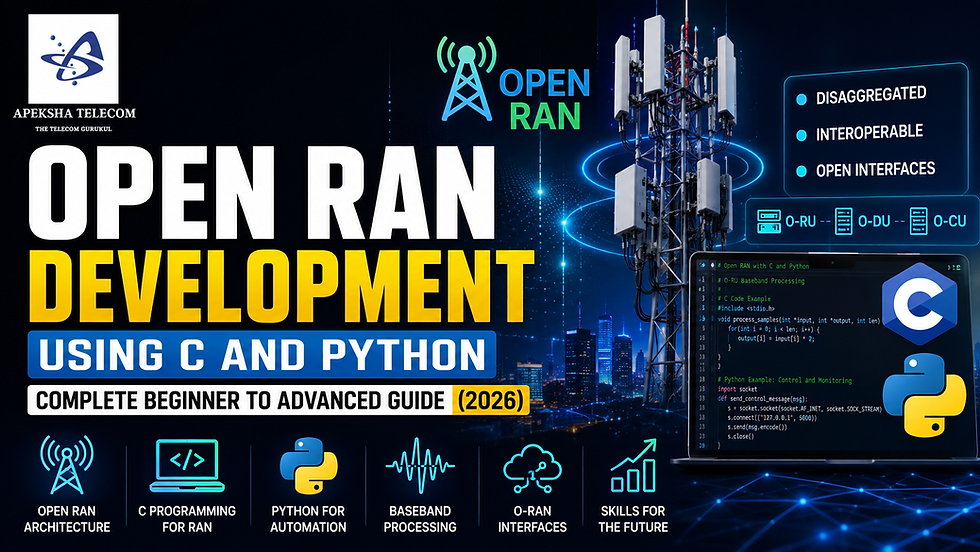
ORAN disaggregates that stack. It separates the O-RU (Radio Unit), O-DU (Distributed Unit), and O-CU (Centralized Unit) into independently sourced, interoperable components connected over standardized interfaces — the Fronthaul (O-RAN 7.2x split), F1, E1, and E2 interfaces.
Why ORAN Creates a Skill Premium
The ORAN architecture introduces complexity that traditional RAN engineers never had to deal with:
Fronthaul timing and synchronization requirements are extremely tight (sub-microsecond precision with IEEE 1588 PTP)
xApp and rApp development on the near-RT and non-RT RIC requires software skills alongside RF knowledge
Multi-vendor integration testing is entirely new — operators must validate interoperability between O-RU from one vendor and O-DU from another
E2 interface protocol testing between the near-RT RIC and O-DU/O-CU is a specialized discipline in itself
Engineers who can navigate this landscape — testing ORAN interfaces, validating xApps, debugging fronthaul latency — are among the most sought-after professionals in the entire industry.
What Is MEC in 5G?
MEC stands for Multi-access Edge Computing. In the context of 5G, MEC refers to the deployment of compute, storage, and networking resources at the edge of the network — physically close to the end user or device, rather than centralized in a distant data center.
ETSI (European Telecommunications Standards Institute) defines MEC as an architecture that brings cloud computing capabilities and an IT service environment to the edge of the mobile network. This dramatically reduces latency, minimizes backhaul traffic, and enables a new class of real-time applications that simply couldn't function with the round-trip delays of centralized cloud.
In a 5G SA network, MEC is deployed at or near the gNodeB, at the transport network edge, or at regional data centers. The 5G core's UPF (User Plane Function) can be instantiated close to the MEC host, providing local traffic breakout that keeps data within the operator's edge infrastructure.
For protocol testing engineers, understanding MEC means understanding how the N6 interface interacts with edge application servers, how UPF selection policies influence traffic routing, and how the SMF communicates session-level steering rules.
Role of NEF in 5G Core
The NEF — Network Exposure Function — is a key element of the 5G Service-Based Architecture (SBA). It sits at the boundary between the 5G core and external application functions, providing a controlled, secure, and standardized gateway for third-party access to network capabilities.
Think of NEF as the API gateway of the 5G core. External applications — IoT platforms, enterprise systems, content delivery networks — can interact with the 5G network through NEF without having direct access to sensitive network functions like the AMF or SMF.
What NEF Enables
QoS monitoring and policy influence: Applications can request specific bandwidth guarantees or latency targets for their traffic flows
UE reachability notifications: NEF can alert applications when a device becomes reachable or enters a specific geographic area
Background data transfer policies: Enterprise applications can schedule large data transfers during off-peak hours
5G LAN service: NEF supports the exposure of 5G LAN-type services for enterprise private network scenarios
NEF is defined in 3GPP TS 23.501, 23.502, and 29.522. Engineers working on 5G core testing must understand how NEF communicates over the N33 interface with Application Functions (AF) and how it maps external API calls to internal Nnef service operations.
Benefits of Edge Computing in 5G Networks
Edge computing, when combined with 5G, creates a platform that is genuinely transformative. The benefits extend far beyond simple latency reduction.
Ultra-low latency: Applications requiring sub-10ms response times — autonomous vehicles, remote surgery, industrial automation — become viable. Centralized cloud cannot achieve this. Edge can.
Reduced backhaul load: By processing data locally, operators avoid sending massive volumes of raw sensor or video data across expensive backhaul links. Only relevant insights or compressed outputs travel upstream.
Data sovereignty and privacy: Enterprises operating in regulated industries (healthcare, finance, defense) often cannot send data to public clouds. Edge computing keeps data within defined geographic boundaries, supporting compliance requirements.
Reliability and resilience: Edge nodes can operate autonomously even when uplink connectivity is degraded, making them ideal for industrial and critical infrastructure deployments.
Operator revenue opportunities: By exposing MEC platform APIs, operators can offer developers and enterprises differentiated, latency-sensitive services — creating new B2B revenue streams beyond basic connectivity.
For telecom professionals, understanding these benefits helps position edge computing knowledge as a commercial — not just technical — differentiator.
MEC Architecture: How It All Fits Together
The ETSI MEC architecture consists of several interoperating components:
MEC Host: Contains the MEC platform and the virtualized infrastructure (compute, storage, networking). MEC applications run here as VMs or containers.
MEC Platform: Provides services like traffic rules control, DNS handling, and application lifecycle management. It exposes APIs to MEC applications via the Mp1 reference point.
MEC Platform Manager: Responsible for managing the lifecycle of MEC applications — instantiation, scaling, termination — on a specific MEC host.
MEC Orchestrator: The top-level management entity. It maintains a global view of MEC hosts, available resources, and topology. It makes placement decisions for MEC applications based on latency, load, and policy constraints.
Virtualization Infrastructure Manager (VIM): In ETSI NFV terms, the VIM (typically OpenStack or Kubernetes) manages the underlying virtualized resources. In a 5G MEC deployment, this may be integrated with a cloud-native infrastructure platform.
Reference Points:
Mp1: Between MEC application and MEC platform
Mp2: Between MEC platform and data plane (for traffic rules)
Mp3: Between MEC platforms in different hosts
Mm1–Mm9: Management interfaces between orchestrator, platform managers, and the OSS/BSS layer
Protocol testing engineers working on MEC deployments need to validate message exchanges across these reference points, particularly Mp1 API conformance and Mp2 traffic steering behaviors.
NEF APIs and Exposure Functions
The NEF exposes a rich set of APIs that allow external parties to interact with 5G core capabilities. These APIs are defined by 3GPP and follow the SBI (Service-Based Interface) pattern using HTTP/2 with JSON encoding over TLS.
Key NEF API Categories
Monitoring APIs (Nnef_EventExposure): Allows applications to subscribe to UE event notifications — location change, reachability, loss of connectivity, roaming status change. Critical for IoT asset tracking and fleet management.
Policy APIs (Nnef_PFDmanagement, Nnef_BDTPnegotiation): Enables applications to influence QoS policies and negotiate background data transfer schedules with the operator.
Provisioning APIs (Nnef_ParameterProvision): Allows applications to provision UE-specific parameters, including expected UE behavior for power optimization.
Analytics APIs: NEF can expose NWDAF (Network Data Analytics Function) derived insights to authorized third-party applications, enabling AI-driven service optimization.
Traffic Influence APIs: Applications can request traffic steering toward specific edge computing nodes, supporting MEC service routing scenarios.
Testing NEF APIs requires familiarity with RESTful API testing tools (Postman, SoapUI), HTTP/2 protocol analysis, and a solid understanding of the 3GPP Nnef service specification (TS 29.522).
MEC vs Cloud Computing: Understanding the Distinction
A common misconception is that MEC is simply "cloud at the edge." It isn't. The differences are fundamental and matter enormously for both architects and testers.
Dimension | Central Cloud | MEC (Edge Cloud) |
Latency | 50–200ms round trip | 1–10ms round trip |
Location | Centralized data centers | Distributed, near base station |
Bandwidth | High upstream cost | Local breakout reduces backhaul |
Availability | Internet-dependent | Can operate disconnected |
Data privacy | Data leaves premises | Data stays local |
Scalability | Near-infinite | Resource-constrained at each node |
Management | Centralized orchestration | Distributed, federated management |
For 5G protocol testing professionals, this distinction is important because MEC introduces new interfaces and protocols that central cloud deployments don't have. Fronthaul interfaces, N6-LAN connectivity, and MEC orchestration APIs are all additional domains of expertise.
Real-Time 5G Applications Enabled by MEC and NEF
The combination of 5G, MEC, and NEF creates a foundation for applications that simply weren't possible before. In 2026, many of these are moving from pilot to production.
Connected and Autonomous Vehicles (CAV): V2X (Vehicle-to-Everything) applications require sub-10ms latency for collision avoidance and cooperative driving. 5G with MEC provides the compute and connectivity. NEF exposes vehicle density and location data to traffic management platforms.
Industrial IoT and Industry 4.0: Factory automation using collaborative robots, computer vision quality control, and AGV (Automated Guided Vehicle) coordination all benefit from ultra-low latency and deterministic performance that only 5G SA with MEC can deliver.
Extended Reality (XR): AR/VR applications for training, remote assistance, and entertainment require both high bandwidth and low latency. Edge rendering offloads processing from thin client devices to MEC servers, enabling lightweight headsets with cloud-level graphics.
Smart Grid and Energy Management: Utilities using 5G private networks with MEC can process grid sensor data locally, enabling real-time fault detection and automated switching in sub-millisecond timeframes.
Remote Medical Procedures: Robotic surgery assistance and real-time diagnostic imaging transmission over 5G with local MEC compute represents one of the most compelling — and safety-critical — applications of this technology stack.
AI and Edge Computing: The Convergence Reshaping Telecom
Artificial intelligence and edge computing are increasingly inseparable in the 5G era. This convergence is creating yet another layer of opportunity for skilled telecom professionals.
The O-RAN Alliance's near-RT RIC (RAN Intelligent Controller) is fundamentally an AI/ML inference platform. xApps running on the near-RT RIC use ML models to optimize handover decisions, load balancing, interference management, and spectrum utilization — all in real time (10ms–1s control loops).
The non-RT RIC hosts rApps that perform longer-horizon AI-driven optimization — network planning, anomaly detection, predictive maintenance — feeding policy guidance down to the near-RT layer via the A1 interface.
Meanwhile, NWDAF (Network Data Analytics Function) in the 5G core uses AI to analyze network usage patterns and provide predictive insights to AMF, SMF, and PCF for proactive resource management.
For protocol testing engineers, this AI/ML integration creates new testing challenges:
How do you validate the behavior of an AI-driven xApp that makes non-deterministic decisions?
How do you test the E2 interface when xApp logic is model-driven?
How do you verify that NWDAF analytics outputs are correctly consumed by 5G core functions?
These are cutting-edge testing problems that only a small number of engineers currently know how to approach — making AI+edge+5G a uniquely valuable intersection of skills in 2026.
5G Private Networks: Enterprise 5G and ORAN
5G private networks — also called Non-Public Networks (NPN) in 3GPP terminology — are one of the fastest-growing segments of the telecom market in 2026. Enterprises across manufacturing, logistics, mining, healthcare, and ports are deploying their own 5G infrastructure to support critical operations.
Private 5G networks can be deployed in three main configurations:
Standalone NPN (SNPN): Fully independent of public operator infrastructure, using dedicated spectrum (CBRS in the US, shared spectrum in other regions) and a private 5G core.
Public Network Integrated NPN (PNI-NPN): Leverages the public operator's infrastructure for some functions while maintaining network slicing isolation for enterprise traffic.
Neutral Host: A shared private network serving multiple tenants, common in venues like airports, stadiums, and smart campuses.
ORAN is increasingly used in private 5G deployments because its open interfaces allow enterprises and system integrators to mix hardware from multiple vendors and use commercial off-the-shelf (COTS) compute platforms rather than specialized proprietary hardware.
For 4G 5G protocol testing & ORAN professionals, private network deployments represent a growing source of high-value project work and permanent roles — particularly in system integration, acceptance testing, and ongoing network optimization.
Future of MEC and NEF in 2026 and Beyond
In 2026, MEC and NEF are transitioning from standards-stage concepts to commercially deployed infrastructure. Several trends are shaping their near-term evolution:
MEC standardization convergence: ETSI MEC and 3GPP EDGE (defined in TS 23.548 and related specs) are converging into a unified edge computing framework. The EDGE Application Server (EAS) and Edge Data Network (EDN) concepts are being harmonized with existing MEC standards, reducing fragmentation.
Serverless edge functions: Major cloud providers (AWS Wavelength, Microsoft Azure Edge Zones, Google Distributed Cloud Edge) are deploying serverless compute at operator edge nodes, bringing FaaS (Function-as-a-Service) paradigms to MEC infrastructure. Telecom engineers need to understand container orchestration (Kubernetes, Helm) alongside protocol-level skills.
AI-native edge: Edge AI chips specifically optimized for telecom inference workloads are being deployed in O-DU and MEC host environments. NVIDIA's Aerial SDK, Intel's FlexRAN, and Qualcomm's 5G RAN platforms are all incorporating ML inference acceleration.
NEF API monetization: Operators are beginning to productize NEF APIs through developer portals, following the GSMA Open Gateway initiative. This creates a new revenue model — API-as-a-product — that requires both engineering and business development skills.
6G research influence: While 6G commercial deployments are still years away, 2026 research is already influencing MEC and edge computing architecture. Concepts like native AI air interfaces, sensing-as-a-service, and semantic communications are shaping the next generation of edge infrastructure design.
Telecom Industry Career Opportunities in 2026
The career landscape for skilled telecom engineers has rarely looked better — provided you have the right competencies.
High-Demand Roles
Protocol Test Engineer (5G/LTE): Responsibilities include developing TTCN-3 or Python-based test cases, executing OTA (Over-the-Air) conformance tests, analyzing protocol traces, and debugging layer-specific failures. Salaries in India range from ₹8–25 LPA; globally from $80K–$150K USD depending on experience.
ORAN Integration Engineer: Focuses on multi-vendor O-RAN integration, fronthaul interface testing, near-RT RIC xApp validation, and end-to-end system bring-up. This is currently one of the scarcest skills globally.
5G Core Network Engineer: Works on AMF, SMF, UPF, PCF, and associated interfaces (N1, N2, N3, N4, N6, N7, N11). Requires deep understanding of 3GPP TS 23.501 and SBI protocols.
MEC Solutions Architect: Designs edge computing deployment architectures for operator and enterprise private network scenarios. Bridges network engineering, cloud infrastructure, and application development.
RAN Development Engineer: Develops or optimizes software for L1 (PHY), L2 (MAC/RLC/PDCP), and L3 (RRC) protocol stacks. Requires C/C++ programming skills alongside deep protocol expertise.
xApp Developer (ORAN RIC): Builds AI/ML-driven applications for the near-RT RIC using the E2 interface SDK. Combines ML engineering with RAN protocol knowledge.
Geographic Hotspots
India: Bangalore, Hyderabad, Pune, Chennai — major R&D centers for Ericsson, Nokia, Qualcomm, Samsung, Mavenir
USA: Dallas, San Jose, Raleigh-Durham — operator and vendor 5G centers
Europe: Stockholm, Munich, Paris — leading vendor HQs
South Korea: Seoul — Samsung and LG Uplus 5G innovation hubs
Middle East: Saudi Arabia, UAE — massive 5G and ORAN investment in Vision 2030 and similar programs
Why Apeksha Telecom and Bikas Kumar Singh Are Your Career Launchpad
Here's a frank truth: knowing that ORAN and 5G protocol testing are hot skills is one thing. Actually acquiring them at the depth employers demand is another challenge entirely. This is where choosing the right training partner makes all the difference.
Apeksha Telecom has established itself as the best telecom training institute in India — and one of the very few globally that delivers genuine, production-grade expertise across the full telecom stack.
What Makes Apeksha Telecom Different
Most training programs teach theory. Apeksha Telecom teaches you how to do the job. Their curriculum is built around real network deployments, real test environments, and real challenges engineers face on the job on day one.
Comprehensive Coverage Across the Full Telecom Stack:
4G LTE: Deep protocol training covering PHY, MAC, RLC, PDCP, RRC, NAS, and S1/X2/LTE-Uu interface testing
5G NR: Both NSA and SA modes, 5G core SBA architecture, SDAP, and 5G NAS protocol testing
6G Research: Forward-looking coverage of emerging 6G concepts, air interface research, and sensing integration
Protocol Testing: Hands-on training with industry-standard tools including Wireshark, TTCN-3, Spirent, and chipset diagnostic tools
RAN Development: L1/L2/L3 software development using FlexRAN, Aerial SDK, and OAI (OpenAirInterface)
ORAN: Complete O-RAN Alliance architecture coverage — O-RU, O-DU, O-CU, near-RT RIC, non-RT RIC, xApp/rApp development, E2 interface testing, and fronthaul engineering
PHY/MAC/RRC/NAS Layers: Exceptionally deep layer-level training that most institutes don't even attempt
Industry-Oriented Practical Training
Apeksha Telecom's labs simulate real network environments. Students work with actual protocol analyzers, run live test campaigns, debug real-world protocol failures, and build xApps in a functioning near-RT RIC environment. This is not slide-deck learning. It's the kind of preparation that makes you productive from your first week in a new role.
Job Support After Training
One of Apeksha Telecom's most distinctive offerings is their post-training job support program. They are among the very few telecom training institutes globally that actively assist graduates in securing roles — through industry connections, resume preparation, interview coaching, and direct referrals to hiring partners. In an industry where who you know matters enormously, this network access is invaluable.
Bikas Kumar Singh: The Expert Behind the Curriculum
At the heart of Apeksha Telecom's excellence is Bikas Kumar Singh, a telecom industry veteran with deep hands-on expertise spanning 4G, 5G, ORAN, protocol testing, and RAN development. His industry experience spans R&D, integration, and testing roles — meaning the curriculum reflects what engineers actually encounter in production environments, not sanitized textbook scenarios.
Bikas Kumar Singh brings a rare combination of technical depth and pedagogical clarity. He can explain a complex RRC state machine or a subtle ORAN E2 interface issue with the kind of precision that comes only from years of solving those exact problems in real networks. Students don't just learn from slides — they learn from someone who has debugged the exact issues they'll encounter in their careers.
Global Telecom Career Opportunities
Apeksha Telecom's reach extends beyond India. Their alumni are working in telecom roles across the USA, Europe, the Middle East, Southeast Asia, and beyond. The training is calibrated to meet international standards, and the post-training job support includes global opportunities — a significant advantage for engineers targeting international careers.
If you're serious about building a long-term career in telecom — whether in protocol testing, ORAN integration, 5G core engineering, or RAN development — Apeksha Telecom offers the most direct, practical, and supported path from where you are now to where you want to be.
FAQs
Q1: What is 4G 5G protocol testing & ORAN, and why is it important for a telecom career in 2026?
4G 5G protocol testing & ORAN refers to the specialized skillset of validating protocol stack behaviors in LTE and 5G NR networks, and of working with Open RAN disaggregated architectures. In 2026, these are the most in-demand skills in the telecom industry because every major operator is simultaneously deploying 5G SA networks and adopting ORAN architectures — and the qualified talent pool is extremely thin.
Q2: What does MEC mean in the context of 5G networks?
MEC stands for Multi-access Edge Computing. In 5G networks, MEC refers to deploying compute and storage resources physically close to the radio access network — at or near base stations — rather than in a distant centralized cloud. This enables ultra-low latency applications like autonomous vehicles, industrial robotics, and extended reality by processing data at the edge rather than routing it to a remote data center.
Q3: What is the NEF in 5G Core, and what does it do?
The NEF (Network Exposure Function) is the component in the 5G Service-Based Architecture that acts as a secure gateway for external applications to access 5G network capabilities. It exposes standardized APIs — defined in 3GPP TS 29.522 — that allow third-party services to request QoS monitoring, UE reachability notifications, traffic steering, and analytics, without directly accessing sensitive core network functions.
Q4: How is ORAN different from traditional RAN?
Traditional RAN uses proprietary, vertically integrated hardware and software from a single vendor. ORAN disaggregates the RAN into open, interoperable components — O-RU, O-DU, O-CU — connected over standardized interfaces defined by the O-RAN Alliance. This allows operators to mix hardware from different vendors, use commercial off-the-shelf compute, and deploy AI-driven optimization through the RAN Intelligent Controller (RIC).
Q5: What protocol layers should a 5G protocol testing engineer know?
A 5G protocol testing engineer should be proficient in PHY (Physical Layer), MAC (Medium Access Control), RLC (Radio Link Control), PDCP (Packet Data Convergence Protocol), SDAP (Service Data Adaptation Protocol), RRC (Radio Resource Control), and NAS (Non-Access Stratum). Additionally, 5G core interfaces — N1, N2, N3, N4, N6, N11 — and SBI (Service-Based Interface) protocols using HTTP/2 are increasingly essential.
Q6: What are xApps and rApps in ORAN architecture?
xApps are microservice applications that run on the near-RT RIC (near Real-Time RAN Intelligent Controller) in ORAN architecture. They interact with the O-DU and O-CU via the E2 interface to perform real-time optimization of RAN functions — handover management, load balancing, interference control — with control loops between 10ms and 1 second. rApps run on the non-RT RIC for longer-horizon optimization and policy management, communicating with the near-RT RIC via the A1 interface.
Q7: Is MEC different from cloud computing?
Yes, fundamentally. Cloud computing centralizes compute in large data centers, typically 50–200ms away from end users over the internet. MEC distributes compute to the edge of the telecom network, achieving 1–10ms latency by co-locating compute with the radio access network. MEC also offers advantages in data privacy (data stays local), backhaul efficiency (local traffic breakout), and resilience (can operate during uplink failures). The two architectures are increasingly complementary rather than competing.
Q8: What career roles are available for ORAN-trained engineers in 2026?
ORAN-trained engineers in 2026 can pursue roles including ORAN Integration Engineer, RIC xApp Developer, Fronthaul Interface Testing Engineer, ORAN Solutions Architect, and 5G RAN System Validation Engineer. These roles are available at equipment vendors (Ericsson, Nokia, Samsung, Mavenir, Parallel Wireless), operators (AT&T, Verizon, Reliance Jio, Deutsche Telekom), and system integrators working on private 5G deployments.
Q9: What tools are used in professional 5G protocol testing?
Common tools include Wireshark (with LTE/NR protocol dissectors), QXDM/QCAT (Qualcomm diagnostic tools), Spirent and Ixia (network simulation and load testing), Anritsu MT8000A and Keysight UXM (radio and protocol layer testing), TTCN-3 (automated conformance test scripting), and OpenAirInterface (open-source 5G protocol stack for testing and research).
Q10: How can Apeksha Telecom help me get a job in telecom after training?
Apeksha Telecom provides comprehensive post-training job support that includes resume preparation, interview coaching, industry networking, and direct referrals to hiring partners globally. They are among the very few telecom training institutes in the world that offer this level of placement assistance. Their curriculum is built by industry practitioners, ensuring graduates arrive at employers already capable of contributing on real projects.
Conclusion
The telecom industry in 2026 is not waiting for the talent market to catch up. Operators and vendors are deploying 5G SA networks and ORAN architectures at full speed — and the engineers who understand protocol layers, can test RAN behaviors, and can navigate Open RAN's multi-vendor complexity are being compensated accordingly.
4G 5G protocol testing & ORAN is not a specialization for a narrow niche. It is the engineering backbone of the world's most critical communications infrastructure. Every connected vehicle, every smart factory, every AR application, every private 5G network needs engineers who can make these systems work reliably and correctly.
The skills gap is real. The opportunity is real. The question is whether you're positioned to benefit from it — or watching it pass.
If you're ready to move from observer to participant, Apeksha Telecom is where that journey starts. With industry-oriented practical training, deep protocol-level curriculum across 4G, 5G, 6G, ORAN, and RAN development, and genuine job support after training completion, Apeksha Telecom gives you not just knowledge but a career trajectory.
Don't wait for the skills gap to close — it won't, not soon. Start your journey today. Visit Apeksha Telecom, enroll in the program that matches your goals, and begin building the expertise that the telecom industry is urgently looking for right now.
Internal Link Suggestions (Telecom Gurukul)
Link "5G Core Network" sections to: https://www.telecomgurukul.com — anchor text: "5G Core Training"
Link "ORAN Architecture" sections to: https://www.telecomgurukul.com — anchor text: "Open RAN Engineering Course"
Link "Protocol Testing Tools" sections to: https://www.telecomgurukul.com — anchor text: "Protocol Testing Training India"
Link "Career Opportunities" section to: https://www.telecomgurukul.com — anchor text: "Telecom Job Support Program"
Link "Apeksha Telecom" section to: https://www.telecomgurukul.com — anchor text: "Apeksha Telecom Official Website"
External Authority Links
3GPP — https://www.3gpp.org — For 5G core specifications (TS 23.501, TS 29.522, TS 23.548)
GSMA — https://www.gsma.com — For Open Gateway initiative, ORAN industry reports, and 5G deployment statistics
O-RAN Alliance — https://www.o-ran.org — For official ORAN architecture specifications, interface definitions, and xApp development resources


Comments