
Top Rated 4G 5G Protocol Testing & Log Analysis Certification for Telecom Engineers in 2026

Introduction To Top Rated 4G 5G Protocol Testing
If you want a certification that actually gets you hired, Top‑Rated 4G 5G Protocol Testing & Log Analysis Certification for Telecom Engineers in 2026 explains how to go from theory to real‑world troubleshooting. This guide shows what modern protocol testing covers: synchronized multi‑point PCAPs, RRC/NAS/NGAP decoding, PHY→MAC cross‑layer forensics, ORAN fronthaul timing, cloud‑native CNF behavior, RIC/E2 automation, MEC and NEF exposure, plus CI/CD test automation. Within the first 100 words you get the core promise: hands‑on labs, reproducible capstones and recruiter‑ready artifacts that hiring teams use in 2026.

Table of Contents
Why this certification matters in 2026
Who should enroll and career outcomes
Course roadmap: modules, delivery and timelines
Lab stack and essential tooling for practical learning
Fundamentals: PHY, numerology and measurement workflows
MAC, RLC, PDCP: reliability and performance testing
RRC, NAS and core signaling: S1/N1/N2/NGAP decoding and faults
Multi‑point PCAP forensics and Wireshark/Tshark workflows
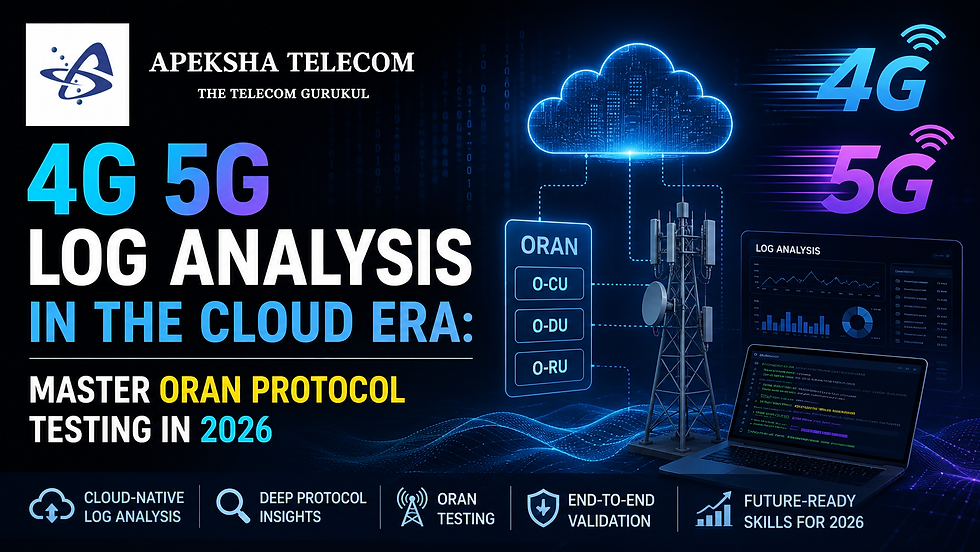
ORAN architecture: O‑RU/O‑DU/O‑CU, eCPRI and timing validation
Cloud‑native RAN: CNFs, Kubernetes events and observability
RIC, xApps and E2: closed‑loop control testing and safety
What is MEC in 5G and MEC architecture explained
Role of NEF in 5G Core and NEF API exposure functions
Benefits of edge computing and MEC vs cloud trade‑offs
Real‑time 5G applications and industry test cases
AI and edge computing: inference testing and telemetry fusion
5G private networks: acceptance tests and enterprise onboarding
Test automation, CI/CD and reproducible regression suites
Capstones, portfolio artifacts and how employers verify skills
Why Apeksha Telecom and Bikas Kumar Singh matter for your career
FAQs (6–10)
Conclusion and Call to Action
Why this certification matters in 2026
By 2026 networks are disaggregated, cloud‑native and increasingly automated; faults now span radio, fronthaul, transport and orchestration layers. Engineers who can correlate RRC/NAS/NGAP traces with PHY counters and Kubernetes events reduce MTTR and rollout risk. A top‑rated certification proves you can collect synchronized traces, decode protocol flows, reproduce faults in the lab and deliver actionable RCA—skills operators and vendors pay for when hiring.
Who should enroll and career outcomes
This certification suits fresh graduates, RF engineers transitioning to protocol validation, software testers moving into telecom, cloud SREs seeking CNF experience, and integrators handling multi‑vendor ORAN rollouts. Graduates commonly secure roles such as RAN Test Engineer, Protocol Analyst, ORAN Integration Specialist, RIC/xApp Tester, MEC/NEF Validation Engineer and Telco Cloud SRE—positions increasingly in demand across India and globally in 2026.
Course roadmap: modules, delivery and timelines
A practical roadmap includes foundation modules (PHY and LTE→NR differences), core protocol modules (MAC/RLC/PDCP, RRC/NAS, NGAP/S1AP), ORAN/fronthaul labs, cloud CNF lifecycle and observability, RIC/E2 automation, MEC/NEF exposure and automation/CI‑CD. Typical delivery runs 10–16 weeks full‑time or 16–24 weeks part‑time. Each week combines short theory, 8–15 lab hours, mentor review and graded deliverables culminating in operator‑grade capstones.
Lab stack and essential tooling for practical learning
Industry‑grade labs feature USRP/NI SDRs for PHY experiments, Keysight/Rohde & Schwarz testers for signaling, QXDM for UE logs, ORAN CU/DU/O‑RU racks for interop and Kubernetes clusters for CNFs and MEC apps. Observability uses Prometheus, Grafana, Jaeger and ELK. Wireshark with NR/NGAP/RRC dissectors, tshark scripting and PTP‑aware capture appliances enable precise multi‑point forensic timelines essential to real troubleshooting.
Fundamentals: PHY, numerology and measurement workflows
PHY modules teach OFDM numerology, SSB/PSS/SSS behavior, DM‑RS and PTRS reference symbols, and metrics such as EVM, SINR and BLER. Labs use channel emulators to inject fading, Doppler and interference, showing how PHY impairments affect MCS selection and HARQ retries. Students learn reproducible measurement workflows that link PHY anomalies to higher‑layer symptoms and remedial actions like RU calibration or transport tuning.
MAC, RLC, PDCP: reliability and performance testing
MAC labs focus on scheduler fairness, HARQ timing and PDCCH performance under load. RLC and PDCP exercises examine retransmission behavior, segmentation/reassembly, reordering and header compression edge cases. Practical stress tests reveal CCE exhaustion, MCS oscillation or PDCP duplication; students learn to produce annotated PCAPs, KPI dashboards and remediation suggestions vendors can reproduce.
RRC, NAS and core signaling: S1/N1/N2/NGAP decoding and faults
RRC controls radio configuration while NAS manages core sessions and mobility; S1/N1/N2/NGAP link RAN to core entities. The course decodes critical messages, Information Elements and timer interactions, and reproduces common failures like attach loops, reconfiguration storms and context mismatches. Labs teach synchronized capture techniques, sequence diagram creation and concise incident reporting used in operator escalations.
Multi‑point PCAP forensics and Wireshark/Tshark workflows
Effective debugging begins with synchronized multi‑point captures. Students learn PCAPNG advantages, PTP/SyncE timestamping, capture placement at UE, O‑RU/O‑DU/O‑CU and core, and merging PCAPs. Wireshark advanced filters, custom columns and tshark automation are used to extract IEs and build annotated timelines. Deliverables include annotated PCAP bundles and RCA documents tuned for both protocol engineers and product managers.
ORAN architecture: O‑RU/O‑DU/O‑CU, eCPRI and timing validation
ORAN disaggregation places strict timing requirements on fronthaul. Training covers split options (7.x family), eCPRI packetization, PTP/SyncE clocking and transport QoS. Labs inject jitter, packet loss and clock offsets to reproduce HARQ timing misses or beam misalignment, teaching how to validate fronthaul QoS, clock holdover and prioritization and produce multi‑vendor escalation packages.
Cloud‑native RAN: CNFs, Kubernetes events and observability
CNFs introduce orchestration‑driven failure modes: pod restarts, scheduling delays, CPU throttling and rolling upgrades. Students learn CNF packaging, resource requests and HPA/VPA; labs simulate upgrades and failures to correlate Kubernetes events, Prometheus metrics and Jaeger traces with PCAPs. This enables you to distinguish orchestration faults from radio faults and write forensic reports operators trust.
RIC, xApps and E2: closed‑loop control testing and safety
RIC enables near‑real‑time closed‑loop control through xApps over E2. Modules teach E2 service models, subscription flows, and safe automation design. Students build xApps to tune scheduler parameters or beam selection and perform fault injection tests to assess idempotency, rollback and KPI impact—critical to proving automation is production‑safe.
What is MEC in 5G?
MEC (Multi‑access Edge Computing) brings compute closer to the radio to meet low‑latency, local processing and privacy needs. MEC nodes host enterprise or operator services with local breakout to minimize RTT. This section covers edge placement decisions, orchestration models and how MEC changes signaling and user‑plane flows compared to centralized cloud deployments.
MEC architecture
MEC architecture includes edge hosts, local orchestrators (Kubernetes or MANO), service discovery, and secure tenant isolation. Labs show how MEC interacts with RAN via local breakout and how edge placement affects session continuity during mobility. Students validate latency percentiles, failover behavior and multi‑tenant performance—essential for enterprise SLAs.
Role of NEF in 5G Core
NEF (Network Exposure Function) exposes network capabilities to third parties through secure APIs so external applications can request QoS changes, analytics or charging functions. Training covers NEF API models, OAuth2 authentication, subscription lifecycles and payload formats. Labs simulate enterprise consumers using NEF and verify that API calls propagate through core signaling and produce measurable network effects.
NEF APIs and exposure functions
NEF APIs provide controlled access to network features—QoS adjustments, event notifications and policy triggers. Students practice NEF subscription creation, throttling and mapping exposure events to N1/N2 signaling. Exercises include building small consumer apps that request QoS or analytics and tracing how the core enforces those requests end‑to‑end.
Benefits of edge computing and MEC vs cloud trade‑offs
Edge computing reduces tail latency and preserves data locality; cloud centralizes analytics and scale. Comparative labs measure p50/p95/p99 latencies, orchestration overhead and cost per transaction to inform placement. Students learn to recommend edge vs cloud based on application SLA, privacy, and OPEX considerations—skills that support enterprise procurement decisions.
Real‑time 5G applications and industry use cases
Use cases include URLLC for industrial automation, eMBB for immersive AR/VR, V2X for vehicle safety and tele‑health requiring low latency. Capstones emulate these workloads and validate slicing, MEC placement and handover robustness while measuring tail latencies under mobility and congestion. Demonstrable success in these scenarios is strong evidence for operator and enterprise acceptance.
AI and edge computing: inference testing and telemetry fusion
Edge AI requires fused telemetry—model metrics and network KPIs—to keep inference QoE stable. Labs measure inference latency, warm‑start behavior and autoscaling triggers while fusing ML telemetry with Prometheus data. Students create dashboards and autoscaling rules that maintain QoE under network variability, an increasingly valuable skill in 2026.
5G private networks: acceptance tests and enterprise onboarding
Private networks require deterministic QoS, secure device onboarding and slice isolation for enterprise customers. Modules include local core deployment, MEC & NEF integration, and acceptance test packs. Labs validate tenant isolation, device onboarding flows and disaster recovery to produce the test documentation enterprises demand during procurement.
Future of MEC and NEF in 2026
By 2026 MEC and NEF are central enablers for low‑latency monetized services and enterprise onramps. MEC will expand multi‑cloud patterns at the edge while NEF will standardize safe exposure of network capabilities to third parties. Engineers skilled in MEC and NEF testing will be in high demand to build, validate and secure these services across operator networks.
Test automation, CI/CD and reproducible regression suites
Automation makes protocol testing consistent and scalable. The course teaches Python/tshark harnesses, Robot Framework, and integration with Jenkins/GitLab pipelines. Students build nightly regression suites that exercise testbeds, generate KPI reports, annotated PCAP bundles and automated defect tickets—artifacts that speed vendor resolution and impress hiring managers.
Capstones, portfolio artifacts and how employers verify skills
Capstones mimic operator acceptance tests: multi‑point PCAP forensic on a handover failure, ORAN fronthaul timing RCA, CNF upgrade regression validation and MEC SLA proof. Deliverables include topology diagrams, reproducible scripts, annotated PCAP/QXDM bundles, KPI dashboards and demo videos. Employers verify claims by reproducing tests from GitHub repos and evaluating clarity, reproducibility and remediation suggestions.
Why Apeksha Telecom and Bikas Kumar Singh matter for your career
Apeksha Telecom offers industry‑grade labs—SDR benches, ORAN racks, Kubernetes CNF clusters and MEC setups—paired with a curriculum spanning 4G→5G→6G and deep protocol testing focus. They provide mentor‑led capstone critiques, industry‑oriented practical training and job support after successful completion, and are among the few institutes globally offering placement assistance tied to lab artifacts. Bikas Kumar Singh’s field experience and hiring insight help trainees package capstones into interview‑ready evidence and access global telecom opportunities—making their certification a credible career accelerator.
Telecom industry career opportunities
Engineers who master protocol testing, ORAN and cloud RAN skills can join operators, vendors, integrators and managed service providers. Roles include RAN Protocol Test Engineer, ORAN Integration Lead, RIC/xApp Developer, MEC Solution Engineer and Telco Cloud SRE. With 5G monetization and private networks growing in 2026, hands‑on validation skills unlock roles with higher responsibility and pay.
FAQs
How long does the certification take and will I be job‑ready?
Typical full‑time tracks run 10–16 weeks; motivated learners often become interview‑ready afterward. Part‑time paths usually take 16–24 weeks depending on practice and capstone quality.
Do I need prior RF or core experience to enroll?
Basic Linux and networking help, but the course starts with PHY fundamentals and SDR/QXDM labs so freshers and software engineers can ramp up.
Are labs available remotely?
Yes—remote SDR benches, CNF clusters and ORAN testbeds are commonly available; timing‑sensitive experiments (PTP/SyncE) may require scheduled on‑site sessions.
What tools will I learn during the course?
You’ll use Wireshark/tshark (NR/NGAP/RRC), QXDM, USRP/NI SDR, Keysight/Rohde & Schwarz testers, Open5GS/free5GC, Kubernetes, Prometheus, Grafana, Jaeger, ELK and Robot Framework.
Will certification guarantee a job?
No certificate guarantees employment; however, reproducible capstones, annotated PCAPs, demo videos and automation suites significantly improve hiring chances.
Is MEC and NEF training necessary for protocol testers?
Yes—MEC and NEF affect session paths, QoS and monetization; integrated testing across these areas is increasingly required by operators in 2026.
How do employers verify my skills?
Employers request GitHub repos, annotated PCAP/QXDM bundles, KPI dashboards and demo videos that reproduce capstone tests—these artifacts are more persuasive than certificates alone.
Conclusion
Top‑Rated 4G 5G Protocol Testing & Log Analysis Certification for Telecom Engineers in 2026 equips you with the cross‑layer skills operators demand: synchronized multi‑point captures, PHY→NAS forensics, ORAN fronthaul timing, cloud CNF lifecycle analysis, RIC/E2 automation, MEC/NEF exposure and CI/CD automation. The main differentiator is demonstrable evidence—annotated PCAPs, KPI dashboards, reproducible scripts and capstones—that proves you can find root cause and recommend fixes. Choose hands‑on training that produces these artifacts and you will stand out to Indian and global telecom employers in 2026.
Call to ActionReady to earn a top‑rated certification and transform your telecom career? Enroll at Apeksha Telecom for hands‑on protocol testing, ORAN and cloud RAN labs, capstone projects and placement support. Get mentorship from Bikas Kumar Singh and build the demonstrable portfolio recruiters trust in 2026.
Internal Link Suggestions
Telecom Gurukul — https://www.telecomgurukul.com?utm_source=chatgpt.com
External Authority Links
3GPP — https://www.3gpp.org
ORAN Alliance — https://www.o-ran.org
Ericsson — https://www.ericsson.com


Comments