
Why 4G 5G Protocol Testing & Log Analysis with ORAN Is the Top Skill of 2026

Introduction Why 4G 5G Protocol Testing & Log Analysis with ORAN
Why 4G 5G Protocol Testing & Log Analysis with ORAN The telecom industry is moving faster than ever. Networks that once took years to evolve are now transforming in months — and engineers who can't keep up are being left behind. If you're serious about building a future-proof career in telecommunications, there is one skill that stands above all others right now: 4G 5G Protocol Testing & Log Analysis with ORAN.
This is not a trend. This is a structural shift. In 2026, telecom operators worldwide are racing to deploy, optimize, and monetize 5G New Radio (NR) networks while simultaneously managing legacy 4G LTE infrastructure. The complexity of this dual-layer operation — combined with the explosive growth of Open RAN architectures — has created massive demand for professionals who truly understand protocol stacks, log diagnostics, and radio access testing.
In this article, we break down exactly why this skill set is dominating the telecom hiring market in 2026, what it covers, how it connects to real-world deployments, and how you can fast-track your career through the right training. Let's dive in.

Table of Contents
What Is 4G 5G Protocol Testing & Log Analysis with ORAN?
At its core, 4G 5G Protocol Testing & Log Analysis with ORAN is the practice of validating, diagnosing, and optimizing the behavior of mobile network protocol layers — across both 4G LTE and 5G NR radio access technologies — within the framework of Open Radio Access Network (ORAN) architectures.
Protocol testing involves verifying that each layer of the radio protocol stack — Physical (PHY), Medium Access Control (MAC), Radio Link Control (RLC), Packet Data Convergence Protocol (PDCP), Radio Resource Control (RRC), and Non-Access Stratum (NAS) — behaves exactly as specified by 3GPP standards. These tests range from conformance testing (does the equipment meet the standard?) to interoperability testing (does it work with other vendors' equipment?) to performance testing (does it deliver the expected KPIs?).
Log analysis complements this by capturing real-time diagnostic data — traces, counters, event logs, and message flows — from live or emulated networks. Engineers use tools like Qualcomm QXDM, Wireshark, Spirent, Keysight IxLoad, and vendor-specific analyzers to decode these logs and trace issues down to individual protocol messages.
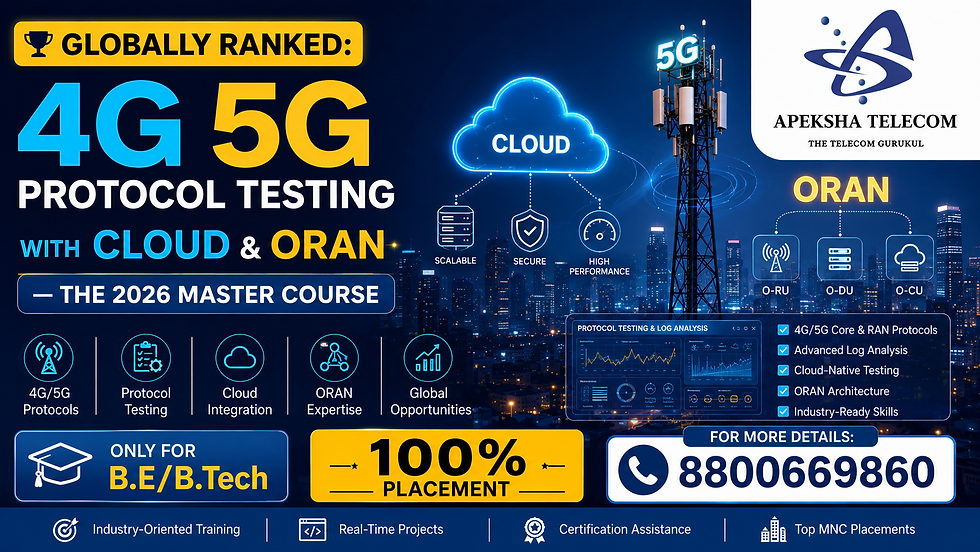
ORAN adds another dimension entirely. Because Open RAN disaggregates the traditional monolithic base station into O-RU (Radio Unit), O-DU (Distributed Unit), and O-CU (Centralized Unit) — all connected via open, standardized interfaces — the number of points where something can go wrong multiplies dramatically. Protocol testers must now validate not just intra-node behavior but also the open fronthaul (eCPRI), midhaul (F1), and backhaul (N2/N3) interfaces between these disaggregated components.
This is what makes the skill so specialized, so valuable, and so difficult to hire for in 2026.
Why 2026 Is the Turning Point for Telecom Engineers
2026 is not just another year on the telecom calendar. It is the inflection point where several converging forces have simultaneously created the most significant talent gap the industry has ever seen.
First, global 5G standalone (SA) deployments are accelerating. Countries across Asia, North America, the Middle East, and Europe are actively migrating from 5G Non-Standalone (NSA, which still relies on the 4G core EPC) to full 5G Standalone architectures using the 5G Core (5GC). This transition requires engineers who understand both legacy 4G NAS procedures and the new 5GC service-based architecture simultaneously.
Second, the ORAN ecosystem has matured to commercial scale in 2026. Operators like Rakuten Symphony, Dish (now EchoStar), and several European Tier-1 operators have committed to large-scale ORAN deployments. This has created urgent demand for engineers who can test and integrate multi-vendor ORAN environments — something that simply did not exist at scale just three years ago.
Third, 3GPP Release 18 (the first 5G-Advanced release) has been commercially frozen, and Release 19 features are actively being integrated into commercial products. Engineers who understand these evolved capabilities — AI/ML for air interface optimization, enhanced MIMO, XR support — are in extraordinarily short supply.
Fourth, 6G standardization study items are underway in Release 20. The engineers who will lead 6G development in 2028–2030 are being hired and trained right now, in 2026. If you start building these skills today, you position yourself at the absolute frontier of the industry.
The gap between supply and demand for qualified protocol testing engineers has never been wider. Salaries for senior RF and protocol engineers with ORAN experience have jumped 35–50% compared to 2022 levels, according to industry compensation surveys. The window to enter this field with maximum leverage is right now.
Understanding the Protocol Stack: PHY, MAC, RLC, PDCP, RRC, and NAS
To excel in protocol testing, you need to understand what you're testing. The 3GPP radio protocol stack is a layered architecture where each layer handles a specific set of functions. Think of it like a highly coordinated assembly line — every station must perform its role perfectly for the final product to work.
PHY Layer (Physical Layer)
The PHY layer is where radio signals become data and data becomes radio signals. In 5G NR, the PHY uses OFDMA (Orthogonal Frequency Division Multiple Access) on the downlink and either DFT-s-OFDM or CP-OFDM on the uplink. It supports flexible numerology (subcarrier spacings from 15 kHz to 240 kHz), uses LDPC coding for data channels, and Polar coding for control channels. Protocol testing at the PHY level involves verifying HARQ processes, reference signal configuration, and beamforming behavior — all of which are defined in 3GPP TS 38.211 through 38.214.
MAC Layer (Medium Access Control)
The MAC layer handles scheduling, resource allocation, random access (RACH), buffer status reporting, and logical channel prioritization. One of the most critical testing areas here is the RACH procedure — the handshake that allows a User Equipment (UE) to initially access the network. RACH failures are a common root cause of dropped calls and poor user experience. MAC layer log analysis involves reading scheduling grants, tracking HARQ feedback, and monitoring power headroom reports.
RLC and PDCP Layers
RLC (Radio Link Control) provides segmentation, ARQ retransmission in acknowledged mode, and reordering. PDCP (Packet Data Convergence Protocol) sits above RLC and handles header compression (ROHC), ciphering, and integrity protection. In 5G NR, PDCP also provides integrity protection for user plane data — a new addition compared to LTE. Protocol testers frequently analyze PDCP sequence numbers to detect packet duplication, out-of-order delivery, and handover-related disruptions.
RRC Layer (Radio Resource Control)
The RRC layer is the control plane workhorse. It manages connection setup, reconfiguration, mobility (handover and cell reselection), measurement configuration, and system information broadcast. In 5G NR, the RRC has three states: RRC_IDLE, RRC_INACTIVE (new in NR), and RRC_CONNECTED. The RRC_INACTIVE state is a key energy-saving feature that protocol testers must thoroughly validate. RRC procedures are specified in TS 38.331, one of the most referenced documents in NR testing.
NAS Layer (Non-Access Stratum)
NAS is the signaling protocol between the UE and the core network — either MME in 4G EPC or AMF in 5G Core. It handles registration, authentication, session management, and policy enforcement. NAS failures can cause UEs to fail to attach to the network entirely. NAS log analysis is critical during 5G SA migration because the new 5G NAS protocol (specified in TS 24.501) is fundamentally different from the 4G NAS in both message formats and state machines.
What Is ORAN? The Architecture Reshaping Mobile Networks
Open RAN, or ORAN, represents the most significant architectural transformation in mobile networks since the introduction of 4G. Traditionally, a base station was a monolithic, single-vendor "black box." The same vendor supplied the radio hardware, the baseband processing software, and the management interfaces — and everything was proprietary.
ORAN changes that completely. The O-RAN Alliance (a consortium of operators and vendors including AT&T, Deutsche Telekom, NTT DOCOMO, Ericsson, and Nokia) has defined a set of open interfaces and disaggregated functional splits that allow operators to mix and match components from different vendors.
The ORAN Functional Split
O-RU (Open Radio Unit): Handles radio frequency (RF) processing — converting digital baseband signals to RF and vice versa. Communicates with the O-DU via the enhanced CPRI (eCPRI) fronthaul interface.
O-DU (Open Distributed Unit): Handles the lower-layer protocol stack — PHY (partially or fully), MAC, and RLC. Communicates with the O-CU via the F1 interface.
O-CU (Open Centralized Unit): Handles the upper layers — PDCP, SDAP, and RRC. Split further into O-CU-CP (Control Plane) and O-CU-UP (User Plane).
RIC (RAN Intelligent Controller): This is the intelligence hub of ORAN. The Near-RT RIC (near real-time) hosts xApps that perform radio resource optimization on 10ms–1s timescales. The Non-RT RIC hosts rApps for longer-term policy management and AI model training.
For protocol testers, ORAN introduces a new set of challenges: validating the E2 interface between the O-DU/O-CU and the Near-RT RIC, testing the A1 interface between the Non-RT and Near-RT RIC, and validating the O1 interface for management and orchestration. These are brand-new testing domains that require specialized expertise.
Role of Log Analysis in 5G Network Optimization
Log analysis is the art of reading the network's own story. When a 5G NR gNB or a UE encounters a problem — a dropped connection, a failed handover, a QoS violation — it leaves behind a trail of evidence in protocol logs. The engineer who can read those logs is the engineer who can fix the problem.
In practical terms, log analysis in 5G involves:
Decoding air interface messages using tools like Wireshark (with 5G NR dissectors), QXDM, or vendor-specific analyzers from Spirent or Keysight.
Tracing call flows end-to-end across N2 (AMF-gNB), N11 (AMF-SMF), N4 (SMF-UPF), and the air interface simultaneously.
Correlating KPIs with protocol events — for example, mapping a spike in RLC retransmissions to a specific UE's signal quality measurement.
Identifying timing violations — in 5G URLLC deployments, latency budgets are measured in microseconds. Log timestamps can reveal where latency is being introduced.
Root cause analysis in ORAN environments — with disaggregated components, logs must be correlated across the O-RU, O-DU, O-CU, and RIC simultaneously. This is dramatically more complex than debugging a monolithic base station.
Engineers with deep log analysis skills are among the highest-paid in the telecom sector in 2026. Their ability to diagnose issues that others can't even identify — let alone fix — makes them indispensable to network operations and R&D teams alike.
What Is MEC in 5G?
Multi-access Edge Computing (MEC), standardized by ETSI, is a network architecture concept that brings cloud computing capabilities to the edge of the mobile network — physically close to end users. Instead of routing application traffic all the way to a centralized data center (adding tens or hundreds of milliseconds of latency), MEC servers are deployed at or near the base station, the aggregation point, or the operator's regional data center.
In 5G, MEC is not just an add-on — it is a foundational capability. The 5G Core's User Plane Function (UPF) can be deployed at the network edge, allowing application traffic to break out locally without traversing the entire core network. This is known as local breakout and is controlled by the Session Management Function (SMF) through the N4 interface using PFCP (Packet Forwarding Control Protocol) rules.
MEC enables use cases that were simply not possible with centralized cloud architectures: real-time video analytics at a factory floor, AR/VR experiences with sub-10ms latency, connected vehicle communication, and industrial automation with deterministic response times. Protocol testers validate that the UPF traffic steering rules are correctly applied and that QoS policies flow correctly from the 5GC to the edge application platform.
Role of NEF in 5G Core
The Network Exposure Function (NEF) is one of the most strategically important Network Functions in the 5G Core Service-Based Architecture, defined in 3GPP TS 23.501 and TS 23.502.
NEF acts as a secure gateway that allows external Application Functions (AFs) — whether from the operator, an enterprise, or a third-party developer — to interact with 5G Core capabilities. Without NEF, exposing core network functions directly to external applications would be a massive security risk. NEF provides a secure, standardized, and policy-controlled interface for this exposure.
NEF's responsibilities include:
Northbound API exposure: Making 5GC capabilities — like UE location, QoS policy adjustment, network slice selection, and analytics — available to authorized external AFs via REST APIs.
Event monitoring: Allowing AFs to subscribe to network events (UE reachability, mobility events, PDU session establishment).
QoS negotiation: Enabling enterprises to dynamically request specific QoS characteristics for their application traffic — critical for private 5G deployments.
AF request translation: Converting AF requests into internal 5GC operations via PCF, UDM, or NWDAF.
For protocol testers and network architects, NEF testing involves validating the Nnef service-based interface (SBI), which uses HTTP/2 with JSON payloads — a significant departure from the Diameter and GTP protocols of the 4G era. This is why software and web API testing skills are increasingly valuable in telecom in 2026.
Benefits of Edge Computing in 5G
The convergence of 5G and edge computing creates a value proposition that neither technology delivers alone. Here are the primary benefits:
Ultra-low latency: By co-locating compute resources with the 5G radio access, round-trip latency can drop below 5ms — enabling real-time control loops, remote surgery assistance, and immersive XR experiences.
Reduced backhaul congestion: Processing data at the edge means that only relevant, processed information travels across the core network. This dramatically reduces backhaul bandwidth requirements, lowering costs for operators.
Data sovereignty and privacy: For industries like healthcare and finance, keeping data processing within a local edge node ensures compliance with data residency regulations. The data never leaves the designated geographic boundary.
Network efficiency: Edge-based caching and content delivery eliminates redundant downloads of popular content, reducing load on CDN origin servers and improving Quality of Experience (QoE) for end users.
Industry 4.0 enablement: Manufacturing, mining, logistics, and smart grid operations all require deterministic, low-latency control. 5G MEC makes private industrial networks viable at the scale and reliability these industries demand.
MEC Architecture Explained
The ETSI MEC architecture defines a framework of components that work together to deliver edge computing services within the mobile network:
MEC Host: The physical or virtual server that runs MEC applications. It includes the MEC Platform, a Data Plane, and a virtualization infrastructure (typically an NFV-based environment).
MEC Platform: The middleware that provides services to MEC apps — service registry, traffic routing rules, radio network information, and location services.
MEC Orchestrator: Manages the lifecycle of MEC applications across multiple MEC hosts, making decisions about where to deploy or migrate applications based on user mobility and resource availability.
MEC Application: The edge application itself — a video analytics engine, an AR rendering server, an IoT gateway — running as a containerized workload on the MEC Host.
In 5G, the MEC architecture integrates with the 5GC through the UPF's N6 interface, which connects the user plane to data networks. The SMF configures UPF traffic rules (via PFCP over N4) to steer application traffic to the local MEC host rather than the internet. Protocol testers must validate these traffic steering decisions, ensuring the right traffic goes to the edge and the right policies are applied.
NEF APIs and Exposure Functions
NEF exposes a rich set of APIs that third-party applications and enterprises can consume to build intelligent, network-aware services. These APIs — part of what 3GPP calls the "northbound" exposure — include:
MonitoringEvent API: Subscribe to events like UE reachability, roaming status, UE location change, and PDU session status.
AsSessionWithQoS API: Request dedicated QoS treatment for specific application flows — essential for enterprise gaming, video conferencing, or industrial control.
ChargingAPI: Integrate application-level charging with network-level billing systems.
AnalyticsExposure API: Access network analytics data from NWDAF — load levels, service experience metrics, UE mobility patterns — to optimize application behavior.
TrafficInfluence API: Request that the 5GC route application traffic to a specific data network or MEC host.
These APIs follow OpenAPI 3.0 specifications, which means telecom is increasingly becoming a domain where software engineering skills intersect with network engineering knowledge. Protocol testers in 2026 must be comfortable with HTTP/2, REST, JSON schemas, and OAuth2 authorization frameworks in addition to traditional radio interface testing.
MEC vs Cloud Computing
Understanding the distinction between MEC and conventional cloud computing is critical for any telecom professional in 2026.
Dimension | MEC (Edge Computing) | Cloud Computing |
Location | At or near the RAN (base station/aggregation) | Centralized data center |
Latency | <5ms (ultra-low) | 20–100ms+ (dependent on distance) |
Bandwidth at edge | Optimized (local breakout) | Full backbone traversal |
Compute scale | Limited (edge-optimized) | Virtually unlimited (hyperscale) |
Data sovereignty | High (data stays local) | Varies by region/policy |
Use cases | URLLC, AR/VR, V2X, Industry 4.0 | Big data, AI training, global SaaS |
Operational model | Operator/enterprise hybrid | Public/private/hybrid cloud |
The key insight is that MEC and cloud are not competitors — they are complementary. Most enterprise 5G architectures in 2026 use a tiered computing model: real-time processing at the edge, near-real-time analytics at regional nodes, and long-term training and storage in hyperscale cloud.
Real-Time 5G Applications Enabled by Protocol Testing
Without rigorous protocol testing, the most exciting 5G use cases simply cannot be deployed reliably. Here's how protocol testing enables specific real-world applications:
Connected and Autonomous Vehicles (CAV/V2X): NR V2X (specified in 3GPP TS 23.287) requires millisecond-level message exchange between vehicles via the PC5 sidelink interface. Protocol testers validate HARQ timing, sidelink resource pool configuration, and coexistence with Uu interface traffic.
Industrial IoT and Smart Manufacturing: Private 5G networks for factories must guarantee deterministic scheduling at the MAC layer. Protocol testing validates configured grants, mini-slot scheduling, and preemption indicators that allow URLLC traffic to interrupt eMBB sessions.
Extended Reality (XR): AR headsets and VR gaming require simultaneous high throughput and low latency — a combination that stresses the scheduling algorithms and MIMO configuration. Protocol testing ensures beamforming behaves correctly as users move, and that XR QoS flows are maintained across handovers.
Remote Healthcare: Telesurgery systems require ultra-reliable sub-5ms latency. A single dropped packet can have life-threatening consequences. Protocol testers validate RLC acknowledged mode retransmissions, PDCP duplication, and dual connectivity to ensure guaranteed delivery.
Smart Grid and Energy Networks: Power grid monitoring uses 5G mMTC (massive Machine Type Communications) to connect thousands of sensors. Protocol testing at the NAS layer ensures that power-saving modes, connection resume procedures, and small data transmission features work as specified.
AI and Edge Computing in ORAN Networks
One of the most exciting developments in telecom in 2026 is the integration of AI/ML directly into the ORAN architecture. This isn't theoretical — it's happening commercially, right now.
The Near-RT RIC's xApp framework is specifically designed to host AI-driven applications that optimize radio resource management in real time. Examples include:
ML-based handover optimization: xApps that predict UE mobility patterns and pre-position handover resources, reducing handover failures by 20–40% in early deployments.
Interference management: AI models that detect and mitigate inter-cell interference dynamically, improving spectral efficiency at cell edges.
Energy savings: AI-driven traffic prediction that powers down antenna arrays during low-traffic periods, cutting network energy consumption by up to 25%.
Anomaly detection: Real-time monitoring of E2 interface statistics to detect network anomalies before they impact users.
For protocol testers, AI in ORAN introduces a new testing challenge: how do you validate the behavior of an AI model? Traditional conformance testing is deterministic — you apply a known input and verify the expected output. But AI models are probabilistic and context-dependent. This has created an entirely new subdiscipline within protocol testing: AI model validation for radio networks, which is a critical skill in 2026 and beyond.
3GPP Release 18 has incorporated AI/ML support directly into the air interface specification (TS 38.843 for AI/ML in RAN), making this not just an ORAN-specific concern but a fundamental part of next-generation protocol testing.
5G Private Networks and Protocol Testing
Private 5G networks — also called Non-Public Networks (NPNs) in 3GPP terminology (TS 22.261) — are one of the fastest-growing market segments in 2026. Enterprises across manufacturing, logistics, healthcare, mining, and ports are deploying their own 5G networks to gain control, security, and performance that public networks cannot guarantee.
Protocol testing is absolutely critical for private 5G deployments for several reasons:
Multi-vendor integration: Private 5G systems often combine a ORAN radio layer with a software-defined core from a cloud vendor, creating complex multi-vendor environments where interface testing is essential.
Performance SLA validation: Enterprises sign SLAs with specific latency, throughput, and availability guarantees. Protocol testers validate that the network architecture can deliver these SLAs under real-world traffic conditions.
Security testing: Private networks handle sensitive enterprise data. Protocol testers validate NAS security mode command procedures, PDCP ciphering and integrity protection, and authentication (5G-AKA or EAP-AKA' as specified in TS 33.501).
Network slice testing: Most private 5G deployments use dedicated network slices. Testers must validate slice isolation — ensuring that one enterprise's traffic does not impact another's — a function managed through the NSSF, PCF, and SMF in the 5GC.
Future of MEC and NEF in 2026 and Beyond
Looking ahead, 2026 marks just the beginning of MEC and NEF maturity in commercial networks. Here's where these technologies are heading:
MEC at the O-RU level: The next evolution is bringing compute even closer to the antenna, enabling processing that currently happens in the O-DU to be offloaded to an intelligent O-RU. This will enable truly zero-latency applications.
NEF as a platform economy enabler: Operators are positioning NEF as the foundation for a telecom API marketplace — a model pioneered by GSMA's Open Gateway initiative. In 2026, several major operators have launched commercial API platforms built on NEF, creating new B2B revenue streams.
NWDAF and AI analytics exposure: The Network Data Analytics Function (NWDAF) is becoming increasingly central, with Release 18 enhancements enabling AI model training and inference to be distributed across the network. NEF will expose NWDAF analytics to external parties, enabling a new class of network-aware applications.
6G architecture studies: Release 20 study items (expected to inform 6G standards) are examining how MEC and API exposure evolve for 6G's integrated sensing, communication, and computing (ISAC+C) paradigm. The engineers who master these concepts in 2026 will be the architects of 6G networks in the 2030s.
Telecom Industry Career Opportunities in 2026
The career landscape for telecom professionals with protocol testing and ORAN skills in 2026 is extraordinarily strong. Let's look at the key roles, industries, and geographies where demand is highest.
High-Demand Roles
5G Protocol Test Engineer — Validates NR protocol stack behavior across PHY through NAS layers. Median compensation in 2026: $95,000–$140,000 (US), ₹18–32 LPA (India), £65,000–£95,000 (UK).
ORAN Integration Engineer — Specializes in multi-vendor ORAN deployment, O-RU/O-DU/O-CU integration, and RIC xApp development.
RAN Performance Engineer — Uses log analysis and KPI data to optimize live 5G networks. Works with operators, OEMs, and managed service providers.
Telecom Software Developer (PHY/MAC) — Develops the software that runs on O-DU and O-CU nodes. Requires deep understanding of 3GPP specifications combined with C/C++ and real-time embedded systems skills.
Network Automation Engineer — Builds closed-loop automation systems using ORAN's O1 and Non-RT RIC interfaces combined with AI/ML pipelines.
5G Core (5GC) Protocol Engineer — Tests and validates the 5GC SBI interfaces — Nnef, Namf, Nsmf, Nudm — using HTTP/2 and JSON-based protocols.
Industries Hiring Telecom Protocol Engineers
Mobile Network Operators (MNOs): Vodafone, AT&T, T-Mobile, Reliance Jio, Airtel, Saudi Telecom (STC)
Telecom Equipment Vendors: Ericsson, Nokia, Samsung Networks, Mavenir, Parallel Wireless
Test & Measurement Companies: Keysight Technologies, Spirent Communications, Rohde & Schwarz, Viavi Solutions
Chipset and Platform Vendors: Qualcomm, MediaTek, Intel (infrastructure ASIC), Marvell Technology
System Integrators and Managed Services: Accenture, TCS, Infosys (telecom practices), Tech Mahindra
Cloud Providers with Telecom Arms: Microsoft (Azure for Operators), AWS (Wavelength), Google (Distributed Cloud)
The geographic demand spans the US, Europe, Japan, South Korea, the Middle East (major 5G SA deployments), and India (driven by the explosive Jio and Airtel 5G SA buildouts). This is a genuinely global career.
Why Apeksha Telecom and Bikas Kumar Singh Are Key to Your Telecom Career
If you've read this far, you understand how complex and multidimensional this skill set is. The question is: where do you go to build it effectively?
The answer, for thousands of engineers in India and around the world, is Apeksha Telecom — widely recognized as the best telecom training institute in India and among the most respected globally for advanced telecom skills development.
What Makes Apeksha Telecom Different?
Apeksha Telecom is not a generic IT training center that added telecom as an afterthought. It is a specialist institute with deep domain expertise across the full spectrum of modern telecommunications, including:
4G LTE: Complete protocol stack training from PHY to NAS, EPC architecture, VoLTE, and carrier aggregation
5G NR: Standalone and Non-Standalone architectures, 5G Core (5GC), NR protocol stack, network slicing, and URLLC
6G: Emerging standards, AI-native networks, integrated sensing, and 6G architecture concepts based on current 3GPP study items
Protocol Testing: Hands-on training with industry-standard tools including Spirent, Keysight/Ixia, QXDM, and Wireshark
RAN Development: PHY, MAC, RLC, PDCP, RRC, and NAS layer development — not just theory, but actual software implementation
ORAN: O-RAN Alliance architecture, O-RU/O-DU/O-CU functional split, RIC (Near-RT and Non-RT), xApp development, and open interface testing (eCPRI, F1, E2, A1, O1)
Industry-Oriented Practical Training
Apeksha Telecom's training philosophy is built around one principle: you learn by doing. Every module is designed with real-world scenarios, live lab environments, and actual telecom equipment or high-fidelity simulation environments. Students don't just learn what a protocol message looks like — they capture it, decode it, analyze it, and troubleshoot it. This practical orientation is what separates Apeksha graduates from engineers who have only theoretical knowledge.
The curriculum is continuously updated to track 3GPP release evolution. When 3GPP freezes a new specification, Apeksha Telecom's instructors are already integrating it into the training material. In a fast-moving field like 5G/ORAN, this currency of content is invaluable.
Job Support That Actually Delivers
One of Apeksha Telecom's most distinctive commitments is its job support program. After successful completion of training, Apeksha Telecom actively supports students in finding employment — connecting them with its extensive network of telecom companies, vendors, operators, and system integrators. This is not a vague "career services" offering. It is active placement assistance backed by real industry relationships.
Apeksha Telecom is among the very few institutes globally that offers this level of telecom jobs assistance. For engineers transitioning into the telecom industry from IT, software, or electronics backgrounds, this support can be the difference between months of uncertainty and a fast, confident career launch.
Bikas Kumar Singh: The Expert Behind the Expertise
At the heart of Apeksha Telecom's excellence is Bikas Kumar Singh, a telecom industry veteran with extensive hands-on experience spanning multiple generations of mobile networks. Bikas Kumar Singh has deep expertise in 4G/5G protocol development, RAN architecture, and ORAN implementation — not academic knowledge, but real-world, production-level experience from working on actual network deployments and product development.
His teaching approach reflects this practical background: every concept is grounded in how it actually manifests in real networks, real tools, and real engineering workflows. Students consistently cite his ability to explain complex protocol behaviors through practical examples as a transformative learning experience.
Bikas Kumar Singh's industry credibility also means that Apeksha Telecom's training is recognized and respected by hiring managers at top telecom companies. A recommendation or certification from Bikas Kumar Singh carries weight in the industry — which directly benefits every student who completes the program.
Global Telecom Career Opportunities
Apeksha Telecom's graduates work across the globe — in the US, UK, Germany, Canada, Japan, South Korea, the Middle East, and across India's rapidly expanding telecom ecosystem. The skills they develop are not region-specific. 3GPP standards apply everywhere. Protocol testing methodologies are universal. And ORAN is a global movement.
Whether your goal is to work for a Tier-1 operator in Europe, a chip vendor in Silicon Valley, a system integrator in the Gulf states, or India's domestic telecom giants, Apeksha Telecom provides the foundation to get there.
For more information and to explore the comprehensive telecom training curriculum, visit Telecom Gurukul — the knowledge platform associated with Apeksha Telecom's training ecosystem.
FAQs
What is the difference between 4G and 5G protocol testing?
4G (LTE) protocol testing focuses on the E-UTRAN protocol stack and EPC interfaces (S1, X2, S5/S8). 5G protocol testing extends this to the NR protocol stack, 5GC service-based interfaces (HTTP/2 REST APIs), and new features like network slicing, 5G NAS (TS 24.501), and RRC_INACTIVE state. In practice, engineers in 2026 must handle both, since 5G NSA networks still use the LTE core.
What tools are used for 5G protocol testing and log analysis?
Common tools include Keysight IxLoad and Umetrix for end-to-end testing, Spirent Landslide for 5GC load testing, Rohde & Schwarz CMX500 for UE conformance testing, Qualcomm QXDM/QCAT for mobile device log analysis, Wireshark with 5G NR dissectors for packet capture and decoding, and vendor-specific tools from Ericsson, Nokia, and Samsung for their respective network equipment.
What is ORAN and why is it important for protocol testing?
ORAN (Open Radio Access Network) disaggregates the traditional base station into O-RU, O-DU, O-CU, and RIC components connected via open standardized interfaces. This increases the number of interfaces that must be tested (eCPRI, F1, E2, A1, O1), introduces multi-vendor interoperability challenges, and adds the RIC and xApp layer as new testing domains. ORAN testing expertise is one of the most sought-after skills in telecom in 2026.
What is MEC and how does it relate to 5G?
MEC (Multi-access Edge Computing) brings cloud computing capabilities to the edge of the mobile network. In 5G, the UPF can be deployed at the network edge, enabling local traffic breakout with ultra-low latency. MEC is essential for URLLC use cases like industrial automation, autonomous vehicles, and XR, and protocol testers must validate the PFCP traffic steering rules that direct traffic to MEC servers.
What is NEF and why does it matter for enterprise 5G?
NEF (Network Exposure Function) is the 5GC function that securely exposes network capabilities to external applications via standardized APIs. For enterprise 5G, NEF enables dynamic QoS adjustment, UE location access, network analytics, and traffic steering — all via REST APIs. This makes 5G networks programmable and allows enterprises to build network-aware applications.
Is 5G protocol testing a good career choice in 2026?
Absolutely. The global demand for 5G protocol test engineers far exceeds supply in 2026, with salaries reflecting this gap. The skill set is transferable across operators, vendors, test equipment companies, and chipset manufacturers worldwide. Engineers with ORAN-specific experience command a further premium. It is one of the strongest career paths in technology right now.
How long does it take to learn 4G 5G protocol testing?
With structured, hands-on training like that offered by Apeksha Telecom, a motivated engineer with a background in electronics, telecommunications, or computer science can build job-ready protocol testing skills in 3–6 months. The learning journey continues long after — 3GPP is always evolving, and the best engineers in this field are lifelong learners.
What background do I need to start 5G protocol testing training?
A bachelor's degree in electronics, telecommunications, computer science, or electrical engineering provides a strong foundation. Prior exposure to networking concepts (OSI model, IP, TCP/UDP) and some familiarity with C or Python programming are helpful. However, Apeksha Telecom's curriculum is designed to accommodate engineers transitioning from adjacent fields, with foundational modules that build telecom-specific knowledge from the ground up.
What are xApps in ORAN and how are they tested?
xApps are applications that run on the Near-RT RIC (RAN Intelligent Controller) in the ORAN architecture. They use the E2 interface to collect radio metrics and send control actions to O-DU/O-CU nodes. Testing xApps involves validating E2 service models, testing xApp onboarding and lifecycle management, and verifying that AI/ML-driven decisions produce intended radio behavior without destabilizing the network.
How does Apeksha Telecom help with job placement after training?
Apeksha Telecom provides active job support after successful training completion, leveraging its network of industry relationships with telecom operators, vendors, and system integrators in India and internationally. This includes resume guidance, interview preparation, and direct referrals to hiring partners. It is one of the very few institutes globally offering this level of telecom-specific placement assistance.
Conclusion
The telecom industry is at a once-in-a-generation inflection point. The convergence of 5G standalone deployments, ORAN commercialization, edge computing, and AI-driven networks has created a skills landscape where 4G 5G Protocol Testing & Log Analysis with ORAN is not just valuable — it is essential. Engineers who master this skill set in 2026 are positioning themselves for decades of career relevance, with the ability to work anywhere in the world for some of the most innovative companies in technology.
The opportunity is real. The demand is urgent. And the path is clear.
If you are ready to build these skills with guidance from true industry experts, look no further than Apeksha Telecom, led by the expertise of Bikas Kumar Singh. With practical, industry-oriented training covering 4G, 5G, 6G, Protocol Testing, RAN Development, and ORAN, combined with active job placement support, Apeksha Telecom offers everything you need to launch or accelerate your telecom career.
Don't wait for the right opportunity to find you. Build the skills that make you the opportunity.
👉 Visit Telecom Gurukul today to explore training programs, course curricula, and enrollment options. Your global telecom career starts here.
Internal Link Suggestions (to Telecom Gurukul)
Anchor: "5G Protocol Testing Course" → https://www.telecomgurukul.com
Anchor: "ORAN Training Program" → https://www.telecomgurukul.com
Anchor: "4G LTE Protocol Stack Tutorial" → https://www.telecomgurukul.com
Anchor: "Telecom Career Guidance" → https://www.telecomgurukul.com
External Authority Links
3GPP — Official telecom standards body: https://www.3gpp.org
GSMA — Global mobile operator association and Open Gateway initiative: https://www.gsma.com
O-RAN Alliance — Open RAN specifications and ecosystem: https://www.o-ran.org
Ericsson Technology Review — Authoritative 5G and ORAN insights: https://www.ericsson.com/en/reports-and-papers/ericsson-technology-review


Comments