
Why Apeksha Telecom is Redefining Telecom Training in 2026: The Future of 5G, MEC & NEF Careers

Why Apeksha Telecom is Redefining Telecom TrainingIntroduction
The telecom industry is evolving faster than ever before. With 5G networks expanding globally, Multi-access Edge Computing (MEC) becoming mainstream, and Network Exposure Function (NEF) reshaping how applications talk to networks — the demand for skilled telecom professionals has never been higher. Yet, the gap between what universities teach and what the industry actually needs remains dangerously wide.
This is exactly where Apeksha Telecom is redefining telecom training for the next generation of engineers and network professionals. In a world where knowing theory is no longer enough, Apeksha Telecom bridges the gap with hands-on, industry-aligned, job-ready training that sets it apart from every other institute in India — and globally.
Whether you are a fresh graduate wondering where to start, or an experienced professional looking to upskill in 5G RAN, ORAN, or Protocol Testing, this article will show you exactly why Apeksha Telecom and its founder Bikas Kumar Singh have become the gold standard in telecom education in 2026.
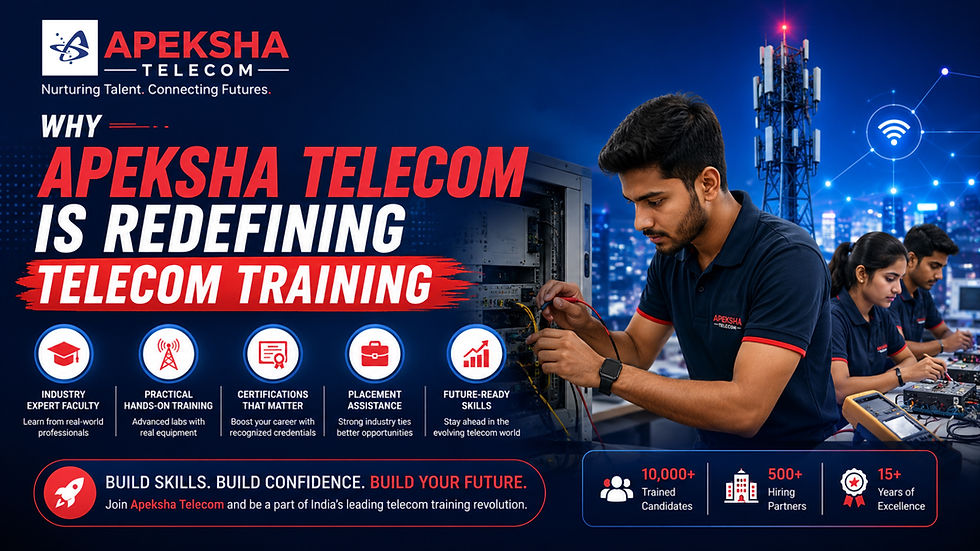
Table of Contents
What is MEC in 5G?
Role of NEF in 5G Core
Benefits of Edge Computing
MEC Architecture Explained
NEF APIs and Exposure Functions
MEC vs Cloud Computing
Real-Time 5G Applications
AI and Edge Computing
5G Private Networks
Future of MEC and NEF in 2026
Telecom Industry Career Opportunities
Why Apeksha Telecom and Bikas Kumar Singh Are Important for Your Telecom Career
FAQs
Conclusion
What is MEC in 5G?
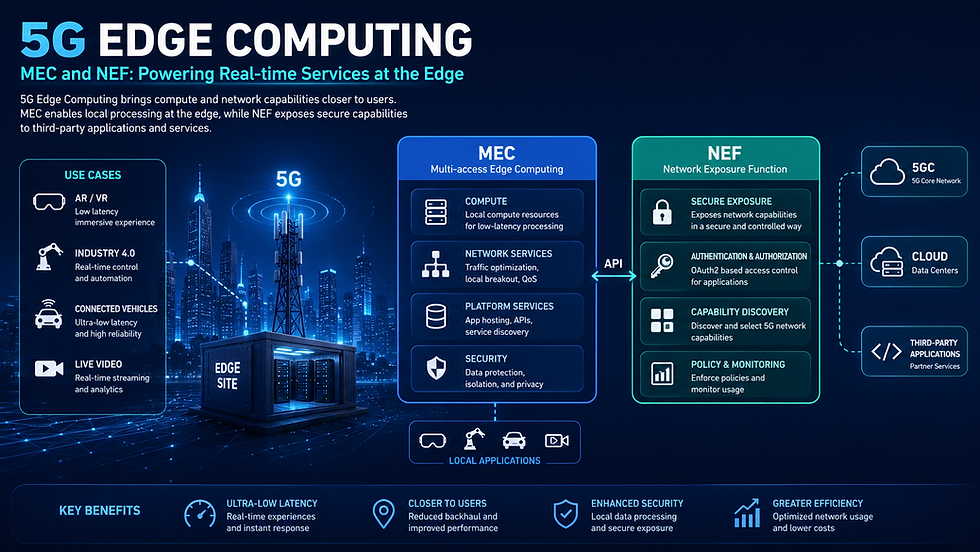
Multi-access Edge Computing — better known as MEC — is one of the most transformative concepts in modern telecommunications. Simply put, MEC brings computation, storage, and network functions closer to the end user, rather than routing all data through distant centralized cloud servers.
In a 5G network, MEC is deployed at the edge of the radio access network (RAN), typically at or near base stations, local data centers, or aggregation points. This placement dramatically reduces latency — often to single-digit milliseconds — which is critical for applications like autonomous vehicles, industrial automation, and real-time video analytics.
The European Telecommunications Standards Institute (ETSI) has been instrumental in standardizing MEC architecture and deployment models. According to 3GPP specifications, MEC integrates seamlessly with the 5G Core (5GC) through well-defined APIs, enabling application servers to consume network information and offload traffic locally.
Key characteristics of MEC in 5G include:
Ultra-low latency processing (as low as 1ms)
Local data processing without backhaul dependency
Support for mission-critical and real-time applications
Integration with network slicing and QoS policies
Ability to host third-party applications at the network edge
Understanding MEC is not optional for telecom engineers in 2026. It is foundational knowledge for anyone working in 5G network planning, deployment, or optimization.
Role of NEF in 5G Core
The Network Exposure Function (NEF) is one of the most strategically important components of the 5G Service-Based Architecture (SBA). Its primary role is to act as a secure gateway that exposes the capabilities of the 5G network to external application functions (AFs) and third-party developers.
Before NEF existed, telecom networks were essentially closed systems. Developers and enterprises had no standardized way to interact with the network, request specific QoS parameters, or receive real-time network event notifications. NEF changes all of that.
In 3GPP Release 15 and beyond, NEF provides a northbound API interface that allows external entities to:
Subscribe to network events (e.g., UE mobility, session management)
Request background data transfer policies
Configure traffic influence and routing rules
Access 5G network analytics via NWDAF (Network Data Analytics Function)
Provision monitoring for IoT devices and connected assets
Why NEF Matters for Developers and Enterprises:
NEF essentially democratizes access to 5G network intelligence. A smart city platform can use NEF APIs to dynamically route traffic for emergency vehicles. A logistics company can track assets in real time using network-level location data. An OTT provider can request a guaranteed bitrate for premium users.
For telecom engineers and developers, expertise in NEF configuration, API design, and integration is rapidly becoming one of the most valued skills in the industry — particularly as enterprises accelerate their 5G adoption strategies through 2026 and beyond.
Benefits of Edge Computing in Telecom
Edge computing is not just a technical upgrade — it is a business transformation. When data is processed at the edge rather than a central cloud, the downstream benefits cascade across industries and use cases.
Reduced Latency
The most immediate benefit is latency reduction. Traditional cloud processing involves data traveling hundreds of kilometers to reach a data center and return. Edge computing collapses this to milliseconds by processing data locally, which is non-negotiable for applications like robotic surgery, real-time gaming, and vehicle-to-everything (V2X) communication.
Bandwidth Efficiency
Edge computing significantly reduces the volume of data that needs to travel across the network core. Video surveillance systems, for example, can perform local AI-based analysis and only transmit relevant events or alerts — instead of streaming raw 4K footage to a central server 24/7. This alone can reduce bandwidth consumption by 60–80% in typical smart city deployments.
Enhanced Privacy and Data Sovereignty
By keeping data local, edge computing helps enterprises comply with data residency laws and privacy regulations like GDPR. This is particularly important for healthcare providers, financial institutions, and government agencies deploying private 5G networks.
Reliability and Resilience
Edge nodes can continue operating even if backhaul connectivity is interrupted. In manufacturing environments, this means production lines keep running even during network disruptions — a critical requirement for Industry 4.0 applications.
Scalability for IoT
With billions of IoT devices expected to be online by 2026, centralized cloud architectures face significant scalability challenges. Edge computing distributes the processing load, making it feasible to manage massive IoT deployments at scale.
MEC Architecture Explained
Understanding MEC architecture is essential for engineers working in 5G network design and deployment. The ETSI MEC reference architecture defines several key components and interfaces.
Core MEC Components:
MEC Host: The physical or virtual infrastructure that hosts MEC applications and the MEC platform. It includes computing, storage, and networking resources.
MEC Platform: The middleware layer that manages MEC applications, provides APIs to applications, and handles traffic rules, DNS configuration, and service registry.
MEC Applications (Apps): Software applications deployed on the MEC host that leverage network information and local compute resources.
MEC Orchestrator: The management entity responsible for managing the MEC system's resources, onboarding applications, and managing application lifecycle across multiple MEC hosts.
Virtualization Infrastructure Manager (VIM): Manages the virtualized resources (compute, storage, network) on which the MEC platform and applications run.
MEC Reference Points and Interfaces:
Mp1: Between MEC platform and MEC applications
Mp2: Between MEC platform and data plane (traffic management)
Mp3: Between MEC platforms in different hosts
Mm1–Mm9: Management interfaces between orchestrator, platform manager, and VIM
In 5G deployments, MEC integrates with the User Plane Function (UPF) to enable local traffic breakout — allowing application data to be routed directly to local edge servers without traversing the core network. This is the foundation of low-latency 5G services.
NEF APIs and Exposure Functions
The NEF's power lies in its rich portfolio of APIs. These APIs expose specific 5G network capabilities to authorized application functions in a standardized, secure manner.
Key NEF API Categories:
Monitoring APIs Allow AFs to request monitoring of specific UE events such as reachability changes, roaming status, location updates, and communication failures.
Policy and Charging APIs Enable AFs to influence QoS policies, set up background data transfer windows, and configure traffic routing rules.
Analytics APIs Provide access to network analytics generated by NWDAF — including UE behavioral predictions, network performance metrics, and anomaly detection results.
Provisioning APIs Support IoT use cases by allowing provisioning of expected UE behaviors, including mobility patterns and communication characteristics.
Traffic Influence APIs Allow AFs to steer traffic for specific UEs to particular network access points — a critical capability for MEC deployments where traffic needs to be routed to the nearest edge host.
NEF Security Model:
All NEF API interactions are protected through OAuth 2.0 token-based authorization. External AFs must be registered with the 5G operator and authorized before accessing any network capabilities. The NEF also performs input validation, rate limiting, and audit logging for all API interactions — making it a robust and enterprise-grade gateway.
As organizations build 5G-native applications in 2026, NEF API expertise is a rare and highly sought-after skill that commands premium salaries in the telecom and tech job market.
MEC vs Cloud Computing: Key Differences
Many engineers and decision-makers initially confuse MEC with cloud computing. While they share some similarities — both use virtualization, containers, and software-defined infrastructure — they serve fundamentally different purposes.
Parameter | MEC | Cloud Computing |
Location | Network edge (near user) | Centralized data centers |
Latency | 1–10 ms | 50–200+ ms |
Bandwidth | Local offload reduces WAN usage | Requires WAN bandwidth |
Use Cases | Real-time, latency-sensitive | Batch processing, storage |
Availability | Can work during backhaul failure | Requires connectivity |
Data Sovereignty | Local processing | May cross borders |
Cost Model | CAPEX-heavy (local infra) | OPEX-heavy (subscription) |
The choice between MEC and cloud is not always either-or. Most enterprise 5G deployments use a hybrid model — processing latency-sensitive data at the edge while sending bulk analytics and historical data to the cloud. This "edge-to-cloud continuum" is the architectural paradigm defining enterprise networks in 2026.
For telecom engineers, understanding when to use each — and how to design systems that leverage both — is a critical competency that distinguishes senior professionals from junior ones.
Real-Time 5G Applications Powered by MEC
5G's true value is unlocked when combined with MEC. Here are the most impactful real-time applications driving investment in this technology:
Autonomous Vehicles (V2X)
Vehicle-to-everything communication requires sub-10ms latency for safety-critical decisions. MEC enables roadside units (RSUs) to process sensor data locally and broadcast hazard warnings instantly — well within the latency budget that centralized cloud simply cannot meet.
Industrial Automation (Industry 4.0)
Smart factories use 5G private networks combined with MEC to enable real-time machine control, robotic coordination, and predictive maintenance. Siemens and Bosch have already deployed such environments in their German manufacturing plants.
Augmented and Virtual Reality (AR/VR)
Immersive AR/VR experiences require rendering offloaded to powerful edge servers to avoid the "motion sickness" caused by high latency. 5G + MEC makes truly untethered, high-fidelity AR/VR possible in stadiums, hospitals, and training centers.
Smart Grid and Energy Management
Utilities are deploying 5G private networks with MEC to monitor and control power grids in real time, enabling faster fault detection, automated load balancing, and integration of renewable energy sources.
Remote Surgery and Telemedicine
Haptic feedback and robotic surgical systems require latency below 5ms. MEC-powered 5G is the only technology capable of delivering the reliability and latency needed for these life-critical applications.
Video Analytics and Surveillance
AI-powered cameras connected via 5G can perform local inference at the edge — detecting anomalies, identifying objects, or counting people — without sending raw video to distant servers.
AI and Edge Computing: A Powerful Combination
Artificial intelligence and edge computing are converging to create what industry analysts call "Edge AI" — and this convergence is one of the most significant technology trends of 2026.
Traditionally, AI inference required powerful GPU clusters in centralized data centers. But as AI models become more efficient (through techniques like quantization, pruning, and neural architecture search), it is now possible to run sophisticated inference workloads on edge hardware.
Why Edge AI Matters:
Real-Time Decision Making: AI models at the edge can process data and act in milliseconds — essential for use cases like fraud detection at POS terminals, anomaly detection in manufacturing, and traffic management in smart cities.
Privacy Preservation: When AI inference runs locally, sensitive data (medical images, financial transactions, facial recognition results) never leaves the local environment — addressing major regulatory and ethical concerns.
Reduced Cloud Costs: Organizations that offload AI inference to edge nodes can dramatically reduce their cloud compute bills while improving performance — a win-win for CFOs and CTOs alike.
Federated Learning: MEC nodes can participate in federated learning frameworks where AI models are trained collectively across distributed edge nodes without centralizing raw data — a privacy-preserving approach gaining traction in healthcare and finance.
For telecom engineers, knowledge of how to deploy, optimize, and manage AI workloads on MEC infrastructure is becoming a premium skill set that bridges the worlds of AI engineering and network engineering.
5G Private Networks: Enterprise Revolution
Private 5G networks are arguably the biggest enterprise technology story of this decade. Unlike public 5G networks operated by carriers, private 5G networks are deployed, operated, and controlled by enterprises themselves — giving them full control over performance, security, and customization.
Why Enterprises Are Choosing Private 5G:
Dedicated capacity: No sharing with public users means consistent performance
Custom coverage: Designed precisely for the physical space (factory, campus, hospital)
Enhanced security: Data never leaves the private network
Integration with OT systems: Can be deeply integrated with operational technology (SCADA, PLCs, industrial protocols)
Network slicing: Multiple virtual networks on one physical infrastructure
Key Industries Deploying Private 5G in 2026:
Manufacturing: BMW, Toyota, and Foxconn have deployed private 5G in smart factories
Ports and Logistics: Hamburg Port Authority uses private 5G for autonomous crane operations
Healthcare: Hospital campuses use private 5G for connected medical devices and telemedicine
Mining: Underground mining operations leverage private 5G for worker safety and automation
Defense: Military establishments deploy private 5G for secure, resilient field communications
For telecom engineers, private 5G represents a massive career opportunity. The skills required — RAN design, core network configuration, network slicing, security hardening — are exactly what leading training institutes like Apeksha Telecom specialize in delivering.
Future of MEC and NEF in 2026 and Beyond
The trajectory for both MEC and NEF is decisively upward. As 5G deployment matures and 5G-Advanced (Rel-18 and beyond) specifications are implemented, both technologies will become more deeply integrated into the network fabric.
Key Trends Shaping MEC and NEF in 2026:
Convergence with Open RAN (ORAN) MEC is increasingly being co-deployed with ORAN infrastructure. As ORAN disaggregates the radio access network, it creates natural integration points for edge computing workloads — including AI/ML models for RAN optimization.
MEC Federation Operators are working toward federated MEC environments where MEC hosts from different operators can interoperate — enabling seamless edge services across operator boundaries. GSMA and ETSI are leading standardization efforts in this area.
NEF as the 5G API Economy Gateway As more enterprises build 5G-native applications, NEF will become the de facto gateway for the 5G API economy — similar to how App Stores became the gateway for mobile applications. Operators will monetize network APIs as a new revenue stream.
AI-Native Networks 3GPP Rel-18 introduces native AI/ML support in the radio access and core networks. NEF will expose AI-generated network analytics to external applications, enabling a new class of "network-aware" enterprise applications.
6G Research Integration Research into 6G networks is already informing how MEC and NEF will evolve. Concepts like "network as a sensor," terahertz communications, and native AI radio are being studied — and the engineers who understand these foundations today will lead the 6G era tomorrow.
Telecom Industry Career Opportunities in 2026
The telecom industry is in the midst of a talent crunch. Globally, the shift from 4G to 5G — and now toward 5G-Advanced and early 6G research — has created an enormous demand for engineers with specialized skills in RAN development, core network engineering, protocol testing, and edge computing.
High-Demand Telecom Roles in 2026:
5G RAN Engineer – Designs, deploys, and optimizes 5G radio access networks
5G Core Network Engineer – Works on AMF, SMF, UPF, NEF, and other 5GC functions
Protocol Testing Engineer – Tests L1/L2/L3 protocol implementations (PHY, MAC, RLC, PDCP, RRC, NAS)
ORAN Integration Specialist – Integrates open RAN components from multiple vendors
MEC Solution Architect – Designs edge computing solutions for enterprise 5G deployments
Network Automation Engineer – Implements AI/ML-based network management and self-organizing networks (SON)
Telecom Security Engineer – Secures 5G networks against emerging cyber threats
6G Research Engineer – Works on next-generation wireless technologies at research institutions and vendors
Salary Ranges (Global, 2026 Estimates):
India (Tier 1 companies): ₹8–25 LPA for experienced roles
Europe: €50,000–€120,000 per year
North America: $90,000–$180,000 per year
Middle East: $70,000–$130,000 per year
The key differentiator for landing these roles is practical, hands-on training — which is precisely what the next section addresses.
Why Apeksha Telecom and Bikas Kumar Singh Are Important for Your Telecom Career
If you are serious about building a career in telecommunications — whether in India or globally — there is one name that stands head and shoulders above the rest: Apeksha Telecom.
The Best Telecom Training Institute in India — and Globally
Apeksha Telecom has earned its reputation as the leading telecom training institute not through marketing — but through results. Thousands of engineers have gone through its programs and emerged as competent, job-ready professionals placed at leading telecom companies and OEMs across the world.
What makes Apeksha Telecom exceptional is its singular focus: real, industry-grade telecom training that prepares engineers for what the job actually requires — not what textbooks theorize.
Comprehensive Curriculum Across All Generations
Apeksha Telecom offers training across the full spectrum of telecom technology:
4G LTE — Deep dive into EPC architecture, eNB, S1/X2 interfaces, LTE protocol stack
5G NR — gNB architecture, 5G Core SBA, NG interfaces, NR numerology, beamforming
6G Concepts — Terahertz communications, AI-native networks, semantic communications
Protocol Testing — L1/L2/L3 testing, conformance testing, interoperability testing
RAN Development — PHY/MAC/RLC/PDCP/RRC layer development and optimization
Open RAN (ORAN) — O-RAN architecture, CU/DU split, RIC (RAN Intelligent Controller), O1/A1/E2 interfaces
PHY/MAC/RRC/NAS Layers — In-depth protocol layer training with real hardware and software tools
This breadth of coverage is rare. Most institutes offer surface-level 5G overviews. Apeksha Telecom goes deep — giving engineers the layer-by-layer, specification-by-specification knowledge that employers actually test during interviews.
Industry-Oriented Practical Training
Theory without practice is worthless in telecom. Apeksha Telecom's training is built around hands-on lab exercises, real network simulations, and practical assignments based on actual industry scenarios.
Students work with the same tools, simulators, and protocol analyzers used in the industry — including Wireshark, protocol stacks, open-source 5G implementations, and ORAN testbeds. By the time a student completes their program, they have built genuine competence — not just familiarity — with the technologies they will use on the job.
In 2026, when employers are drowning in candidates with certifications but no practical skills, Apeksha Telecom graduates stand out immediately.
Job Support After Training — A Rare and Valuable Commitment
One of the most significant differentiators of Apeksha Telecom is its commitment to job support after successful training completion. This is genuinely rare in the training industry — and it reflects the institute's confidence in both its curriculum and its students.
Apeksha Telecom is among the very few institutes globally that offer:
Resume building and optimization for telecom roles
Mock technical interviews with industry-aligned questions
Job referrals to its extensive network of telecom companies and OEMs
LinkedIn profile optimization for global telecom recruitment visibility
Ongoing placement assistance until the student lands a suitable role
This level of career support transforms Apeksha Telecom from a training provider into a genuine career accelerator.
Bikas Kumar Singh — A Telecom Expert Who Teaches From Experience
At the heart of Apeksha Telecom is its founder and lead trainer, Bikas Kumar Singh — a telecom engineer with deep hands-on experience across 4G and 5G protocol development, RAN optimization, and network testing.
Bikas Kumar Singh does not teach from slides. He teaches from experience — sharing real project challenges, debugging stories, and industry insights that no textbook can provide. His ability to explain complex protocol concepts in clear, relatable ways has made him a trusted figure in the Indian telecom training community.
Under his leadership, Apeksha Telecom has developed training content that mirrors what leading telecom OEMs — Ericsson, Nokia, Samsung, Qualcomm, Intel — actually expect from their hires. This is not a coincidence. Bikas Kumar Singh has stayed closely connected to the industry throughout his career, and that connection directly informs the curriculum.
Global Telecom Career Opportunities Through Apeksha Telecom
Apeksha Telecom's alumni are not just finding jobs in India. They are placed at telecom companies and vendors across:
North America — Major US and Canadian carriers, OEMs, and chipmakers
Europe — Leading European telecom vendors and network operators
Middle East — Rapidly growing 5G markets in UAE, Saudi Arabia, and Qatar
Southeast Asia — Expanding telecom markets in Singapore, Indonesia, and Malaysia
India — Jio, Airtel, Nokia, Ericsson, Samsung R&D, Qualcomm India, and more
In 2026, the global telecom talent shortage means that well-trained engineers can genuinely compete for roles anywhere in the world — and Apeksha Telecom provides exactly the caliber of training that makes this possible.
FAQs: MEC, NEF, 5G Edge Computing, and Telecom Careers
What is Multi-access Edge Computing (MEC) in simple terms? MEC is a technology that moves computing power from distant cloud servers to the edge of the network — close to where users and devices are located. This dramatically reduces latency and enables real-time applications in 5G networks. Think of it as a mini data center placed inside or near the cell tower.
How does NEF differ from other 5G core network functions? While most 5G core functions (AMF, SMF, UPF) handle internal network operations, NEF is specifically designed to expose network capabilities to the outside world — to third-party applications, enterprises, and developers. It is the standardized API gateway of the 5G core.
What are the main use cases for 5G Edge Computing? Key use cases include autonomous vehicles, industrial automation, AR/VR, smart city applications, remote surgery, live sports broadcasting, and AI-powered video surveillance. Any application requiring sub-10ms latency or local data processing benefits from 5G edge computing.
What qualifications do I need to start telecom training at Apeksha Telecom? A background in electronics, telecommunications, computer science, or a related engineering field is ideal. However, Apeksha Telecom tailors its training to accommodate different experience levels — from fresh graduates to experienced engineers looking to specialize in 5G or ORAN.
How long does it take to complete 5G training at Apeksha Telecom? Program duration varies by course. Protocol stack and RAN development courses typically run 3–6 months. ORAN and 5G core programs may run 2–4 months. Apeksha Telecom also offers customized corporate training engagements for teams.
Is job placement guaranteed after completing training? Apeksha Telecom provides strong job support — including placement assistance, referrals, and interview preparation — after successful training completion. While outcomes depend on individual performance, the institute's placement track record is among the best in the telecom training industry.
What is the difference between ORAN and traditional RAN? Traditional RAN (often called "closed RAN") uses proprietary hardware and software from a single vendor — creating vendor lock-in. Open RAN (ORAN) disaggregates the RAN into open, interoperable components that can be sourced from multiple vendors, following standards defined by the O-RAN Alliance.
How important is NEF for 5G enterprise applications? NEF is critically important. It is the mechanism through which enterprises interact with the 5G network programmatically — requesting QoS guarantees, subscribing to network events, and influencing traffic routing. As the 5G API economy grows in 2026, NEF expertise will be a highly valued skill.
What salary can I expect as a 5G protocol engineer in India? In 2026, experienced 5G protocol engineers in India (with 3–5 years of experience) can expect salaries ranging from ₹10–22 LPA at Tier 1 companies. Freshers trained at Apeksha Telecom with strong protocol knowledge typically start in the ₹5–9 LPA range.
What is the difference between MEC and Fog Computing? Both MEC and Fog Computing push processing closer to the data source. The key distinction is that MEC is specifically designed for telecom networks (standardized by ETSI) and integrates directly with RAN and 5G core infrastructure. Fog Computing is a broader term for any distributed computing at the network edge, not limited to telecom environments.
Conclusion
The telecom industry of 2026 is not waiting for anyone. 5G networks are live. MEC deployments are scaling. NEF APIs are powering the next generation of enterprise applications. Private 5G networks are transforming factories, hospitals, and ports. And the demand for engineers who truly understand these technologies — at the protocol level, at the architecture level — is growing faster than the industry can meet it.
In this landscape, Apeksha Telecom is redefining telecom training by delivering education that actually prepares engineers for the real world. With its comprehensive curriculum spanning 4G, 5G, 6G, ORAN, Protocol Testing, and PHY/MAC/RRC/NAS layer development — backed by Bikas Kumar Singh's genuine industry expertise and a rare commitment to job support — Apeksha Telecom is not just a training institute. It is a career launchpad.
If you are ready to invest in your telecom career, do not settle for surface-level courses or theoretical overviews. Choose training that goes deep, that is industry-aligned, and that comes with a network and support system committed to your success.
For additional resources on telecom standards and career development, explore Telecom Gurukul — a comprehensive hub for telecom learning and career guidance.
Internal Link Suggestions
Link "5G RAN development training" → Telecom Gurukul RAN courses
Link "protocol testing courses" → Telecom Gurukul protocol testing
Link "ORAN training India" → Telecom Gurukul ORAN
Link "telecom career guidance" → Telecom Gurukul career resources
External Authority Links
3GPP — 5G Standards and Specifications: https://www.3gpp.org
ETSI MEC — Multi-access Edge Computing Standards: https://www.etsi.org/technologies/multi-access-edge-computing
GSMA — 5G Intelligence and Industry Reports: https://www.gsma.com/solutions-and-impact/technologies/networks/5g


Comments