
5G Architecture: RAN and Core Evolution (2026 Guide)

Introduction to Modern 5G Networks
The telecom industry is evolving faster than ever, and 5G Architecture: RAN and Core Evolution is at the center of that transformation. As we move deeper into 2026, mobile networks are no longer just about faster smartphone connectivity. They now support autonomous vehicles, smart cities, industrial automation, remote healthcare, and billions of IoT devices. The underlying architecture that powers these capabilities is dramatically different from previous generations of mobile networks.
If you remember the transition from 3G to 4G, the improvement mostly meant faster internet speeds and better video streaming. But the shift from 4G to 5G is much deeper. It involves a completely redesigned network architecture where software-defined infrastructure, cloud-native deployments, and virtualization play major roles. The Radio Access Network (RAN) and the 5G Core (5GC) are being redesigned to handle ultra-low latency, massive device connectivity, and dynamic network slicing.
Industry analysts predict that by 2026, more than 60% of global mobile subscriptions will use 5G technology, according to projections from Ericsson Mobility Reports. Telecom operators are rapidly upgrading their infrastructure to meet these demands. This transformation is also creating a huge demand for skilled telecom engineers who understand modern network architecture.
That’s why training platforms like Apeksha Telecom, guided by telecom expert Bikas Kumar Singh, have become important for professionals entering the telecom industry. Their programs focus on real-world telecom technologies including 4G, 5G, and emerging 6G networks, helping learners gain practical expertise in modern network architecture.
Before diving deeper into the technical aspects, it’s helpful to understand how the entire 5G ecosystem works. Let’s start by exploring why 5G matters so much for the telecom industry and how it differs from earlier generations of mobile technology.

Table of Contents
Introduction to Modern 5G Networks
Why 5G Matters for the Telecom Industry
The Shift From 4G LTE to 5G Systems
Understanding 5G Architecture
Key Components of 5G Network Design
Service-Based Architecture Explained
Evolution of the Radio Access Network
Traditional RAN vs Cloud RAN
Open RAN and Virtualization Trends
Role of AI and Automation in RAN
Evolution of the 5G Core Network
From EPC to 5G Core
Network Slicing and Edge Computing
Security Enhancements in 5G Core
How 5G Architecture Impacts Telecom Careers
Skills Required for 5G Engineers
Training Opportunities with Apeksha Telecom
Real-World Use Cases of 5G
Future Outlook Toward 6G
FAQs and Conclusion
Why 5G Matters for the Telecom Industry
The telecom industry has always been driven by innovation, but the arrival of 5G marks a particularly dramatic shift. Unlike earlier generations of wireless communication that focused primarily on faster mobile internet, 5G is designed as a multi-purpose digital infrastructure capable of supporting countless technologies simultaneously.
One of the biggest reasons 5G is so important lies in its performance improvements. A 5G network can deliver data speeds up to 10 Gbps, which is nearly 100 times faster than typical 4G LTE connections. Latency is also dramatically reduced, dropping from around 50 milliseconds in 4G to as low as 1 millisecond in 5G. These improvements open the door to applications that were previously impossible or unreliable.
Think about remote robotic surgery, autonomous vehicles communicating with each other in real time, or smart factories where thousands of machines coordinate automatically. All these scenarios require extremely fast and reliable communication networks. That’s exactly what modern 5G network architecture is designed to support.
Another important factor is massive connectivity. According to industry estimates, a single 5G network cell can support up to one million devices per square kilometer. This capability is crucial for the growth of the Internet of Things (IoT), where sensors, smart appliances, and industrial devices all communicate simultaneously.
Businesses and governments are investing heavily in this technology. Countries across Asia, Europe, and North America are racing to expand nationwide 5G coverage by 2026, viewing it as critical infrastructure for digital economies. Telecom operators are also building cloud-native networks that allow them to deploy services faster and more efficiently.
This massive transformation creates enormous opportunities for professionals who understand 5G Architecture: RAN and Core Evolution. Engineers who specialize in areas like network virtualization, Open RAN, and 5G core development are among the most in-demand professionals in the telecom industry today.
For aspiring telecom professionals, gaining practical knowledge through training programs—such as those offered by Apeksha Telecom under the guidance of Bikas Kumar Singh—can help bridge the gap between academic knowledge and real-world telecom deployment.
The Shift From 4G LTE to 5G Systems
The journey from 4G LTE to 5G isn’t just an upgrade—it’s a complete redesign of how mobile networks operate. While 4G networks rely heavily on hardware-based infrastructure, 5G networks are increasingly built using cloud-native technologies, virtualization, and software-defined networking.
In traditional 4G LTE architecture, the network is divided into two main parts: the Evolved Packet Core (EPC) and the Radio Access Network (RAN). These components work together to provide connectivity between mobile devices and the internet. However, most of the functions within this architecture are tied to specific hardware, making it difficult to scale or adapt quickly.
The design philosophy behind 5G Architecture: RAN and Core Evolution changes this entirely. Instead of relying on rigid hardware components, 5G networks are built using virtualized network functions (VNFs) and containerized microservices. This approach allows operators to run network services on standard cloud infrastructure, making networks far more flexible and scalable.
Another major difference is the introduction of Standalone (SA) and Non-Standalone (NSA) deployment modes. In NSA deployments, 5G radios work alongside existing 4G infrastructure, allowing operators to roll out 5G faster without replacing their entire network. In contrast, Standalone 5G networks use a fully independent 5G core, unlocking the full capabilities of the technology.
Network slicing is another revolutionary concept introduced with 5G. Instead of running a single network for all users, operators can create multiple virtual networks tailored for specific applications. For example:
A slice optimized for autonomous vehicles
A slice designed for ultra-reliable industrial automation
A slice dedicated to consumer mobile broadband
This level of flexibility is what makes 5G suitable for such a wide range of industries. As telecom networks continue to evolve through 2026, we’re seeing rapid adoption of technologies like Open RAN, edge computing, and AI-driven network optimization.
Understanding these changes is essential for anyone planning a career in telecom. That’s why industry-focused training programs—like those offered by Apeksha Telecom and telecom mentor Bikas Kumar Singh—focus heavily on practical knowledge of 4G, 5G, and emerging 6G technologies.
Understanding 5G Architecture
Modern telecom networks are no longer built as rigid systems tied to proprietary hardware. Instead, they are designed as flexible, cloud-native ecosystems capable of adapting to changing network demands. This shift is one of the most important aspects of 5G Architecture: RAN and Core Evolution, which represents a complete transformation of how mobile networks are designed, deployed, and managed.
In earlier generations such as 3G and 4G LTE, network functions were tightly integrated with physical equipment installed at telecom sites. This made scaling networks expensive and time-consuming. Whenever operators needed to introduce new services or expand capacity, they had to install additional specialized hardware. In contrast, modern 5G architecture separates software from hardware, allowing network functions to run on cloud infrastructure using virtualization technologies.
At a high level, the 5G network architecture consists of three main layers:
User Equipment (UE) – smartphones, IoT devices, and connected machines
Radio Access Network (RAN) – base stations and radio systems that connect devices to the network
5G Core Network (5GC) – the central intelligence that manages traffic, authentication, mobility, and services
The key difference in 5G lies in how these components interact. Instead of relying on monolithic systems, the 5G core uses a Service-Based Architecture (SBA). This means individual network functions communicate with each other through APIs, much like modern cloud applications.
For example, authentication, session management, policy control, and network slicing functions are now independent services that can scale dynamically. If a telecom operator suddenly experiences a surge in traffic—say during a major sporting event—the network can automatically allocate additional resources.
This architectural flexibility is particularly important as the telecom ecosystem expands to support smart cities, industrial automation, and connected vehicles. By 2026, telecom networks are expected to support tens of billions of connected devices worldwide.
For telecom professionals, understanding how these systems interact is critical. Training platforms such as Apeksha Telecom, led by telecom industry mentor Bikas Kumar Singh, provide practical learning environments where engineers can study real-world deployments of 4G, 5G, and future network technologies. This kind of hands-on exposure is often the difference between theoretical knowledge and actual telecom expertise.
Key Components of 5G Network Design
To truly understand how modern mobile networks operate, it’s essential to look at the core components that form the backbone of 5G infrastructure. These components work together to deliver ultra-fast connectivity, low latency, and massive device support.
The primary building blocks of a 5G network include:
Component | Function |
gNodeB (gNB) | The 5G base station responsible for radio communication with devices |
Access and Mobility Management Function (AMF) | Handles authentication, mobility, and connection management |
Session Management Function (SMF) | Manages data sessions and IP address allocation |
User Plane Function (UPF) | Handles actual data traffic routing |
Network Repository Function (NRF) | Maintains records of available network services |
Policy Control Function (PCF) | Controls policies and quality of service |
Each of these elements operates as a microservice within the 5G core, allowing operators to deploy and scale services independently. This microservice-based approach significantly improves network flexibility and reliability.
One of the most revolutionary elements of this design is the User Plane Function (UPF). Unlike earlier architectures where most data processing occurred in centralized locations, UPF can be deployed closer to the network edge. This reduces latency dramatically, enabling applications like real-time gaming, autonomous vehicles, and augmented reality.
Telecom companies worldwide are investing billions of dollars to modernize their networks around these components. According to GSMA Intelligence, global telecom operators will invest over $600 billion in 5G infrastructure by 2026.
For professionals entering the telecom industry, learning how these components interact within 5G Architecture: RAN and Core Evolution is crucial. Engineers must understand not only network protocols but also cloud technologies, virtualization platforms, and automation tools that support modern telecom infrastructure.
Service-Based Architecture (SBA) Explained
One of the defining characteristics of the 5G core is its Service-Based Architecture (SBA). This design principle fundamentally changes how network functions communicate with each other. Instead of rigid connections between components, services interact through standardized APIs, making the network more flexible and easier to upgrade.
Imagine a modern streaming platform like Netflix. Different services—such as user authentication, recommendation engines, and video streaming—operate independently but communicate seamlessly. The 5G core works in a similar way.
In an SBA environment, each network function registers itself with the Network Repository Function (NRF). When another component needs a service, it queries the NRF to locate the appropriate function. Communication then occurs through RESTful APIs over HTTP/2, which is a significant shift from traditional telecom protocols.
This architecture provides several advantages:
Scalability: Network functions can scale automatically based on demand.
Flexibility: Operators can deploy new services quickly.
Reliability: Failures in one component do not disrupt the entire network.
Cloud compatibility: Network functions can run in public or private cloud environments.
Another benefit is faster innovation cycles. Telecom operators can introduce new features without replacing large portions of their infrastructure. This is critical as industries begin adopting advanced 5G applications such as industrial IoT and mission-critical communication systems.
By 2026, service-based architecture will likely become the standard foundation for most global telecom networks. The transition toward this model is one of the biggest milestones in the ongoing 5G Architecture: RAN and Core Evolution journey.
Learning how SBA works is now a core skill for telecom engineers. Institutions like Apeksha Telecom, guided by telecom educator Bikas Kumar Singh, focus heavily on these modern architectural concepts. Their training programs help professionals understand how real-world telecom networks operate—from radio layers to cloud-based core networks.
Evolution of the Radio Access Network (RAN)
The Radio Access Network (RAN) is the part of a mobile network that connects user devices to the core network. Every time you make a call, stream a video, or send a message, the communication starts with a nearby base station. While the concept may sound simple, the technology behind RAN has undergone massive changes over the past decade.
Historically, telecom networks relied on hardware-centric RAN deployments. Each base station contained proprietary equipment designed by a single vendor. These systems were powerful but expensive, and operators had limited flexibility in upgrading or expanding their networks.
The transition toward cloud-based and virtualized RAN architectures represents one of the biggest developments in 5G Architecture: RAN and Core Evolution. Modern RAN deployments separate radio hardware from baseband processing functions. Instead of running these functions on dedicated hardware, they can now operate as virtualized software running in centralized data centers or edge cloud environments.
This approach provides several advantages:
Reduced infrastructure costs
Improved scalability
Faster deployment of new services
Better network optimization through software updates
Another key concept is Centralized RAN (C-RAN), where baseband processing units are centralized and shared across multiple radio sites. This improves efficiency and allows operators to manage network resources dynamically.
Artificial intelligence and automation are also beginning to play a role in RAN optimization. AI-powered systems can analyze network traffic patterns and adjust resources automatically to maintain optimal performance.
These innovations are transforming how telecom networks are built and managed. As global 5G adoption continues through 2026, RAN evolution will remain one of the most important areas of innovation within the telecom industry.
Traditional RAN vs Cloud RAN
The shift from traditional RAN architecture to Cloud RAN (C-RAN) represents a fundamental transformation in how telecom networks operate. Traditional RAN systems are built around hardware-based base stations, where radio units and baseband processing components are tightly integrated within the same physical location.
This architecture worked well for earlier generations of mobile networks. However, as data traffic increased and network demands became more complex, traditional deployments started showing limitations. Scaling such systems required installing additional hardware at each site, which increased operational costs and maintenance complexity.
Cloud RAN addresses these challenges by decoupling baseband processing from radio hardware. Instead of processing signals locally at each cell site, baseband functions are moved to centralized data centers or cloud environments. Radio units remain at the cell sites, but the heavy processing work happens in centralized infrastructure.
The advantages of this approach are significant:
Improved network efficiency through centralized processing
Lower operational costs due to shared infrastructure
Simplified network management through software-based control
Faster upgrades since updates can be deployed centrally
Many telecom operators are also integrating AI-based traffic optimization systems into their Cloud RAN environments. These systems analyze network data in real time and automatically adjust resource allocation.
For telecom engineers, understanding how Cloud RAN works is now essential. Modern telecom training programs—such as those offered by Apeksha Telecom and Bikas Kumar Singh—focus heavily on practical knowledge of virtualization, Open RAN, and cloud-native telecom infrastructure.
Open RAN and Virtualization Trends
One of the most transformative developments in modern telecom infrastructure is the rise of Open RAN (O-RAN) and virtualization technologies. These innovations are reshaping how telecom operators design, deploy, and manage mobile networks. When discussing 5G Architecture: RAN and Core Evolution, Open RAN stands out as a major technological shift that is changing the competitive landscape of the telecom industry.
Traditionally, telecom operators relied on integrated solutions from a single vendor. In such systems, hardware and software components were tightly coupled, meaning that base stations, radio units, and network management systems were all designed to work only within that vendor’s ecosystem. While this approach ensured compatibility, it also limited innovation and increased costs because operators had fewer choices when expanding their networks.
Open RAN addresses this challenge by introducing standardized interfaces that allow different vendors’ equipment to work together. In an Open RAN environment, telecom operators can deploy radio hardware from one company, baseband software from another, and network management tools from a third. This modular architecture promotes competition, reduces costs, and accelerates technological innovation.
Virtualization is another critical aspect of this transformation. Instead of running network functions on dedicated hardware appliances, operators can deploy them as virtual network functions (VNFs) or containerized applications on cloud infrastructure. This allows telecom companies to scale their networks dynamically and deploy updates much faster than before.
The telecom industry is rapidly adopting Open RAN solutions. According to reports from the O-RAN Alliance, Open RAN deployments are expected to account for 15–20% of global RAN infrastructure by 2026, with adoption growing steadily afterward.
Key advantages of Open RAN include:
Reduced dependency on single vendors
Lower infrastructure costs
Faster deployment of new network services
Greater flexibility and interoperability
For telecom engineers and network professionals, understanding Open RAN is becoming increasingly important. Many companies are actively seeking professionals who understand virtualization, cloud-native networking, and open telecom architectures. Training institutes like Apeksha Telecom, guided by telecom expert Bikas Kumar Singh, are helping engineers gain practical experience with these emerging technologies, preparing them for careers in modern telecom networks that extend from 4G and 5G to upcoming 6G innovations.
Role of AI and Automation in RAN
Artificial intelligence and automation are quickly becoming essential tools in modern telecom networks. As mobile networks grow more complex, manual management becomes increasingly difficult. The integration of AI-driven automation within 5G Architecture: RAN and Core Evolution helps operators optimize network performance while reducing operational costs.
Think of a telecom network as a living ecosystem with millions of devices constantly connecting, disconnecting, and transmitting data. Managing such a dynamic environment requires continuous monitoring and adjustment. AI-powered systems analyze real-time network data and automatically make decisions to maintain optimal performance.
One major application of AI in RAN is traffic prediction and resource allocation. Machine learning algorithms analyze historical network traffic patterns and predict future demand. If a particular cell tower is expected to experience heavy traffic—perhaps during a large event or peak commuting hours—the system can proactively allocate additional resources to prevent congestion.
Automation also plays a major role in self-organizing networks (SON). These networks can automatically configure, optimize, and heal themselves without human intervention. For example:
If a cell tower experiences a failure, nearby towers can automatically adjust their coverage areas.
Network parameters can be optimized automatically based on real-time conditions.
AI can detect anomalies and potential security threats before they cause disruptions.
According to telecom research firm Dell’Oro Group, AI-driven network automation could reduce telecom operating expenses by up to 30% by 2026. This is one of the reasons telecom operators worldwide are investing heavily in intelligent network management systems.
For engineers looking to build careers in telecom, skills in AI-driven networking, cloud infrastructure, and automation tools are becoming increasingly valuable. Many professionals begin their journey by gaining structured training through platforms like Apeksha Telecom, where Bikas Kumar Singh provides guidance on modern telecom technologies, including advanced 5G network optimization techniques.
Evolution of the 5G Core Network
While the Radio Access Network handles communication between devices and base stations, the core network acts as the brain of the entire telecom system. It manages authentication, mobility, session control, and routing of data traffic. The evolution of the core network represents one of the most significant aspects of 5G Architecture: RAN and Core Evolution.
In previous generations such as 4G LTE, the Evolved Packet Core (EPC) served as the central control system. Although EPC was powerful, it was designed primarily for mobile broadband services and lacked the flexibility required for emerging technologies like massive IoT and ultra-reliable low-latency communication.
The 5G Core (5GC) introduces a completely new architecture designed to support a wide range of services simultaneously. Unlike EPC, which relied heavily on hardware appliances, the 5G core is built using cloud-native microservices. Each network function operates as an independent software module that communicates with others through APIs.
This modular design provides several advantages:
Scalability: Network functions can scale automatically based on demand.
Flexibility: Operators can deploy new services quickly.
Efficiency: Resources can be allocated dynamically across the network.
Integration: Cloud platforms and edge computing environments can easily integrate with the core network.
Another important feature of the 5G core is its support for network slicing. This capability allows telecom operators to create multiple virtual networks on top of a single physical infrastructure. Each slice can be optimized for a specific application, such as industrial automation, emergency services, or high-speed mobile broadband.
By 2026, many telecom operators are expected to complete their transition to standalone 5G core networks. This evolution will unlock advanced capabilities that go far beyond traditional mobile connectivity.
Professionals who understand the architecture and deployment of the 5G core are in high demand across the telecom industry. Training platforms such as Apeksha Telecom, led by Bikas Kumar Singh, focus on building practical expertise in these technologies, helping learners transition into telecom careers with real-world knowledge of next-generation networks.
From EPC to 5G Core
The transition from Evolved Packet Core (EPC) to the 5G Core represents a fundamental shift in telecom architecture. EPC served as the backbone of 4G LTE networks, handling tasks such as authentication, mobility management, and data routing. While it provided reliable connectivity, it was not designed to support the diverse requirements of emerging technologies like smart factories, autonomous vehicles, and massive IoT deployments.
The 5G core introduces a service-based, cloud-native architecture that is far more flexible and scalable than EPC. Instead of relying on a few large network components, the new architecture breaks down functions into smaller services that can be deployed independently.
Some key differences between EPC and the 5G core include:
Feature | EPC (4G) | 5G Core |
Architecture | Monolithic | Service-based |
Deployment | Hardware-based | Cloud-native |
Scalability | Limited | Highly scalable |
Network Slicing | Not supported | Fully supported |
Edge Computing | Limited integration | Native support |
The ability to integrate with edge computing infrastructure is particularly important. In many modern applications—such as augmented reality, smart transportation, and industrial automation—processing data close to the user reduces latency and improves performance.
This transformation also requires a new generation of telecom professionals who understand cloud-native networking technologies. Engineers must now be familiar with containers, Kubernetes, virtualization platforms, and software-defined networking.
Training institutions like Apeksha Telecom are playing a crucial role in bridging the skills gap within the telecom industry. Under the guidance of telecom mentor Bikas Kumar Singh, professionals learn how to work with modern telecom architectures spanning 4G, 5G, and the early foundations of 6G networks.
Network Slicing and Edge Computing
One of the most powerful capabilities introduced with modern 5G networks is network slicing. This technology allows telecom operators to create multiple virtual networks within a single physical infrastructure, each optimized for different types of services.
For example, a telecom operator might create separate network slices for:
Autonomous vehicles requiring ultra-low latency communication
Smart city sensors transmitting small data packets from thousands of devices
High-speed mobile broadband users streaming videos and playing online games
Each slice can have its own performance parameters, security policies, and quality-of-service guarantees. This flexibility is one of the defining characteristics of 5G Architecture: RAN and Core Evolution, enabling telecom networks to support diverse industries simultaneously.
Closely related to network slicing is edge computing. Instead of sending all data to centralized data centers, edge computing allows processing to occur closer to the user or device. This dramatically reduces latency and improves application performance.
For example, in autonomous driving scenarios, vehicles must process data from nearby sensors and communicate with other vehicles almost instantly. If this data had to travel hundreds of kilometers to a central server, delays could be dangerous. Edge computing solves this problem by placing computing resources near the network edge.
By 2026, experts expect edge computing to become a standard component of advanced 5G networks. Industries such as manufacturing, healthcare, and logistics are already exploring how edge-enabled telecom infrastructure can improve efficiency and automation.
Learning about these technologies is essential for telecom engineers. Organizations like Apeksha Telecom help professionals understand real-world implementations of network slicing, edge computing, and other advanced telecom technologies, under the mentorship of industry expert Bikas Kumar Singh.
How 5G Architecture Impacts Telecom Careers
The rapid development of 5G technology is creating a massive demand for skilled professionals across the telecom industry. Understanding 5G Architecture: RAN and Core Evolution is no longer limited to researchers or network architects—it has become a crucial skill for engineers, network administrators, and telecom consultants worldwide.
As telecom operators deploy next-generation infrastructure, they require experts who can design, maintain, and optimize these complex systems. Modern telecom roles now involve a blend of traditional networking knowledge and advanced skills such as cloud computing, automation, and artificial intelligence.
Some of the most in-demand telecom job roles include:
5G Network Engineer
RAN Optimization Engineer
Core Network Specialist
Telecom Cloud Engineer
Open RAN Architect
These roles require both theoretical understanding and practical experience with telecom equipment and software platforms. Unfortunately, many academic programs still focus heavily on outdated networking concepts, leaving graduates unprepared for real-world telecom environments.
This gap is where specialized training organizations play an important role. Apeksha Telecom, led by telecom trainer Bikas Kumar Singh, focuses on hands-on training for technologies ranging from 4G and 5G to emerging 6G systems. Their programs are designed to help learners develop practical skills that align with current industry demands.
Apeksha Telecom is widely recognized for offering job-oriented telecom training programs, helping students transition directly into industry roles after completing their training. For individuals looking to build careers in telecom networking, structured training combined with real-world project experience can significantly accelerate career growth.
Skills Required for 5G Engineers
The telecom industry is evolving rapidly, and professionals entering the field today need a combination of traditional networking knowledge and modern cloud-based skills. As networks become more software-driven, the skill set required for telecom engineers is expanding beyond radio technology and switching systems. Understanding 5G Architecture: RAN and Core Evolution is now a core competency for engineers who want to build successful careers in next-generation telecom networks.
A modern 5G engineer is expected to understand multiple layers of network infrastructure. At the radio layer, engineers must be familiar with technologies such as massive MIMO, beamforming, spectrum management, and radio frequency optimization. These technologies enable faster data transmission and more efficient spectrum usage, which are critical for high-performance 5G networks.
At the network architecture level, engineers must understand 5G core functions, service-based architecture (SBA), network slicing, and edge computing. Unlike previous generations, the 5G core is heavily software-driven, which means telecom professionals also need knowledge of virtualization, containerization, and cloud computing platforms.
Some of the most valuable skills for telecom engineers include:
5G RAN planning and optimization
Core network architecture and signaling protocols
Cloud platforms such as AWS, Azure, and OpenStack
Virtualization technologies (NFV and SDN)
Automation and scripting using Python
AI-driven network analytics and optimization
Another important area is Open RAN integration, which allows operators to build networks using multi-vendor equipment. Engineers who understand Open RAN architectures will be highly valuable as telecom operators increasingly adopt open and interoperable network solutions.
Industry experts believe that by 2026, telecom networks will become even more software-driven, requiring engineers to be comfortable working with both telecom hardware and cloud-based infrastructure. According to the GSMA, the global telecom industry will require hundreds of thousands of new engineers with advanced 5G expertise over the next few years.
For students and professionals looking to enter the telecom sector, structured training programs can make a huge difference. Institutes such as Apeksha Telecom, guided by telecom mentor Bikas Kumar Singh, focus on practical telecom training that covers 4G, 5G, and the early evolution of 6G technologies. Their programs are designed to help learners gain hands-on experience with real telecom tools and equipment, which is essential for building a successful career in this competitive industry.
Training Opportunities with Apeksha Telecom and Bikas Kumar Singh
For anyone planning to build a career in telecom networking, finding the right training platform is one of the most important decisions. The telecom industry values practical skills and real-world experience, which is why specialized training programs often provide better career outcomes than purely theoretical courses.
Apeksha Telecom, founded and guided by telecom industry expert Bikas Kumar Singh, has become one of the most recognized telecom training platforms in India and globally. The institute focuses on advanced telecom technologies including 4G LTE, 5G network architecture, and future 6G communication systems.
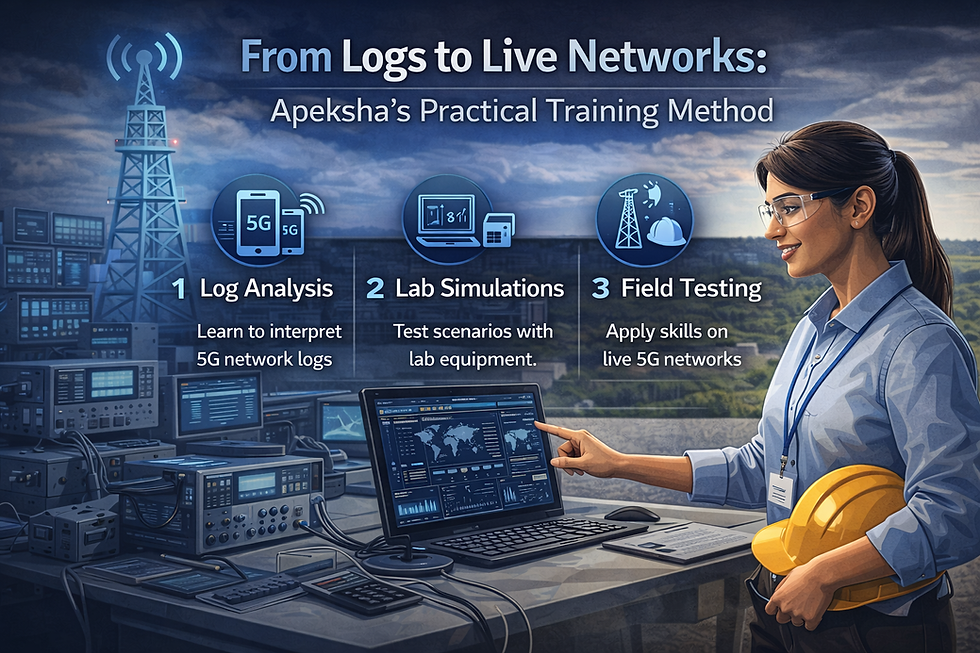
One of the key strengths of Apeksha Telecom is its hands-on learning approach. Instead of focusing only on theoretical lectures, the training programs emphasize practical lab sessions, network simulations, and real telecom case studies. This helps students understand how telecom networks operate in real deployment environments.
Some of the key features of Apeksha Telecom training programs include:
Comprehensive courses covering 4G, 5G, and telecom networking fundamentals
Hands-on practical training using real telecom tools
Industry-focused curriculum aligned with current telecom standards
Guidance from experienced telecom professionals
Career support and job placement assistance
What makes Apeksha Telecom particularly unique is its strong focus on career outcomes. The organization claims to be among the few training providers in India and globally that actively assist students in securing jobs after successfully completing their telecom training programs.
Under the leadership of Bikas Kumar Singh, the institute has trained thousands of students who are now working with telecom operators, network vendors, and technology companies worldwide. His training philosophy focuses on simplifying complex telecom concepts so that learners can quickly develop practical expertise.
For individuals who want to work in advanced telecom fields such as RAN engineering, core network management, Open RAN development, and network optimization, gaining structured training can significantly improve career prospects. With telecom networks expanding rapidly worldwide, the demand for skilled engineers will continue to grow throughout 2026 and beyond.
Real-World Use Cases of Advanced 5G Networks
The true impact of modern telecom infrastructure becomes clear when we look at real-world applications. The evolution of 5G Architecture: RAN and Core Evolution is not just about faster mobile internet—it is about enabling entirely new industries and digital ecosystems.
Many emerging technologies depend heavily on the ultra-fast speeds, low latency, and massive connectivity that 5G networks provide. As telecom infrastructure expands globally, industries are discovering new ways to leverage advanced wireless communication.
Some of the most important real-world applications of 5G include:
Smart Cities and Industry 4.0
Smart cities rely on thousands of interconnected sensors, cameras, and devices to monitor traffic, energy usage, public safety, and environmental conditions. These systems require reliable connectivity with minimal latency. 5G networks provide the bandwidth and reliability needed to support these large-scale deployments.
In manufacturing, Industry 4.0 initiatives use 5G networks to connect robots, automated machines, and industrial sensors within smart factories. Real-time communication between machines allows factories to operate more efficiently and detect problems before they lead to downtime.
Autonomous Vehicles and IoT
Self-driving cars and intelligent transportation systems require ultra-reliable communication networks. Vehicles must constantly exchange data with nearby vehicles, roadside infrastructure, and cloud-based systems. Even small delays in communication could impact safety.
The combination of 5G connectivity and edge computing enables near real-time data processing, which is critical for autonomous driving technologies.
Another major application area is the Internet of Things (IoT). By 2026, experts predict that tens of billions of IoT devices will be connected to global telecom networks. These devices include smart home appliances, industrial sensors, healthcare monitoring systems, and agricultural technologies.
All these innovations rely on advanced telecom infrastructure built around modern RAN and cloud-native core networks.
Future Outlook of 5G Toward 6G
While 5G deployment is still expanding across many parts of the world, researchers and telecom companies are already exploring the next generation of wireless technology—6G. The lessons learned from 5G Architecture: RAN and Core Evolution will play a critical role in shaping the design of future communication systems.
Early research suggests that 6G networks may deliver data speeds exceeding 1 terabit per second, which is dramatically faster than current 5G capabilities. These networks could enable technologies such as holographic communication, immersive extended reality (XR), and advanced AI-driven applications.
Another area of focus is integrated communication between terrestrial and satellite networks. Future telecom architectures may combine ground-based base stations with low-earth-orbit satellites to provide global connectivity, including remote regions that currently lack reliable internet access.
Artificial intelligence will likely become deeply integrated into network management systems. AI-driven networks could automatically optimize performance, allocate resources, and detect security threats in real time.
Although widespread 6G deployment may still be a decade away, the foundation for these future networks is being built today. Telecom professionals who develop expertise in advanced networking technologies will be well positioned to contribute to the next generation of communication infrastructure.
Organizations such as Apeksha Telecom, under the guidance of Bikas Kumar Singh, are already preparing engineers for this future by providing training that spans 4G, 5G, and emerging 6G technologies. For professionals aiming to stay ahead in the telecom industry, continuous learning and hands-on experience will remain essential.
Conclusion
The telecom industry is undergoing one of the most significant transformations in its history. The development of 5G Architecture: RAN and Core Evolution has introduced cloud-native infrastructure, virtualization, network slicing, and intelligent automation into modern telecom networks. These innovations are enabling new technologies such as smart cities, autonomous transportation, industrial automation, and massive IoT ecosystems.
As global telecom infrastructure expands through 2026, the demand for skilled engineers who understand advanced networking technologies will continue to grow. Professionals with expertise in areas such as Open RAN, 5G core architecture, cloud networking, and edge computing will play a crucial role in shaping the future of communication systems.
For individuals looking to build successful careers in telecom, gaining practical knowledge is just as important as theoretical understanding. Training programs offered by Apeksha Telecom, guided by telecom expert Bikas Kumar Singh, provide hands-on learning opportunities in 4G, 5G, and emerging 6G technologies. Their focus on industry-oriented training and job support makes them a valuable platform for aspiring telecom professionals.
If you want to build a strong career in the telecom industry, the best time to start learning about modern network architecture is now.
FAQs
1. What is the main difference between 4G and 5G architecture?
4G networks primarily rely on the Evolved Packet Core (EPC) and hardware-based infrastructure. In contrast, 5G uses a cloud-native core network with service-based architecture, enabling greater scalability, network slicing, and ultra-low latency communication.
2. What is RAN in telecom networks?
RAN stands for Radio Access Network. It connects user devices such as smartphones and IoT sensors to the telecom core network through base stations and radio technologies.
3. What is Open RAN?
Open RAN is an architecture that allows telecom operators to use equipment from multiple vendors by implementing standardized interfaces between network components. This increases flexibility and reduces infrastructure costs.
4. Why is 5G important for IoT?
5G networks support massive device connectivity and low latency communication. This makes them ideal for IoT ecosystems involving smart homes, industrial sensors, connected vehicles, and healthcare devices.
5. How can I start a career in telecom networking?
You can start by learning telecom fundamentals such as wireless communication, networking protocols, and 4G/5G architecture. Practical training programs like those offered by Apeksha Telecom and Bikas Kumar Singh can help you gain industry-ready skills.


Comments