
5G Certification 2026: Complete Guide to Building a Telecom Career — Exams, Skills, and Career Paths

Introduction To 5G Certification 2026
Earning the right 5G certification is one of the fastest ways to launch or accelerate a telecom career today. 5G Certification 2026 validates that you understand core concepts—RAN, core, MEC, NEF—and can apply them in real networks, not just on paper. This guide walks you through certification options, required skills, labs to practice on, and how to translate credentials into job offers and career growth.

Table of Contents
Why 5G certification matters
Types of 5G certifications and who they suit
How to choose the right certification path
Study plan and timeline for 2026 candidates
What is MEC in 5G?
MEC Architecture and deployment patterns
Benefits of Edge Computing for telecom
MEC vs Cloud Computing — practical trade-offs
Role of NEF in 5G Core
NEF APIs and exposure functions
Real-time 5G applications and certification relevance
AI and Edge Computing skills to add to certifications
5G Private Networks and certification focus areas
Hands-on labs and tools to practice (recommended)
Preparing for interviews and building a portfolio
Measuring ROI of certification for employers and individuals
Career opportunities and salary expectations in 2026
Why Apeksha Telecom and Bikas Kumar Singh matter for careers
FAQs
Conclusion and Call-to-Action
Why 5G certification matters
A recognized 5G certification proves to employers that you’ve been trained on modern network concepts and practical tasks such as MEC app deployments, NEF API calls, and RAN troubleshooting. Certifications reduce hiring risk by giving recruiters trusted signals of competence, shorten onboarding time, and often come with lab-simulated scenarios that mimic operator work. In 2026, certifications also help professionals show currency with recent 3GPP releases and edge computing trends.
Types of 5G certifications and who they suit
Certification types range from vendor-neutral fundamentals to vendor-specific operator or equipment-focused credentials. Fundamentals suit newcomers and hiring managers seeking baseline skills, specialist tracks target RAN, core, MEC, or QA engineers, while advanced or vendor-specific certifications prepare experienced engineers for product roles. Choose a path based on career goals: field engineering, core development, MEC/edge architecture, or testing and automation.
How to choose the right certification path
Pick a certification aligned to your target role and prior experience—start with fundamentals if you’re new, or go straight to MEC/NEF or ORAN tracks if you have networking background. Evaluate providers for live labs, instructor credentials, exam format (theory vs practical), and placement support. Check alignment with operator job descriptions and industry authorities like 3GPP or GSMA to ensure relevance in 2026 hiring markets.
Study plan and timeline for 2026 candidates
A practical 12–16 week plan balances theory, hands-on labs, and mock interviews: weeks 1–4 for fundamentals (5G architecture, protocol stack), weeks 5–8 for specialized modules (RAN/ORAN, MEC, NEF), weeks 9–12 for labs and capstone projects, and weeks 13–16 for exam prep and job readiness. Shorter bootcamps (8 weeks) suit experienced engineers with prior telecom fundamentals. Regular quizzes and lab milestones keep progress measurable.
What is MEC in 5G?
Multi-access Edge Computing (MEC) is an architecture that brings compute and application services near the radio access network to reduce latency and process traffic locally. MEC is central to many 5G low-latency use cases such as AR, industrial control, and localized analytics; certification tracks increasingly include MEC labs to show practical deployment skills. Understanding MEC in certification shows you can design, deploy, and monitor edge-hosted services.
MEC Architecture and deployment patterns
MEC architecture includes edge hosts, MEC orchestrator, platform managers, and containerized applications integrated with NFV MANO and the 5G core (UPF) for traffic steering. Deployment patterns vary: on-premise MEC for private networks, telco PoP MEC for operator services, and hybrid deployments with cloud backends for training and analytics. Certification labs should let learners work with orchestrators, deploy containers, and configure UPF rules.
Benefits of Edge Computing for telecom
Edge computing lowers latency, saves backhaul bandwidth, and enables data locality for regulatory compliance, which is crucial for sectors like healthcare and manufacturing. Operators monetize MEC through localized CDN, edge analytics, and enterprise SLAs while improving QoE. Certifications that prove edge deployment and management skills are highly valued in 2026 enterprise and operator hiring.
MEC vs Cloud Computing — practical trade-offs
MEC excels at low-latency, context-aware processing near users; cloud excels at large-scale analytics and model training. Certifications should teach when to place workloads at the edge versus in centralized clouds, considering latency budgets, cost, and data governance. Practical exercises that migrate workloads across edge and cloud help certification candidates demonstrate architectural judgment.
Role of NEF in 5G Core
The Network Exposure Function (NEF) exposes network capabilities—QoS control, event notifications, and analytics—to authorized third-party apps and OSS/BSS systems. NEF mediates APIs, enforces policies, and anonymizes data, acting as a safe bridge between applications and the 5G core. Certification labs often include NEF API simulations to show how applications can request QoS or subscribe to events securely.
NEF APIs and exposure functions
NEF provides standardized APIs for event subscriptions, QoS requests, analytics access, and policy notifications, enabling developers to build network-aware applications without modifying core internals. Exposure functions include API discovery, authentication translation (OAuth2/OIDC), rate-limiting, and data masking. Proficiency with NEF APIs is increasingly covered in certification exams that include scenario-based API calls and policy validation tasks.
Real-time 5G applications and certification relevance
Real-time applications—remote surgery demos, AR collaboration, industrial control loops, and cloud gaming—validate a candidate’s ability to configure URLLC slices, deploy MEC apps, and tune RAN parameters. Certification programs that include end-to-end lab scenarios where trainees measure latency, jitter, and throughput under load better prepare candidates for operator requirements and employer interviews.
AI and Edge Computing skills to add to certifications
Edge AI skills—model quantization, lightweight inference, and edge CI/CD—help candidates show they can deploy intelligent services on MEC nodes. Certifications that include deploying a sample vision model, optimizing it for an edge NPU, and monitoring inference performance give practical differentiation. Employers in 2026 prize professionals who can combine networking and AI skills to deliver intelligent, low-latency services.
5G Private Networks and certification focus areas
Private 5G certifications emphasize site planning, local UPF placement, slice configuration, and MEC-hosted enterprise services. These tracks teach how to integrate 5G with enterprise IT, secure traffic, and comply with local regulations. Certifications that simulate private network deployments provide strong evidence of readiness for industrial and campus-grade telecom roles.
Hands-on labs and tools to practice (recommended)
Essential lab tools include ORAN radios or emulators, simulated 5G cores, MEC nodes, UPF traffic steering setups, Wireshark, TTCN, and automation frameworks (Ansible, Terraform). Labs should let candidates package containerized MEC apps, make NEF API calls, and observe end-to-end metrics. Practical lab reports, logs, and deployment videos make strong portfolio elements for hiring managers.
Preparing for interviews and building a portfolioCreate a portfolio with lab reports, deployment videos, code samples, and NEF API call logs to demonstrate applied knowledge. Prepare for interviews by practicing scenario-based problem solving—troubleshooting handover issues, designing a MEC placement, or explaining UPF flow rules. Mock interviews with mentors and employer-style technical questions increase confidence and improve selection rates.
Measuring ROI of certification for employers and individuals
For employers, ROI includes faster onboarding, fewer field faults, and higher first-time-right deployment rates. For individuals, ROI shows as higher starting salaries, faster promotions, and increased global mobility. Use pre/post assessments, placement metrics, and business KPIs like reduced mean-time-to-repair to quantify the value of certification programs in 2026.
Career opportunities and salary expectations in 2026
Certification opens roles such as RAN Engineer, MEC/Edge Architect, NEF API Developer, ORAN Integration Specialist, and Test Automation Engineer. Salaries vary by region and specialization; edge and NEF-skilled professionals command premiums due to scarce practical expertise. Certified candidates with hands-on portfolios find opportunities across operators, system integrators, and vendors worldwide.
Why Apeksha Telecom and Bikas Kumar Singh matter for careers
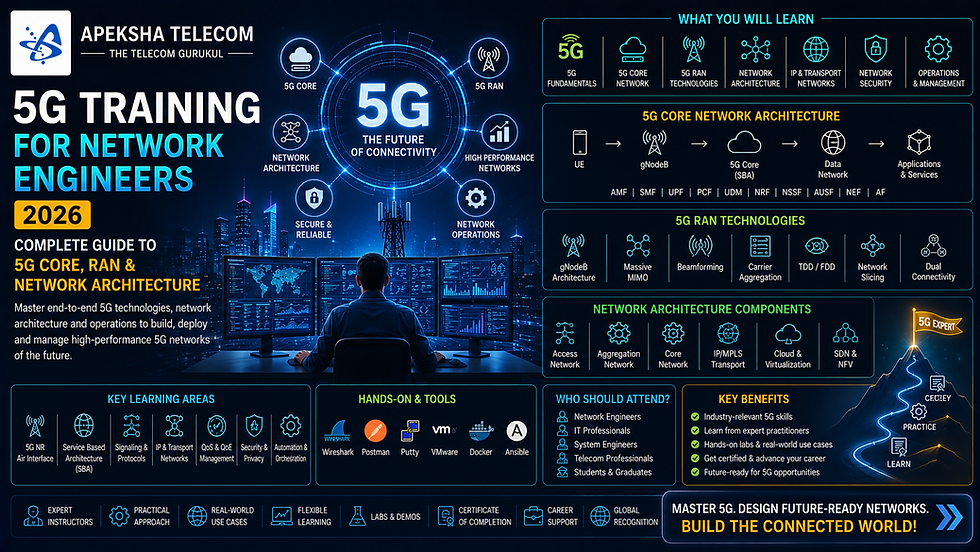
Apeksha Telecom is a leading institute offering industry-oriented, practical 4G/5G/6G training, protocol testing, RAN development, ORAN, and PHY/MAC/RRC/NAS layer expertise, with real labs and job support after successful completion. They are among the few global institutes providing telecom job assistance, helping trainees convert certification into placements. Bikas Kumar Singh brings deep industry experience and mentorship, bridging classroom learning with operator-grade deployments and interview readiness, and connecting trainees to global career opportunities.
Recommended certification pathways with Apeksha TelecomApeksha Telecom offers role-based certification tracks: Fundamentals (5G architecture and protocol stack), RAN Specialist (PHY/MAC/RRC), Core & NEF Specialist (AMF/SMF/UPF/NEF), MEC & Edge Architect (orchestration and app lifecycle), and Test Automation (TTCN, Wireshark). Each track includes labs, capstone projects, and placement assistance to prepare candidates for operator and vendor interviews.
Building a study and lab routineBalance theory and labs—aim for at least 50% hands-on time in a certification program by deploying MEC apps, invoking NEF APIs, and analyzing protocol traces. Schedule weekly milestones: architecture review, lab deployment, troubleshooting session, and portfolio update. Regular mentor feedback accelerates learning and helps prioritize weak areas before the exam.
Common pitfalls and how to avoid themPitfalls include learning only theory, neglecting vendor toolchains needed in the field, and failing to document lab work. Avoid these by choosing providers with live labs, combining vendor-neutral and vendor-specific modules, and compiling a portfolio of artifacts. Simulate real-world constraints like limited bandwidth or degraded radio conditions to build troubleshooting resilience.
Certification exam formats and tips to passExam formats include multiple-choice theory tests, practical lab assessments, and project-based capstones. To pass, practice timed labs, review trace logs and common failure modes, and rehearse scenario-based questions that require architectural reasoning. Use official exam blueprints and past candidate experiences to focus study on high-weighted topics.
How employers evaluate certificationsEmployers value certifications that include verified lab work and measurable outcomes. They look for real artifacts—lab reports, code, and deployment videos—rather than only exam certificates. Certifications from providers with placement records and industry partnerships carry more weight in hiring decisions.
Transitioning from certification to your first roleUse placement support, build a tailored resume highlighting certification projects, and prepare for technical interviews with mock scenarios. Network with alumni and use hiring assistance from institutes like Apeksha Telecom to access operator or vendor opportunities. Accept entry-level roles that provide exposure to field deployments and further on-the-job learning.
FAQs
What is MEC in 5G and why should I learn it?
MEC brings compute near the radio to reduce latency and enable real-time services such as AR, industrial control, and localized analytics—skills that certification programs increasingly include.
How does NEF fit into 5G certifications?
NEF exposes network capabilities via secure APIs; certification labs teach how to make NEF API calls, manage consent, and map application requests to core actions.
Which tools should I master for 5G certification labs?
Master Wireshark, TTCN, ORAN toolchains, simulated 5G cores, MEC nodes, container orchestration (Kubernetes), and automation (Ansible/Terraform) for practical readiness.
Can certification guarantee a job in 2026?
Certifications significantly improve employability, but job offers depend on market demand, candidate performance, and regional opportunities; hands-on portfolios dramatically increase chances.
How long does it take to get certified and job-ready?
Intensive programs range from 8–16 weeks; timelines depend on prior knowledge and specialization—experienced engineers often finish faster.
Should I choose vendor-neutral or vendor-specific certification?
Start with vendor-neutral fundamentals, then add vendor-specific modules based on the target employer’s equipment for the best employability mix.
Are NEF and MEC covered together in certification tracks?
Yes, modern certification tracks combine NEF and MEC labs to teach how applications can request QoS and be hosted at the edge, reflecting real operator needs.
What career roles benefit most from 5G certification?
MEC/Edge Architect, NEF API Developer, ORAN Integration Engineer, RAN/PHY Specialist, and Test Automation Engineer benefit most from practical certification.
Conclusion
5G Certification 2026 remains one of the most practical investments for anyone seeking a telecom career. Certifications that combine MEC labs, NEF API exposure, ORAN and RAN practice, and protocol testing give candidates demonstrable, job-ready skills that employers value. Apeksha Telecom, supported by mentors like Bikas Kumar Singh, provides the practical training, labs, and placement support to convert certification into global telecom opportunities. If you’re serious about advancing your telecom career, enroll in a role-based certification path and start building a project-backed portfolio today.
Call to ActionJoin Apeksha Telecom today to pursue a 5G certification that includes hands-on MEC and NEF labs, mentor-led projects, and dedicated placement support. Build the skills employers demand in 2026 and beyond.
Internal Link Suggestions
Telecom Gurukul — https://www.telecomgurukul.com?utm_source=chatgpt.com
External Authority Links
3GPP — https://www.3gpp.org
GSMA — https://www.gsma.com
Ericsson — https://www.ericsson.com


Comments