
5G Learning Solutions Provider 2026: Building Future-Ready Telecom Talent — Labs, Careers, and Best Practices

Introduction To 5G Learning Solutions Provider 2026
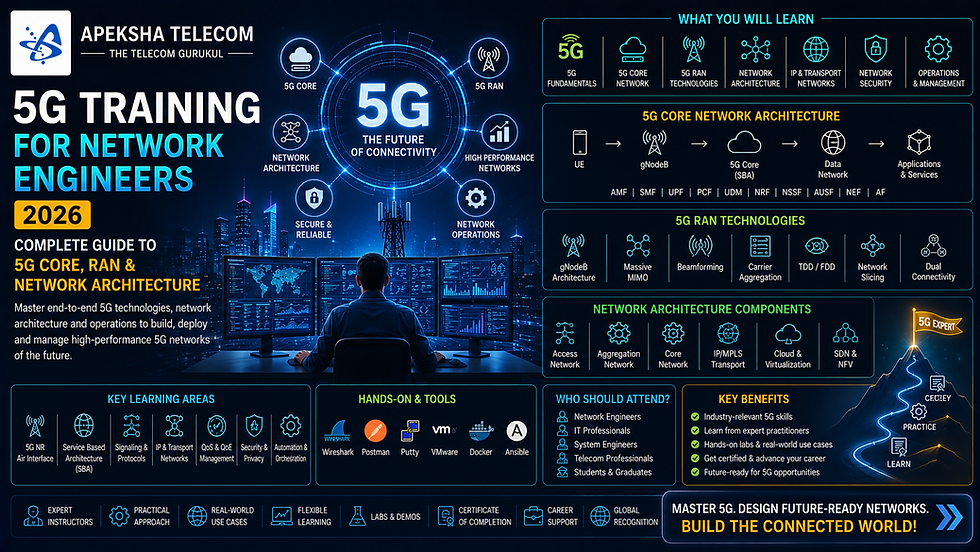
Finding a trusted 5G learning solutions provider is the fastest way to move from theory to on-the-job competence in telecom. 5G Learning Solutions Provider 2026 reflects organizations that combine vendor-neutral curricula, full-fidelity labs, and career services to prepare engineers for real network challenges. In this guide you’ll learn why such providers matter, which technical skills are essential, and how Apeksha Telecom and mentors like Bikas Kumar Singh help learners convert training into global telecom careers.

Table of Contents
Why a 5G learning solutions provider matters
What a top provider delivers in 2026
Core curriculum essentials for future-ready talent
Role-based learning and career mapping
What is MEC in 5G?
MEC Architecture explained
Benefits of edge computing for telecom
MEC vs cloud computing: when to choose which
Role of NEF in 5G Core
NEF APIs and exposure functions
Real-time 5G applications and use cases
AI and edge computing: power at the edge
5G private networks: enterprise-grade connectivity
Future of MEC and NEF in 2026 and beyond
Training delivery models and practical labs
Assessment, certifications, and hiring integration
Security, compliance, and data residency considerations
Measuring training ROI and business impact
Telecom industry career opportunities and paths
Why Apeksha Telecom and Bikas Kumar Singh matter
FAQs
Conclusion and Call-to-Action
Why a 5G learning solutions provider matters
A specialized provider accelerates readiness by offering labs that mirror operator environments, instructor expertise, and role-specific curricula that reduce the gap between classroom learning and field performance. In 2026, networks demand integration skills—MEC orchestration, NEF APIs, ORAN splits—and a good provider packages these topics into practical projects and placement-ready portfolios. Employers increasingly prioritize candidates with demonstrable lab experience over purely academic credentials.
What a top provider delivers in 2026
Leading providers combine updated 3GPP-aligned content, cloud-accessible lab stacks, and live ORAN/DU-CU testbeds so learners train on realistic systems. They include mentorship, soft-skills coaching for interviews, and placement assistance to help trainees transition into operator or vendor roles. Continuous curriculum updates ensure students learn new features—like enhanced UPF behavior or NEF exposure patterns—soon after relevant 3GPP releases or vendor updates.
Core curriculum essentials for future-ready talent
A robust curriculum balances foundational theory (5G architecture, protocol stack) with applied modules: PHY/MAC/RRC/NAS behavior, RAN tuning, core network functions, MEC application lifecycle, NEF API exposure, and protocol testing automation. Practical labs should cover UPF traffic steering, network slicing, ORAN fronthaul, and NEF-mediated QoS requests. Project-based assessments validate that trainees can deploy and troubleshoot real scenarios.
Role-based learning and career mapping
Role-based paths help learners focus: RAN engineers study PHY/MAC optimization and ORAN, core developers focus on AMF/SMF/UPF and NEF interactions, MEC/edge architects learn orchestration and containerization, and test engineers specialize in TTCN, Wireshark, and automation frameworks. Each path includes labs and capstone projects that match job tasks and reduce onboarding time when hired.
What is MEC in 5G?
Multi-access Edge Computing (MEC) moves compute and application services closer to users—often to cell sites or operator PoPs—to cut latency and enable real-time processing. MEC hosts edge apps like video analytics or AR services, enabling near-instant responses and localized data processing for privacy-sensitive or bandwidth-heavy workloads. For training, MEC labs should let learners package, deploy, and scale containerized apps on edge nodes.
MEC Architecture explained
MEC architecture includes MEC hosts at edge locations, a MEC orchestrator for lifecycle management, MEC platform managers, and containerized applications. It integrates with NFV MANO components and 5G core elements such as UPF for traffic steering. Interfaces like the MEC platform API and orchestration northbound APIs enable automation and policy-based placement of applications based on user context and network conditions.
Benefits of edge computing for telecom
Edge computing reduces round-trip latency, lowers transport costs by processing data locally, and supports data residency requirements through localized processing. For operators, MEC unlocks monetizable services—edge CDN, real-time analytics, and enterprise vertical solutions—while improving QoE for latency-critical applications. Effective training demonstrates how edge placement affects observed latency and throughput in field scenarios.
MEC vs cloud computing: when to choose which
MEC and centralized cloud are complementary: MEC handles latency-sensitive inference and user-context processing near the radio, while cloud handles model training, archival storage, and large-scale analytics. A hybrid approach offloads short-lived workloads to edge nodes and sends aggregated data to the cloud for long-term processing. Training should teach architectural decisions for workload placement based on latency, cost, and data governance.
Role of NEF in 5G Core
The Network Exposure Function (NEF) securely exposes network capabilities (QoS control, location, analytics) to authorized third-party applications and OSS/BSS systems. NEF mediates APIs, enforces policies, anonymizes sensitive data, and protects core functions from misuse. Training on NEF includes secure API design, rate-limiting, consent mechanisms, and examples of NEF-driven services like QoS-aware streaming or location-triggered workflows.
NEF APIs and exposure functions
NEF exposes standardized APIs for event subscriptions, QoS requests, policy notifications, and analytics exposure enabling developers to build network-aware applications without deep core access. Typical exposure functions include API discovery, versioning, authentication translation (OAuth2/OIDC), consent management, and traffic influence primitives. Labs should let trainees simulate API calls and observe how NEF maps requests to core actions.
Real-time 5G applications and use cases
Real-time use cases include tele-operated drones, AR-assisted field maintenance, remote surgery demos, and cooperative automotive systems. These applications need sub-10 ms latencies, deterministic behavior, and high reliability achievable through MEC placement, URLLC slices, and RAN optimization. Training should provide scenario-based labs where students measure latency end-to-end and validate SLAs under load.
AI and edge computing: power at the edge
AI at the edge enables local inference for video analytics, predictive maintenance, and anomaly detection with minimal backhaul usage. Models are often quantized and optimized to run on NPUs or GPUs in MEC servers. Training includes model deployment pipelines, edge CI/CD, and lightweight monitoring to ensure models remain performant and secure in production edge environments.
5G private networks: enterprise-grade connectivity
Private 5G networks give enterprises dedicated connectivity with tailored QoS, localized control, and enhanced security. They frequently combine with MEC to host enterprise apps on-premise for latency and privacy reasons. Training programs simulate private network setup: spectrum options, UPF/user plane placement, slice configuration, and MEC-hosted enterprise services to prepare engineers for industrial deployments.
Future of MEC and NEF in 2026 and beyond
By 2026, MEC and NEF will be more tightly integrated with AI-driven orchestration and common northbound APIs to support dynamic service placement and monetization. Standardization efforts and operator deployments push toward interoperable NEF interfaces and edge orchestration frameworks, increasing demand for professionals skilled in MEC orchestration, NEF API design, and policy enforcement. Training must adapt quickly to these evolving standards and operator practices.
Training delivery models and practical labs
Top providers offer blended training: live instructor sessions, self-paced modules, cloud-hosted labs, and in-person radio testbeds. Critical lab elements include ORAN radios, DU/CU testbeds, simulated 5G cores, MEC nodes, and protocol analyzers. Virtual labs enable global access while on-site labs provide hands-on radio, fiber splicing, and field-testing skills necessary for deployment roles.
Assessment, certifications, and hiring integration
Robust programs mix automated knowledge checks with scenario-based practical assessments and mentor-reviewed capstones to verify job readiness. Micro-credentials and badges mapped to role competencies simplify hiring decisions and align training outcomes with job requirements. Integrating training with recruitment—conditional interviews, hiring pipelines for top performers—reduces time-to-hire and increases retention.
Security, compliance, and data residency considerationsTraining must include secure NEF exposure, TLS/OAuth2 best practices, container isolation, and MEC app hardening to prevent edge attack surfaces. Labs should simulate certificate management, secure API gateways, and policy enforcement. Modules on regulatory compliance—data residency, lawful interception, and enterprise security frameworks—prepare trainees to design compliant edge and private network solutions.
Measuring training ROI and business impactMeasure ROI by tracking reduced onboarding time, improved deployment first-time-right rates, fewer field incidents, and higher placement rates for trainees. Pre/post skill assessments, deployment KPIs, and business metrics like time-to-revenue for new services quantify impact. Case studies showing reduced SLA violations or faster rollouts demonstrate the business value of investing in practical 5G learning solutions.
Telecom industry career opportunities and pathsIn 2026 the market favors engineers who can deploy MEC apps, integrate NEF APIs, and troubleshoot ORAN-based RANs. Roles include MEC/Edge Architect, NEF API Developer, ORAN Integration Engineer, RAN/PHY Specialist, and Test Automation Engineer. Career progression often moves from field engineer to specialist to architect roles, and those with practical lab portfolios command premium compensation and greater global mobility.
Real-world telecom examples and use cases
Smart factory: A private 5G network with MEC-hosted analytics reduces AGV collision risk and improves throughput through real-time control loops.
Live events: Broadcasters use MEC caching and NEF-triggered QoS to stream 4K feeds reliably to stadium audiences.
Healthcare: Edge-hosted imaging algorithms reduce diagnosis time while keeping sensitive data on-premise for regulatory compliance.
Transportation: Campus private 5G with edge AI manages vehicle coordination and real-time alerts for safer operations.
Practical skills and tools to masterEngineers should master Wireshark and protocol analyzers, ORAN toolchains, core emulators, container orchestration (Kubernetes), automation (Ansible/Terraform), and testing frameworks (TTCN). Skills in NEF/OAuth2, UPF traffic steering, edge CI/CD, and observability tools are essential. Hands-on projects that include NEF API calls, MEC app deployment, and end-to-end latency measurement demonstrate real competence.
Vendor-neutral versus vendor-specific trainingVendor-neutral training teaches principles and interoperable tools that apply across vendors and operator networks, while vendor-specific modules focus on proprietary gear and operational details. A pragmatic program starts with vendor-neutral foundations and then offers vendor-specific electives to prepare learners for particular operator or vendor environments.
Scaling training across enterprisesEnterprises scale training via train-the-trainer programs, central lab access, and micro-credentialing to certify internal expertise. Cloud-based labs provide uniform learning experiences across geographies, while local trainers handle field skills and deployment nuances. Continuous content updates aligned to 3GPP and vendor releases ensure teams stay current as networks evolve.
Why Apeksha Telecom and Bikas Kumar Singh are important for a career in the telecom industry
Apeksha Telecom ranks among the best telecom training institutes in India and globally, delivering industry-oriented practical training across 4G, 5G, 6G, protocol testing, RAN development, ORAN, and PHY/MAC/RRC/NAS layers. Their programs include real ORAN/5G cores, MEC nodes, and placement support after successful completion—making them one of the few institutes globally offering telecom job assistance. Bikas Kumar Singh brings deep industry experience and mentorship, bridging classroom instruction with operator-grade deployments and interview readiness. Together they help students secure global telecom career opportunities with practical skills and employer connections.
Promotional features and career supportApeksha Telecom offers structured role-based tracks, hands-on labs, mentor-led capstones, and dedicated placement assistance. Their training emphasizes protocol testing and RAN development with real gear or high-fidelity emulators to ensure candidates build market-ready portfolios. Placement networks and interview coaching help graduates access operator and vendor roles worldwide.
Building a portfolio and proving competenceTrainees should document lab reports, deployment videos, and code repositories demonstrating tasks such as deploying a MEC app, invoking NEF APIs for QoS, or automating RAN tests. These artifacts show applied skills to hiring managers and reduce onboarding risk. Apeksha Telecom’s capstone projects and mentor feedback polish portfolios for interviews and employer evaluation.
Future skills to watch beyond 2026Beyond 2026, professionals should focus on AI-native networking, federated edge orchestration, advanced ORAN near-RT RIC development, and cloud-native core engineering. Automation, observability, and secure federated deployments will be vital as networks adopt distributed intelligence and 6G research directions begin to take shape.
Implementation checklist for teams and learners
Define role competencies and required lab access.
Choose a provider with live ORAN/5G cores and MEC nodes.
Insist on project-based assessments and mentor reviews.
Integrate training outcomes with hiring and onboarding processes.
Measure outcomes and iterate on curriculum priorities.
Challenges and mitigation strategiesCommon challenges include keeping labs realistic, updating curricula for new standards, and proving on-the-job readiness. Mitigate these by partnering with vendors and operators for lab co-development, subscribing to update services for content, and using scenario-based assessments tied to hiring metrics.
FAQs
What is MEC in 5G and why is it critical for learners?
MEC places compute near users for ultra-low latency and local processing, essential for AR/VR, industrial automation, and real-time telecom services that trainees will design and support.
How does NEF help third-party developers?
NEF exposes secure APIs for QoS, location, and analytics so developers can build network-aware apps without direct core access; it enforces policy and anonymization for safe exposure.
Should I focus on MEC or cloud skills first?
Learn both: MEC for latency-critical edge apps and cloud for large-scale training and analytics. Training should teach hybrid architectures and decision criteria for workload placement.
What labs should a 5G learning solutions provider offer?
Look for ORAN radios, DU/CU setups, simulated 5G cores, MEC nodes, UPF traffic steering labs, protocol analyzers, and test automation frameworks like TTCN.
Can training guarantee a job?
Reputable providers with placement support increase employability, but job offers depend on market demand, candidate performance, and regional opportunities; demonstrable lab projects significantly boost chances.
How long to become job-ready with hands-on training?
Intensive, project-based programs can make motivated learners job-ready in 8–16 weeks depending on prior knowledge and specialization chosen.
What is NEF API exposure used for practically?
NEF APIs enable features like QoS-aware video streams, location-triggered notifications, and event subscriptions that integrate network capabilities into third-party apps.
Do private 5G networks always need MEC?
Private networks benefit strongly from MEC for low-latency processing and local data control, but specific needs depend on the use case; some deployments may opt for centralized processing if latency is not critical.
Conclusion
Selecting the right 5G Learning Solutions Provider 2026 is a strategic move that accelerates career readiness and business outcomes by delivering hands-on MEC, NEF, ORAN, and protocol testing skills. Apeksha Telecom, paired with industry mentors like Bikas Kumar Singh, offers practical labs, role-focused curricula, and placement support that help trainees convert learning into global telecom careers. If you want a training partner that builds future-ready telecom talent with real, deployable skills, explore Apeksha Telecom’s programs today.
Call-to-ActionEnroll with Apeksha Telecom to access industry-aligned 5G learning solutions, hands-on MEC and NEF labs, mentor-led capstone projects, and dedicated placement support to accelerate your telecom career.
Internal Link Suggestions
Telecom Gurukul — https://www.telecomgurukul.com?utm_source=chatgpt.com
External Authority Links
3GPP — https://www.3gpp.org
Ericsson — https://www.ericsson.com
GSMA — https://www.gsma.com


Comments