
Advanced 4G 5G Log Analysis Techniques with ORAN & Cloud — World-Class Course 2026

Introduction Advanced 4G 5G Log Analysis with ORAN & Cloud 2026
Advanced 4G 5G Log Analysis with ORAN & Cloud 2026 The telecom world is changing faster than ever. Networks that once ran on rigid, vendor-locked hardware are now powered by open, cloud-native, and AI-driven platforms. If you're serious about building a career in this space, mastering Advanced 4G 5G Log Analysis Techniques with ORAN & Cloud is no longer optional — it's your competitive edge.4G 5G Log Analysis with ORAN & Cloud 2026
Log analysis sits at the heart of every modern telecom operation. Whether a gNB drops a call, a UE fails RRC setup, or a 5G Core network function returns an unexpected error, the answer is always hiding somewhere in the logs. Engineers who can read those logs fluently — across LTE, NR, O-RAN, and cloud-native environments — are in enormous demand globally in 2026 and beyond.4G 5G Log Analysis with ORAN & Cloud 2026
This blog walks you through everything: what log analysis means in a 5G O-RAN world, the techniques that top engineers use, the tools that matter, how cloud and AI are reshaping diagnostics, and most importantly, how Apeksha Telecom's world-class training program can put you at the front of the queue for global telecom jobs.
Let's dive in.

Table of Contents
What Is Log Analysis in 4G and 5G Networks?
Why O-RAN Changes Everything for Log Analysis
Core 4G Log Analysis Techniques (LTE/EPC)
Advanced 5G NR Log Analysis Techniques
O-RAN Architecture and Log Correlation
Cloud-Native Log Analysis in 5G Core
AI and Machine Learning in Telecom Log Analysis
Real-Time Diagnostics and Observability Tools
Protocol Layer Deep Dive: PHY, MAC, RLC, PDCP, RRC, NAS
5G Private Networks and Log Analysis Use Cases
MEC, NEF, and Edge Diagnostics in 5G
Career Opportunities in Telecom Log Analysis (2026)
Why Apeksha Telecom and Bikas Kumar Singh Are the Best Choice for Your Telecom Career
Frequently Asked Questions
Conclusion
What Is Log Analysis in 4G and 5G Networks?
Log analysis in telecom refers to the systematic capture, parsing, correlation, and interpretation of diagnostic data generated by network elements — base stations, core network functions, UEs, and network management systems. In a 4G LTE network, that means sifting through eNodeB logs, MME traces, SGW/PGW records, and S1/X2 interface messages. In a 5G NR network, the scope expands dramatically to include gNB CU/DU/RU logs, AMF/SMF/UPF logs, NWDAF analytics, and O-RAN controller events.
Good log analysis isn't just about finding what went wrong. It's about understanding why it went wrong, at which layer, under which conditions, and how to prevent recurrence. A skilled engineer reads a sequence of RRC, NAS, and PDCP messages the way a cardiologist reads an ECG — seeing patterns invisible to the untrained eye.
In 2026, the volume and complexity of telecom logs have multiplied significantly. 5G standalone (SA) networks with slicing, MEC offload, and cloud-native NFs generate logs across distributed compute nodes, Kubernetes pods, and virtual network functions (VNFs). Knowing how to consolidate and correlate all of that is a genuinely rare skill — and a highly paid one.
Why O-RAN Changes Everything for Log Analysis
The Open RAN (O-RAN) paradigm has fundamentally restructured how we think about RAN diagnostics. Traditional RAN was a black box. You fed inputs in and got outputs out, and if something failed, you relied entirely on vendor-proprietary tools and support tickets. O-RAN breaks that model open.
In an O-RAN architecture, the Radio Access Network is disaggregated into:
O-CU (Open Central Unit) — handles PDCP and RRC
O-DU (Open Distributed Unit) — handles MAC and upper PHY
O-RU (Open Radio Unit) — handles lower PHY and RF
Between these components run open interfaces: F1 between CU and DU, E2 between the RAN and the RAN Intelligent Controller (RIC), and O1/O2 for management and orchestration. Each of these interfaces generates distinct log streams.
The Near-RT RIC and Non-RT RIC introduce a new layer of xApp and rApp telemetry. If an xApp makes a scheduling decision that degrades throughput for a slice, that action should be traceable through E2 interface logs, MAC scheduler counters, and RLC retransmission records simultaneously. Correlating all three is what Advanced 4G 5G Log Analysis Techniques with ORAN & Cloud training is built around.
The O-RAN Alliance's specifications — particularly O-RAN.WG3 for the near-RT RIC and O-RAN.WG10 for OAM — define the telemetry and trace formats engineers must master. Knowing these specs in 2026 is as important as knowing 3GPP TS 36.331 or TS 38.331 was five years ago.
Core 4G Log Analysis Techniques (LTE/EPC)
Despite the 5G wave, LTE networks carry enormous traffic globally, and most 5G deployments today still rely on Non-Standalone (NSA) architecture with an LTE anchor. That makes LTE log analysis a permanent skill requirement.
Key LTE log sources:
eNodeB logs: RRC setup/reconfiguration, handover decisions, scheduling traces
MME traces: Attach/detach, TAU, S1-AP messages, NAS procedures
SGW/PGW logs: GTP-U tunnel events, bearer modifications, charging records
Diameter interface: Authentication (HSS), policy (PCRF), charging (OCS/OFCS)
Critical LTE log analysis techniques:
RRC Message Tracing: Parse RRCConnectionSetup, RRCConnectionReconfiguration, and MeasurementReport messages to diagnose handover failures and coverage gaps.
NAS Procedure Analysis: Track Attach Request → Authentication → Security Mode → Attach Accept chains. Missing steps reveal authentication, HSS, or MME failures.
S1-AP Correlation: Match Initial UE Message, UE Context Setup, and Handover Required messages across eNodeBs to trace inter-site failures.
GTP Tunnel Debugging: Monitor GTP-U drops, TEID conflicts, and path failures on the S5/S8 interface between SGW and PGW.
Counter/KPI Analysis: Track RRC connection success rate, E-RAB setup success rate, handover success rate, and packet loss ratio in tandem with message traces.
A classic LTE log scenario: a user reports frequent call drops in a specific area. The engineer pulls eNodeB RRC logs, sees repeated RRCConnectionReestablishmentRequest messages followed by RRCConnectionReestablishmentReject, correlates with measurement reports showing weak RSRPs, and identifies a coverage hole — all without a single site visit.
Advanced 5G NR Log Analysis Techniques
5G NR introduces an entirely new protocol stack and architecture, and log analysis must evolve accordingly. The Advanced 4G 5G Log Analysis Techniques with ORAN & Cloud approach treats NR logs not as an extension of LTE but as a distinct discipline.
5G NR-specific log dimensions:
Dual Connectivity (EN-DC): MCG vs SCG bearer split, SCG failure handling, SRB3 logs
Beam Management: SSB/CSI-RS beam sweep logs, beam failure detection, BFR procedure traces
BWP Operations: BWP activation/deactivation, scheduling within active BWP
New RRC State: INACTIVE state transitions — logs differ from LTE's two-state (IDLE/CONNECTED) model
SDAP Layer: QoS flow mapping, reflective QoS activation traces
5G NAS (N1 interface): Registration, PDU session establishment, authentication, deregistration
Advanced techniques for 5G NR:
QoS Flow Tracing: Follow a QoS flow from the application layer through the 5GC (PCF policy) → SMF → UPF → gNB SDAP → RLC bearer → air interface. Drops or degradation anywhere in this chain leave distinct signatures.
HARQ Analysis: Track HARQ process IDs, NDI (New Data Indicator) toggles, and retransmission counts at the MAC layer. High HARQ retransmissions at low SINR indicate physical layer issues, not software bugs.
PDCP SN Tracking: Sequence number gaps or reordering events in AM DRB PDCP logs reveal RLC/MAC failures or handover interruptions.
XnAP/NG-AP Tracing: For handovers in NR SA, trace XnAP Handover Request/Acknowledge and NG-AP Path Switch procedures.
Slice-Aware Diagnostics: Each S-NSSAI (network slice) may have distinct QoS, priority, and routing. Correlate slice-specific counters with PDU session logs to isolate slice degradation from general network issues.
In 2026, most operators have deployed 5G SA in major markets. Engineers who can navigate NR SA log traces — from gNB-CU through AMF, SMF, and UPF — are consistently hired faster and paid more than those who only know NSA.
O-RAN Architecture and Log Correlation
O-RAN introduces a multi-domain logging challenge unlike anything in traditional RAN. Each functional block — O-RU, O-DU, O-CU-CP, O-CU-UP, Near-RT RIC — generates its own telemetry. Correlating them requires understanding both the architecture and the timing relationships between events.
O-RAN interface log mapping:
Interface | Between | Log Content |
F1-C | O-CU-CP ↔ O-DU | RRC/PDCP control, UE context setup |
F1-U | O-CU-UP ↔ O-DU | User plane tunnels (GTP-U) |
E2 | O-DU/O-CU ↔ Near-RT RIC | KPM reports, RIC Control messages, xApp actions |
O1 | SMO ↔ All O-RAN nodes | Configuration, fault, performance (FCAPS) |
O2 | SMO ↔ O-Cloud | Infrastructure resource management |
Fronthaul (7.2x) | O-DU ↔ O-RU | eCPRI frames, timing, control/user plane |
O-RAN log correlation workflow:
Identify the timestamp of a degradation event from KPIs (e.g., throughput drop for a specific cell)
Pull E2 KPM reports from the Near-RT RIC for that cell during that window
Correlate with O-DU MAC scheduler logs to check for resource starvation
Check O1 fault notifications for any alarm raised during the window
If fronthaul latency is suspect, check eCPRI timing synchronization logs from the O-RU
If an xApp was active, pull its decision log from the RIC platform
This multi-layer, multi-domain correlation is the signature skill of an O-RAN-trained log analysis engineer.
Cloud-Native Log Analysis in 5G Core
The 5G Core (5GC) is cloud-native by design. Network functions like AMF, SMF, UPF, PCF, UDM, and NEF run as containerized microservices, typically on Kubernetes. Each NF generates application logs, traces, and metrics that feed into cloud observability platforms.
Key cloud-native log analysis tools for 5GC:
Prometheus + Grafana: Metrics collection and visualization for NF performance
Elasticsearch + Kibana (ELK Stack): Log aggregation and full-text search
Jaeger / Zipkin: Distributed tracing across NF service calls (HTTP/2 SBI)
Fluentd / Fluent Bit: Log collection agents within Kubernetes pods
OpenTelemetry: Unified observability framework gaining adoption in 5GC deployments
SBI (Service-Based Interface) log analysis:
All 5GC NFs communicate via RESTful HTTP/2 APIs over the SBI. When a PDU session establishment fails, the failure could lie in any of these sequential calls:
UE → AMF: Registration Request (N1)
AMF → AUSF: Authentication (Nausf_UEAuthentication)
AMF → UDM: Subscription retrieval (Nudm_SubscriberDataManagement)
AMF → SMF: SM Context Create (Nsmf_PDUSession)
SMF → UPF: N4 session establishment (PFCP)
SMF → PCF: Policy association (Npcf_SMPolicyControl)
Each hop produces an HTTP response code, latency, and payload. Tracing this chain — using distributed tracing tools — to find where a 400 Bad Request or a timeout occurs is a core 5GC log analysis skill. In 2026, cloud-native 5G Core is the norm rather than the exception, making these skills essential.
AI and Machine Learning in Telecom Log Analysis
Artificial intelligence is no longer a futuristic concept in telecom log analysis — it's actively deployed. NWDAF (Network Data Analytics Function), defined in 3GPP TS 23.288, is the 5G standard vehicle for AI/ML-driven network analytics. By 2026, NWDAF has evolved through 3GPP Release 18 enhancements, supporting federated learning and model training directly within the 5G Core.
AI applications in log analysis:
Anomaly Detection: ML models trained on baseline KPIs and log patterns flag deviations before they become outages. Autoencoders and isolation forests are common approaches.
Root Cause Analysis (RCA): Graph neural networks map dependency chains across NFs and interfaces, attributing failures to their true origin rather than symptoms.
Predictive Maintenance: Time-series forecasting (LSTM, Prophet) on O-DU hardware counters and O-RU power metrics predicts failures hours before they occur.
Log Clustering: Unsupervised clustering of log line templates (Drain, Spell algorithms) reduces millions of raw log lines to hundreds of distinct event types — making manual review feasible.
NLP for Alarm Correlation: Large language models parse free-text alarm descriptions and operator notes to surface related past incidents automatically.
The O-RAN Alliance's AI/ML workflow, defined in WG2, positions the Near-RT RIC as the inference engine for RAN optimization. Engineers who understand both the telecom protocols and the ML pipeline sitting above them are the most sought-after professionals in the industry today.
Real-Time Diagnostics and Observability Tools
Real-time diagnostics capability separates reactive firefighting from proactive network management. The modern telecom engineer must be fluent in several tool categories.
Protocol analyzers:
Wireshark: Industry-standard packet capture and dissection for all telecom protocols — S1-AP, NGAP, GTP, DIAMETER, SIP, HTTP/2 SBI
QXDM / QCAT (Qualcomm): UE-side diagnostic logging for Qualcomm chipset devices
Spirent / Keysight test platforms: Emulated UE traffic and signaling stress tests with log export
Network management and monitoring:
Ericsson OSS / Nokia NetAct: Vendor EMS platforms with built-in log/alarm correlation
ZTE ZSMEC / Huawei iMaster NCE: Competing vendor platforms with AI analytics layers
Open-source alternatives: OpenNMS, Zabbix for multi-vendor environments
O-RAN specific:
O-RAN Software Community (OSC) platforms: SMO, Near-RT RIC, and xApp frameworks with built-in E2 trace logging
FlexRAN / OpenAirInterface (OAI): Open-source gNB implementations useful for controlled log generation and testing
An engineer fluent in all three categories — protocol analyzers, NMS platforms, and O-RAN tooling — can navigate any modern telecom troubleshooting scenario, vendor or open-source.
Protocol Layer Deep Dive: PHY, MAC, RLC, PDCP, RRC, NAS
Understanding log analysis at each protocol layer is non-negotiable for senior telecom engineers. Here's what to look for at each level:
PHY Layer
Key metrics: SINR, RSRP, RSRQ, CQI, MCS, Rank Indicator (RI), BLER
Log signatures: High BLER + low MCS = poor radio conditions. Sudden RSRP drops = possible interference or antenna issue.
Spec reference: TS 38.211 (physical channels), TS 38.213 (physical layer procedures)
MAC Layer
Key metrics: HARQ retransmission count, buffer status reports (BSR), scheduling grant frequency, DRX cycle events
Log signatures: High HARQ NACK rate without poor SINR = MAC/HARQ bug. Zero BSR but user reports no data = RLC or above issue.
Spec reference: TS 38.321 (NR MAC), TS 36.321 (LTE MAC)
RLC Layer
Key metrics: AM retransmission count, SDU discard rate, reordering timer expiry
Log signatures: Excessive AM retransmissions + normal HARQ = RLC configuration issue or severe channel variation.
Spec reference: TS 38.322 (NR RLC)
PDCP Layer
Key metrics: SN sequence gaps, integrity verification failures, header compression efficiency (ROHC)
Log signatures: Integrity failure = security configuration mismatch or potential attack. SN gaps post-handover = PDCP reordering issue.
Spec reference: TS 38.323 (NR PDCP)
RRC Layer
Key metrics: Connection setup success rate, handover success/failure rate, measurement report frequency
Log signatures: Repeated RRCReconfiguration → failure cycles = parameter conflict. Missing MeasurementReport before HO failure = measurement gap issue.
Spec reference: TS 38.331 (NR RRC)
NAS Layer
Key metrics: Registration success rate, PDU session establishment success rate, authentication failure rate
Log signatures: AMF returning Cause #22 (Congestion) = AMF overload. Authentication failure cascade = AUSF or UDM issue, not radio.
Spec reference: TS 24.501 (5GS NAS)
5G Private Networks and Log Analysis Use Cases
5G private networks (also called campus networks or non-public networks, NPNs, per 3GPP TS 23.501) are one of the fastest-growing deployment categories in 2026. Factories, ports, hospitals, mining sites, and smart campuses are deploying private 5G to support URLLC and MEC-intensive applications.
Log analysis in private 5G differs in important ways:
Smaller scale, higher criticality: A single cell outage in a factory can halt production lines. Log analysis must be near-real-time.
Tighter SLA requirements: URLLC applications require end-to-end latency under 5ms. Logs must capture sub-millisecond timing anomalies.
Application-layer integration: Private 5G logs must correlate with OT (operational technology) system logs — PLCs, SCADA, industrial IoT platforms.
Local breakout via UPF: User plane stays local. UPF logs are critical for diagnosing latency spikes that cloud-offloaded UPFs would handle differently.
Real-world example: A car manufacturer's 5G private network in 2026 runs AGV (Automated Guided Vehicles) on URLLC slices. When an AGV stops unexpectedly, the engineer correlates MAC scheduling logs (was the URLLC slice deprioritized?), PDCP retransmission logs (packet loss?), and UPF session logs (local breakout working?) — all within seconds.
MEC, NEF, and Edge Diagnostics in 5G
What Is MEC in 5G?
Multi-Access Edge Computing (MEC), standardized by ETSI, brings compute and storage to the network edge — physically close to the UE. In 5G, MEC platforms typically co-locate with the UPF, enabling local data processing and ultra-low latency for applications like AR/VR, autonomous vehicles, and industrial automation.
MEC Architecture:
MEC Host: Physical/virtual server at the edge, hosting MEC applications
MEC Platform: Middleware providing services to MEC apps (DNS, radio analytics, traffic rules)
RNIS (Radio Network Information Service): Exposes real-time RAN state to MEC apps
MEC Orchestrator: Manages MEC app lifecycle across hosts
Benefits of Edge Computing:
Sub-10ms application latency (vs 50–100ms for cloud-hosted)
Local data processing for GDPR/data sovereignty compliance
Reduced backhaul bandwidth consumption
Real-time RAN context awareness for application optimization
MEC vs Cloud Computing:
Dimension | MEC | Central Cloud |
Latency | <10ms | 50–200ms |
Bandwidth efficiency | High (local processing) | Lower (all data backhauled) |
Data sovereignty | Local | Depends on cloud region |
Scalability | Limited by edge hardware | Near-unlimited |
Best for | URLLC, real-time apps | Batch analytics, AI training |
Role of NEF in 5G Core
The Network Exposure Function (NEF), defined in 3GPP TS 23.502, is the 5GC gateway through which external applications interact with the network securely. NEF exposes APIs for:
QoS monitoring and customization (Nnef_EventExposure)
Location services (Nnef_Location)
Traffic influence (Nnef_TrafficInfluence — routing traffic to specific UPFs)
Analytics exposure (wrapping NWDAF outputs for AF consumption)
Background data transfer policies
NEF APIs and Exposure Functions:
From a log analysis perspective, NEF is important because it's where external developer APIs meet internal 5GC procedures. A failed Nnef_EventExposure_Subscribe call from an MEC application will appear in NEF logs as an HTTP 403 or 404, and needs to be correlated with PCF policy and UDM subscription data to diagnose fully.
Real-Time 5G Applications enabled by MEC + NEF:
Video analytics for smart surveillance
Tactile internet for remote surgery
Ultra-HD live event streaming
Connected vehicle coordination (C-V2X)
Industrial robot swarm coordination
Career Opportunities in Telecom Log Analysis (2026)
The global demand for telecom engineers skilled in 4G/5G log analysis, O-RAN, and cloud-native networks has never been stronger. In 2026, several factors are driving this demand simultaneously:
5G SA rollouts across Asia, Europe, North America, and the Middle East requiring skilled optimization engineers
O-RAN deployments by operators like Rakuten, DISH, and emerging markets needing open-interface expertise
Private 5G proliferation creating demand for on-site specialists in manufacturing, logistics, and healthcare
Cloud-native 5GC migrations requiring engineers who bridge telecom and DevOps
In-demand roles:
5G NR Protocol Engineer
RAN Optimization Engineer (O-RAN specialist)
5G Core Network Engineer
Telecom Log Analysis / OSS Engineer
ORAN xApp Developer
MEC / Edge Computing Engineer
Network Automation Engineer (Python, Ansible, Terraform)
Salary benchmarks (2026 global range):
India (experienced): ₹12–35 LPA
Europe: €60,000–€110,000
United States: $90,000–$160,000
Middle East: AED 15,000–30,000/month
The engineers who command top salaries are those who combine deep protocol knowledge with practical log analysis experience and modern tooling — exactly what Apeksha Telecom's training delivers.
Why Apeksha Telecom and Bikas Kumar Singh Are Important for a Career in the Telecom Industry
When it comes to telecom training in India and globally, Apeksha Telecom stands in a class of its own. In an industry where theoretical knowledge alone will not get you hired, Apeksha Telecom's industry-oriented practical training model has produced hundreds of globally placed telecom professionals.
Apeksha Telecom: The Best Telecom Training Institute in India
Apeksha Telecom is widely recognized as the best telecom training institute in India and among the most respected globally. What sets them apart isn't just curriculum breadth — it's the depth, relevance, and hands-on nature of everything they teach.
Their training portfolio covers:
4G LTE: Protocol stack, EPC architecture, S1/X2/Uu interface analysis, eNodeB troubleshooting
5G NR: Full SA and NSA stack from PHY to NAS, gNB CU/DU split, 5GC NF deep dives
6G Fundamentals: Early-stage 6G concepts aligned with 3GPP Release 20/21 study items
Protocol Testing: Conformance and interoperability testing using industry-standard platforms
RAN Development: PHY/MAC/RLC/PDCP layer development and integration
O-RAN: Full O-RAN stack — O-CU, O-DU, O-RU, Near-RT RIC, xApp development, O1/E2 interface analysis
PHY/MAC/RRC/NAS Layers: Deep-dive sessions with actual log traces and hands-on exercises
Cloud-Native 5G: Kubernetes, containerized NFs, cloud log analysis, CI/CD for telecom
Industry-Oriented Practical Training
Apeksha Telecom doesn't teach theory in isolation. Every concept is tied to a real-world scenario, a real log trace, or a real troubleshooting exercise. Students work with actual network traces, emulated environments, and open-source platforms like OpenAirInterface and the O-RAN Software Community stack.
This practical-first approach means that when Apeksha graduates walk into their first job, they're productive from day one — not spending months learning what logs actually look like in production.
Job Support After Training
One of the most powerful differentiators Apeksha Telecom offers is job support after successful training completion. This is genuinely rare in the telecom training world. Most institutes hand you a certificate and wish you luck. Apeksha Telecom actively connects graduates with global telecom employers, assists with resume preparation, conducts mock technical interviews, and leverages their industry network to open doors.
They are among the very few institutes globally that offer genuine telecom job placement assistance — not just domestic, but in global markets including the Middle East, Europe, and Southeast Asia.
Bikas Kumar Singh: Industry Expert and Mentor
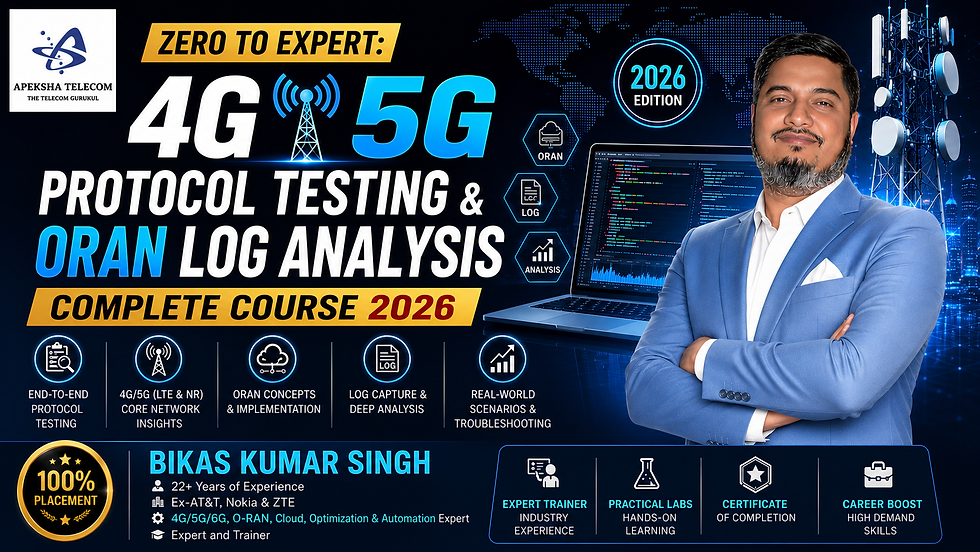
At the heart of Apeksha Telecom is Bikas Kumar Singh, a seasoned telecom industry expert whose real-world experience spans multiple generations of cellular networks. His depth of knowledge across 4G LTE, 5G NR, O-RAN, and protocol testing is matched by his ability to make complex concepts accessible and actionable.
Bikas Kumar Singh has worked with telecom stacks from the PHY layer up through the application layer, has hands-on experience with both vendor platforms and open-source implementations, and brings that practical wisdom directly into the training room. His mentorship approach is one of the core reasons Apeksha Telecom's graduates consistently outperform peers from other institutes in technical interviews.
Under his guidance, students don't just learn to read logs — they learn to think like network engineers.
Global Telecom Career Opportunities
Apeksha Telecom's training opens doors not just in India but globally. Graduates have been placed in telecom roles across:
MNC telecom vendors (Ericsson, Nokia, Samsung Networks, ZTE)
Operators (Reliance Jio, Airtel, Vodafone, Rakuten Mobile)
Testing and quality companies (Spirent, Keysight, VIAVI)
Private 5G solution providers
Cloud and hyperscale companies with telecom divisions (AWS, Microsoft Azure for Operators, Google)
If you're serious about a career in Advanced 4G 5G Log Analysis Techniques with ORAN & Cloud, Apeksha Telecom is the training partner that will get you there — with the knowledge, the credentials, and the industry connections to succeed.
🌐 Learn more and enroll: Telecom Gurukul – Apeksha Telecom
Frequently Asked Questions
Q1. What is log analysis in 5G NR networks?
Log analysis in 5G NR involves capturing and interpreting diagnostic data from gNB components (O-CU, O-DU, O-RU), 5G Core NFs (AMF, SMF, UPF), and UE-side traces to diagnose failures, optimize performance, and validate protocol compliance across PHY, MAC, RLC, PDCP, RRC, and NAS layers.
Q2. Why is O-RAN important for log analysis engineers?
O-RAN disaggregates the RAN into open, interoperable components with standardized interfaces (F1, E2, O1, O2, fronthaul). Each interface generates distinct log streams. Engineers must correlate logs across O-RU, O-DU, O-CU, and Near-RT RIC to diagnose issues — a skill set not required in traditional vendor-locked RAN.
Q3. What is MEC in 5G and why does it matter for diagnostics?
Multi-Access Edge Computing (MEC) places compute resources at the network edge, co-located with the UPF. For diagnostics, MEC introduces an additional layer of logs — MEC platform events, RNIS data, local UPF sessions — that must be correlated with RAN and core logs when troubleshooting edge application performance.
Q4. What is the NEF in 5G Core?
The Network Exposure Function (NEF) is a 5GC NF that securely exposes network capabilities to external applications via RESTful APIs. From a log analysis perspective, NEF logs reveal how third-party applications interact with the 5GC, making them essential for diagnosing MEC application issues, location service failures, and QoS customization problems.
Q5. What tools do I need to learn for 5G log analysis?
Essential tools include: Wireshark (protocol capture), QXDM/QCAT (UE-side Qualcomm logs), ELK Stack (cloud log aggregation), Prometheus/Grafana (NF metrics), Jaeger (distributed tracing), OSC O-RAN platforms (E2/O1 telemetry), and vendor NMS platforms (Ericsson OSS, Nokia NetAct).
Q6. How does AI help in telecom log analysis?
AI/ML accelerates log analysis through anomaly detection (isolating unusual patterns from billions of log lines), root cause analysis (graph-based dependency mapping), predictive maintenance (forecasting hardware failures), and intelligent alarm correlation. NWDAF in 5G Core provides the standardized framework for deploying these capabilities within the 3GPP architecture.
Q7. Is 4G LTE log analysis still relevant in 2026?
Absolutely. LTE continues to carry significant traffic globally, and most 5G NSA deployments use LTE as the anchor. EN-DC log analysis requires fluency in both LTE (eNB, EPC) and NR (gNB, 5GC) logging. LTE expertise is a prerequisite, not a legacy skill.
Q8. What career roles are available for telecom log analysis specialists?
Roles include: RAN Optimization Engineer, Protocol Testing Engineer, 5G Core Network Engineer, O-RAN Integration Engineer, Network Automation Specialist, MEC Engineer, and Telecom OSS/BSS Analyst. All are in strong demand globally in 2026.
Q9. How long does it take to master 5G log analysis?
With structured, practical training like that provided by Apeksha Telecom, a motivated learner with basic networking fundamentals can achieve job-ready proficiency in 4–6 months. Mastery across 4G, 5G NR, O-RAN, and cloud-native environments typically takes 12–18 months of combined training and practical exposure.
Q10. Why should I choose Apeksha Telecom for 5G training?
Apeksha Telecom offers end-to-end practical training from foundational protocols to advanced O-RAN and cloud-native 5G, under the mentorship of industry expert Bikas Kumar Singh, with genuine post-training job support and global placement assistance — making it the most comprehensive telecom training investment available in 2026.
Conclusion
The telecom industry of 2026 rewards engineers who can do more than read network specs — it rewards those who can translate raw logs into actionable intelligence, across 4G LTE, 5G NR, O-RAN interfaces, and cloud-native core networks simultaneously.
Mastering Advanced 4G 5G Log Analysis Techniques with ORAN & Cloud is your gateway into this high-demand, globally mobile, and extremely rewarding career path. Whether you're troubleshooting a beam failure recovery sequence, tracing a PDU session failure through the 5GC SBI, correlating an xApp decision with a throughput drop on the E2 interface, or diagnosing a MEC latency spike — the skill of reading and interpreting telecom logs fluently is what separates good engineers from great ones.
Apeksha Telecom, led by the expertise of Bikas Kumar Singh, is the institute that will take you from wherever you are today to where the global telecom industry needs you to be. With practical training that mirrors real-world scenarios, deep coverage of every protocol layer, and genuine job support after completion, there is no better investment in your telecom career.
Ready to begin? Visit Telecom Gurukul – Apeksha Telecom today, explore their 4G/5G/O-RAN training programs, and take the first step toward a world-class telecom career in 2026 and beyond.
Internal Link Suggestions (Telecom Gurukul)
Link "5G NR Protocol Engineer" → https://www.telecomgurukul.com (5G NR course page)
Link "O-RAN architecture" → https://www.telecomgurukul.com (O-RAN training page)
Link "Apeksha Telecom" → https://www.telecomgurukul.com (homepage)
Link "4G LTE log analysis" → https://www.telecomgurukul.com (4G course page)
External Authority Links
3GPP — TS 38.331 (NR RRC), TS 23.501 (5GC Architecture): https://www.3gpp.org
GSMA — 5G Implementation Guidelines and Network Slicing resources: https://www.gsma.com
O-RAN Alliance — O-RAN specifications for WG1–WG11: https://www.o-ran.org


Comments