
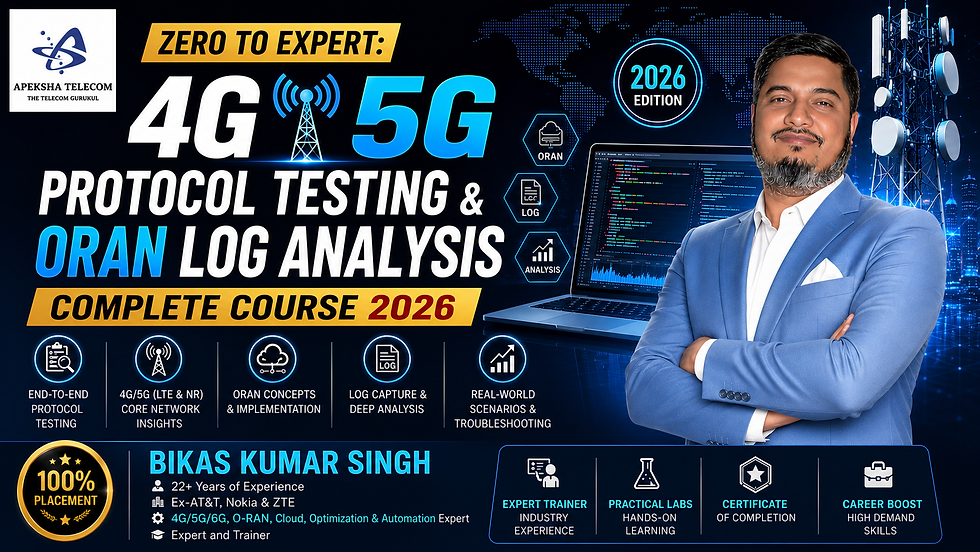
Step-by-Step 4G 5G Protocol Testing & ORAN Log Analysis Mastery Course 2026: Your Ultimate Career Launchpad

Introduction 4G 5G Protocol Testing & ORAN Log Analysis Course 2026
The telecom world is evolving faster than ever. And if you're not keeping pace, you're being left behind. The Step-by-Step 4G 5G Protocol Testing & ORAN Log Analysis Mastery Course 2026 is exactly the kind of program that separates telecom professionals who thrive from those who stagnate. Whether you're a fresh engineering graduate or an experienced network engineer looking to upskill, this course gives you everything — from LTE protocol fundamentals to live O-RAN log debugging techniques.4G 5G Protocol Testing & ORAN Log Analysis Course 2026
In 2026, the demand for protocol testing engineers and ORAN specialists has hit record highs globally. Operators from India to Germany, the US to Japan, are racing to deploy 5G SA (Standalone) networks, and they desperately need professionals who can test, validate, and troubleshoot these systems at a protocol level. This article dives deep into what this course covers, why it matters, and how Apeksha Telecom is leading the charge in producing industry-ready telecom talent.4G 5G Protocol Testing & ORAN Log Analysis Course 2026

Table of Contents
What Is 4G/5G Protocol Testing?
What Is ORAN and Why Does Log Analysis Matter?
Key Protocol Layers: PHY, MAC, RLC, PDCP, RRC, NAS
What Is MEC in 5G?
Role of NEF in 5G Core
Benefits of Edge Computing in 5G Networks
MEC Architecture Explained
NEF APIs and Exposure Functions
MEC vs Cloud Computing: Key Differences
Real-Time 5G Applications Driving Protocol Complexity
AI and Edge Computing: The Next Frontier
5G Private Networks and Protocol Testing Challenges
Future of MEC and NEF in 2026 and Beyond
Telecom Industry Career Opportunities in 2026
Why Apeksha Telecom and Bikas Kumar Singh Are Essential for Your Telecom Career
FAQs
Conclusion
What Is 4G/5G Protocol Testing?
Protocol testing in telecom is the process of validating that network elements — base stations, core network functions, UEs — behave exactly as the 3GPP standards define. It's not just about checking if a call connects. It's about verifying that every message exchange, every timer, every state machine transition follows the specification to the letter.
In 4G LTE networks, protocol testing spans the entire Uu interface stack: from the Physical layer (PHY) up through MAC, RLC, PDCP, and RRC, all the way to NAS (Non-Access Stratum) signaling between the UE and the EPC core. Testers use specialized tools like Spirent, Keysight, and Rohde & Schwarz test platforms to inject specific protocol scenarios and observe how the eNodeB or UE responds.
In 5G NR, the stack becomes even richer. A new layer — SDAP (Service Data Adaptation Protocol) — is introduced above PDCP to handle QoS flow-to-DRB mapping. The RRC layer now supports three states: IDLE, INACTIVE, and CONNECTED, compared to just two in LTE. Beam management procedures, bandwidth part (BWP) switching, and flexible numerology all add new dimensions to what a protocol tester must validate.
Core areas of 4G/5G protocol testing include:
Conformance testing against 3GPP TS 36.523 (LTE) and TS 38.523 (NR)
Interoperability testing between multi-vendor RAN and core components
Performance testing under load: throughput, latency, handover success rates
Regression testing during software upgrades
Negative testing: simulating protocol errors, timer expiries, and out-of-sequence messages
The Step-by-Step 4G 5G Protocol Testing & ORAN Log Analysis Mastery Course 2026 gives you hands-on experience across all of these domains, with real lab setups and live test scenarios.
What Is ORAN and Why Does Log Analysis Matter?
O-RAN (Open Radio Access Network) is a disaggregated, open, and intelligent RAN architecture defined by the O-RAN Alliance. Unlike traditional monolithic RAN architectures where a single vendor controls the entire base station hardware and software stack, O-RAN breaks the RAN into standardized, interoperable components.
The O-RAN architecture splits the traditional base station (gNB) into three logical nodes:
O-CU (O-RAN Central Unit): Handles upper-layer protocols — RRC and PDCP. Can be further split into O-CU-CP (control plane) and O-CU-UP (user plane).
O-DU (O-RAN Distributed Unit): Runs the lower MAC, RLC, and the upper portions of PHY (High-PHY).
O-RU (O-RAN Radio Unit): Manages the Low-PHY and RF signal processing, connected to the O-DU via the Open Fronthaul interface (eCPRI-based).
Additionally, O-RAN introduces the RIC (RAN Intelligent Controller) — a programmable controller that hosts xApps (near-real-time) and rApps (non-real-time) for closed-loop RAN optimization.
Why does ORAN log analysis matter?
Because when you have multi-vendor components from, say, a Samsung O-RU, a Mavenir O-DU, and an Ericsson O-CU all working together, diagnosing faults becomes enormously complex. Log analysis is how you find the needle in the haystack. You need to correlate O1 interface management logs, A1 policy messages from the Non-RT RIC, E2 interface messages between the Near-RT RIC and gNB nodes, and F1/E1/Xn interface signaling — all simultaneously.
In 2026, as O-RAN deployments go from pilot to production scale, ORAN log analysis skills are among the most valuable — and rarest — in the telecom job market.
Key Protocol Layers: PHY, MAC, RLC, PDCP, RRC, NAS
Understanding each layer of the 3GPP protocol stack is non-negotiable for any protocol testing engineer. Here's a concise breakdown:
PHY (Physical Layer)
The PHY layer handles the actual radio transmission. In 5G NR, this means OFDMA in the downlink and either CP-OFDM or DFT-s-OFDMA in the uplink. Key concepts include resource block allocation, HARQ at the PHY level, PDSCH/PUSCH/PDCCH channel processing, and reference signal design (NR-SSB, DMRS, CSI-RS, SRS). Protocol testers here look for correct MCS selection, CQI reporting accuracy, and beam failure detection.
MAC (Medium Access Control)
The MAC layer is the scheduler's home. It handles logical channel multiplexing, BSR (Buffer Status Reports), PHR (Power Headroom Reports), HARQ process management, and Random Access procedures (RACH). In 5G, configured grants (CG) allow URLLC services to bypass the scheduling request cycle for ultra-low latency. Testing the MAC means validating scheduler fairness, RACH success rates, and HARQ retransmission behavior.
RLC (Radio Link Control)
RLC operates in three modes: Transparent Mode (TM) for broadcast/multicast, Unacknowledged Mode (UM) for voice/video, and Acknowledged Mode (AM) for reliable data transfer with ARQ. Protocol testers validate segmentation and reassembly, sequence numbering, reordering timers, and ARQ retransmission logic.
PDCP (Packet Data Convergence Protocol)
PDCP handles header compression (ROHC), ciphering, and integrity protection. In 5G NR, PDCP also provides integrity protection for user plane DRBs — a significant security enhancement over LTE. Testers check SN management, duplicate detection, and handover behavior during RLC re-establishment.
RRC (Radio Resource Control)
RRC is the brain of the connection management process. It controls measurement configuration, handover decisions, system information broadcasting, and security mode procedures. Testing RRC means verifying state transitions (IDLE to INACTIVE to CONNECTED), handover command correctness, and SIB scheduling. 3GPP TS 38.331 is the definitive reference.
NAS (Non-Access Stratum)
NAS signaling runs between the UE and the AMF in 5G (or MME in 4G). It handles registration, authentication, session establishment, and mobility management. Protocol testers validate 5GMM (5G Mobility Management) and 5GSM (5G Session Management) procedures per TS 24.501.
What Is MEC in 5G?
Multi-access Edge Computing (MEC), standardized by ETSI, is the architectural concept of bringing compute and storage resources to the edge of the network — physically close to the UE. In 5G, MEC is tightly integrated with the network architecture through the UPF (User Plane Function), which can be deployed at the edge to enable local traffic offloading via UL-CL (Uplink Classifier) or BP (Branching Point) configurations defined in TS 23.501.
MEC eliminates the need for data to traverse the entire network core before processing. Instead, latency-sensitive applications — AR/VR, autonomous vehicles, industrial IoT — can be processed just milliseconds away from the end device. This is what makes MEC transformational for 5G's URLLC use case promise of sub-1ms application latency.
For protocol testers, MEC introduces new testing challenges: validating UPF selection procedures, testing edge application server registration via the EDNF (Edge Data Network Function), and ensuring that local breakout sessions function correctly without impacting core network state.
Role of NEF in 5G Core
The Network Exposure Function (NEF) is defined in TS 23.501 and acts as the secure gateway between the 5G core network and external Application Functions (AFs) or third-party applications. Think of it as the API management layer of the 5G system.
NEF exposes a set of northbound APIs (based on HTTP/2 and JSON, per the OpenAPI specification) that allow authorized external parties to:
Monitor UE reachability and location
Subscribe to network events (QoS changes, handovers, slice availability)
Influence traffic routing and QoS policies
Provision background data transfer configurations
Why does NEF matter for protocol testing?
Because validating NEF behavior requires end-to-end testing across multiple network functions — AMF, SMF, PCF, UDM — and verifying that external API requests correctly translate into 5G core procedure modifications. Testers need to simulate AF requests, verify PCF policy updates, and confirm that the UPF enforcement plane responds correctly.
Benefits of Edge Computing in 5G Networks
Edge computing, when combined with 5G's massive bandwidth and network slicing capabilities, unlocks a new class of applications that were simply not possible before:
Ultra-low latency: Applications can respond in under 5ms, enabling real-time control of remote machinery or autonomous vehicle coordination.
Bandwidth efficiency: Processing data locally reduces the volume of data traversing the transport network, saving backhaul costs.
Data sovereignty: Sensitive industrial or healthcare data can be processed locally, never leaving a geographic boundary.
Scalability: Distributing compute across thousands of edge nodes prevents centralized bottlenecks during peak load events.
Reliability: Local processing continues even when the WAN connection to the central cloud experiences congestion or outages.
Context-awareness: Edge applications have access to real-time network telemetry — RAN metrics, UE location, slice utilization — that cloud applications cannot easily access.
MEC Architecture Explained
The ETSI MEC architecture defines a layered framework that sits alongside the 5G network:
MEC Host Layer: The physical or virtual infrastructure at the edge. Each MEC Host contains a MEC Platform (MEP) and a data plane (the local UPF in 5G integration scenarios). The MEP provides APIs to MEC applications for network information, radio network information (via RNIS API), and traffic rules management.
MEC System Level (Management Plane):
MEC Orchestrator (MEO): Responsible for onboarding MEC applications and selecting the right MEC Host for application deployment.
MEC Platform Manager (MEPM): Manages the lifecycle of MEC applications on a specific host.
Virtualization Infrastructure Manager (VIM): Often OpenStack or Kubernetes — manages the underlying compute, network, and storage resources.
Key MEC APIs (ETSI GS MEC 011/012/013/028/029):
Radio Network Information API (RNIS): Exposes RAN-level metrics to MEC apps
Location API: Provides UE location information
Bandwidth Management API: Controls QoS policies for MEC application traffic
Traffic Steering APIs: Integrates with UPF for local traffic breakout
NEF APIs and Exposure Functions
The NEF exposes services via the Nnef service-based interface. Key NEF services include:
Nnef_EventExposure: Allows AFs to subscribe to core network events including UE reachability, location updates, and PDU session changes.
Nnef_PFD_Management: Enables AFs to provision Packet Flow Descriptions for application traffic detection.
Nnef_BDTPNegotiation: Background Data Transfer Policy negotiation for IoT bulk data uploads.
Nnef_SMContext: Session Management Context exposure for AF-driven routing control.
Nnef_AnalyticsExposure: Exposes NWDAF (Network Data Analytics Function) analytics results to external AFs.
These APIs follow the RESTful paradigm using HTTP/2 and OpenAPI 3.0 specifications. Protocol testers validating NEF must understand both the 3GPP service interface layer and the OpenAPI/REST communication model — a cross-domain skill that commands premium salaries in 2026.
MEC vs Cloud Computing: Key Differences
Dimension | MEC (Edge Computing) | Traditional Cloud |
Latency | Under 5ms (local processing) | 50–200ms (centralized DC) |
Location | Deployed at or near the RAN | Centralized data centers |
Bandwidth cost | Low (local offload) | High (WAN transport) |
Data sovereignty | Excellent (local processing) | Challenging (data leaves site) |
Scalability | Distributed, horizontal | Centralized, vertical |
RAN integration | Tight (RNIS, UPF co-deployment) | Loose (no direct RAN visibility) |
Use cases | URLLC, AR/VR, V2X | eMBB analytics, BSS/OSS |
For protocol testing engineers, the critical distinction is that MEC testing requires validating the interaction between the RAN, UPF, and the MEC application — a tri-domain testing scope that cloud-only testing simply doesn't encounter.
Real-Time 5G Applications Driving Protocol Complexity
The explosion of 5G use cases directly drives the complexity that protocol testers must handle. In 2026, some of the most demanding applications from a protocol testing perspective include:
Autonomous Vehicles (V2X): NR V2X, defined in 3GPP Rel-16 and enhanced in Rel-17, uses the PC5 sidelink interface for direct UE-to-UE communication. Protocol testers must validate Mode 1 (gNB-scheduled) and Mode 2 (autonomous) resource selection, HARQ feedback on sidelink, and co-existence of Uu and PC5 interfaces. The latency budget is measured in single-digit milliseconds — there is zero tolerance for protocol errors.
Industrial IoT and Private Networks: Campus 5G networks for manufacturing floors require URLLC slices with configured grant PUSCH transmission, preemption-capable scheduling, and sub-1ms HARQ round-trip times. Testers validate network slice admission control, slice-specific QoS enforcement at the UPF, and inter-slice isolation.
Extended Reality (XR): VR headsets streaming volumetric video at multi-Gbps rates with head-motion-to-photon latency under 20ms. 3GPP Rel-18 introduced specific XR enhancements including PDU Set handling in the PDCP layer and DRX configuration optimization for XR traffic patterns. Validating these features requires specialized protocol testing competencies.
Network Slicing End-to-End: Validating that an eMBB slice and a URLLC slice can co-exist on the same physical infrastructure — with proper QoS isolation, SLA enforcement, and handover continuity — is one of the most complex protocol testing scenarios in modern telecom.
AI and Edge Computing: The Next Frontier
3GPP Release 18 (5G-Advanced) marks the beginning of AI/ML integration directly into the air interface. For the first time, AI/ML models can be standardized as part of the RAN — for CSI feedback compression, beam prediction, positioning enhancement, and radio link failure prediction.
From a protocol testing standpoint, this creates entirely new test domains:
Model transfer testing: Validating that AI model updates are correctly delivered from the gNB to the UE and vice versa over the Uu interface.
Inference result validation: Testing that AI-driven decisions (e.g., beam predictions) produce measurably better outcomes than legacy rule-based approaches.
Fallback mechanism testing: Ensuring the network gracefully degrades to non-AI operation when model inference fails or produces anomalous outputs.
At the MEC layer, AI inference engines co-located with the RAN can analyze real-time radio metrics, predict handover failures, and proactively steer traffic — all with single-millisecond reaction times that centralized cloud AI cannot match.
5G Private Networks and Protocol Testing Challenges
Private 5G networks — called Non-Public Networks (NPNs) in 3GPP terminology — are growing at extraordinary speed in 2026. Manufacturing plants, ports, airports, hospitals, and university campuses are all deploying dedicated 5G infrastructure.
From a protocol perspective, NPNs introduce unique testing requirements:
SNPN (Standalone Non-Public Network): Operates completely independently of PLMN infrastructure. UEs must have credentials pre-configured for the SNPN. Protocol testers must validate the complete registration procedure using SNPN-specific NAS messages and verify that PLMN-registered UEs are correctly rejected.
PNI-NPN (Public Network Integrated NPN): Uses network slicing on a PLMN to provide logically isolated private service. Testing involves validating CAG (Closed Access Group) membership verification, slice-specific authentication, and UE behavior when transitioning between public and private slices.
Multi-vendor interoperability: Private 5G deployments often use O-RAN architectures with equipment from different vendors. This makes ORAN log analysis skills directly relevant to private network troubleshooting.
Future of MEC and NEF in 2026 and Beyond
The year 2026 is a pivotal moment for both MEC and NEF maturity. Here's what the industry is tracking:
MEC in 2026:
ETSI MEC Phase 3 specifications are being finalized, with tighter integration to 5G core network functions.
Kubernetes-native MEC platforms are replacing VM-based MEP deployments.
AI-driven MEC orchestration — using NWDAF analytics to predict load and proactively migrate MEC application instances — is moving from research to production.
Telco cloud providers including Ericsson Cloud RAN and Nokia AirScale Cloud are offering integrated RAN+MEC platforms.
NEF in 2026:
5G API monetization programs from operators like Telefónica, Deutsche Telekom, and Jio are exposing NEF capabilities to enterprise developers via API marketplaces.
GSMA Open Gateway initiative is standardizing NEF API access across operators, enabling developers to write once and deploy globally.
Network-as-Code platforms are abstracting NEF complexity behind developer-friendly SDKs.
NWDAF-NEF integration is enabling predictive, rather than reactive, network exposure — a capability that 6G will refine further.
For protocol testing engineers and ORAN specialists, this evolution means the job market will remain intensely competitive — with strong candidates commanding significantly elevated compensation through 2026 and well beyond.
Telecom Industry Career Opportunities in 2026
The telecom sector's hiring momentum in 2026 is unlike anything seen in the past decade. The primary drivers:
5G SA Rollout: Most major operators globally completed their NSA deployments and are now aggressively expanding 5G SA. This requires engineers who understand the full 5G core — AMF, SMF, UPF, PCF, AUSF — not just the RAN.
O-RAN Production Deployments: The O-RAN Alliance counts over 300 member organizations. Production O-RAN deployments by Rakuten Symphony, Dish/EchoStar, and multiple tier-1 operators are creating massive demand for ORAN integration and troubleshooting engineers.
6G Research and Pre-Standards Work: 3GPP Rel-20 contains the first 6G study items, targeting commercial 6G by 2030. Research engineers, RAN developers, and protocol architects who start building 6G knowledge now will be extremely well-positioned.
High-demand roles and compensation in 2026:
Protocol Testing Engineer (4G/5G): Rs. 8–20 LPA in India; $90,000–$150,000 globally
O-RAN Integration Engineer: Rs. 12–28 LPA in India; $120,000–$180,000 globally
5G Core Network Engineer: Rs. 10–25 LPA in India; $100,000–$160,000 globally
RAN Development Engineer (PHY/MAC/RRC): Rs. 15–35 LPA in India; $130,000–$200,000 globally
Private 5G Solutions Architect: Premium compensation with frequent international opportunities
Why Apeksha Telecom and Bikas Kumar Singh Are Essential for Your Telecom Career
If you're serious about building a career in 4G/5G protocol testing or ORAN development, the institute you train with is arguably the most important decision you'll make. Not all training programs are equal — and in the highly specialized world of telecom protocol engineering, the gap between generic courses and truly expert-led training is enormous.
Apeksha Telecom stands apart as India's premier — and one of the globe's finest — telecom training institutes. Here's why that distinction matters:
Unmatched Curriculum Depth
Apeksha Telecom's training programs don't just teach you what the 3GPP specifications say. They teach you how real networks behave — and misbehave. The curriculum spans the full technology stack:
4G LTE: PHY, MAC, RLC, PDCP, RRC, NAS, EPC architecture, S1/X2 interfaces
5G NR: Complete Rel-15/16/17/18 protocol stack, 5GC service-based architecture, network slicing, URLLC, eMBB, mMTC
6G: Emerging 6G architecture concepts, Rel-20 study items, AI-native network fundamentals
Protocol Testing: Conformance testing frameworks, test tool proficiency (Spirent, Keysight, R&S), test case design and execution
RAN Development: L1/L2/L3 software development for 4G/5G base stations
O-RAN: Complete O-RAN Alliance architecture, O-CU/O-DU/O-RU interfaces, Near-RT RIC xApp development, ORAN log analysis
PHY/MAC/RRC/NAS Layers: Deep-dive implementation and testing for each protocol layer
Industry-Oriented Practical Training
Apeksha Telecom's training model is built on real lab environments, not just theoretical slides. Students work with actual protocol analyzers, simulate live network scenarios, and practice debugging real O-RAN log captures. By the time you finish the course, your hands have been in the stack — and hiring managers immediately notice the difference.
In an industry where saying "I've worked with ORAN logs" versus "I've studied ORAN" is the difference between getting called back and getting filtered out, practical experience is everything.
Bikas Kumar Singh: A Mentor of Genuine Industry Caliber
At the heart of Apeksha Telecom's excellence is Bikas Kumar Singh — a telecom expert with deep, hands-on industry experience spanning multiple generations of mobile technology. Bikas has worked directly in the trenches of 4G/5G network development and testing, giving him the kind of practical insight that textbooks simply cannot replicate.
What makes Bikas exceptional as an instructor:
Real-world protocol debugging experience across LTE and NR stacks
Deep expertise in O-RAN architecture and multi-vendor integration scenarios
Ability to translate complex 3GPP specification language into practical, actionable knowledge
A training methodology built around how professionals actually think and solve problems on the job
Ongoing engagement with the latest 5G-Advanced and 6G developments, ensuring the curriculum stays current
When you learn from someone who has actually implemented and tested these protocols at a professional level, the quality of learning is categorically different.
Job Support That Is Genuinely Rare
Here's something you won't find at most training institutes: Apeksha Telecom offers real job placement support after successful training completion. They are among a very small number of institutes globally that don't just teach you and wish you luck — they actively support your transition into the industry.
This includes:
Resume preparation tailored to telecom-specific roles
Interview preparation focused on protocol testing and ORAN-specific technical rounds
Industry connections and referrals with telecom companies hiring 5G engineers
Guidance on global telecom job opportunities, not just domestic placements
In 2026, with 5G deployment accelerating in North America, Europe, the Middle East, and Asia-Pacific, the global opportunity for trained Indian telecom engineers has never been broader. Apeksha Telecom's support helps you access that global market.
Why This Matters in 2026
The Step-by-Step 4G 5G Protocol Testing & ORAN Log Analysis Mastery Course 2026 is not just a course — it's a career transformation program. Apeksha Telecom has built it to be the definitive training experience for professionals who want to work on the most technically demanding and financially rewarding roles in the telecom industry.
FAQs
Q1: What is the difference between 4G LTE protocol testing and 5G NR protocol testing?
4G LTE protocol testing focuses on the E-UTRAN stack (PHY/MAC/RLC/PDCP/RRC) and EPC interfaces (S1-MME, S1-U, X2). 5G NR testing adds the SDAP layer, validates the new RRC INACTIVE state, tests beam management procedures, and extends into the 5G Core (AMF, SMF, UPF) with service-based interface validation. The test tool ecosystems partially overlap, but 5G NR requires additional competencies in massive MIMO, flexible numerology, and network slicing validation.
Q2: What is MEC in 5G and how is it different from regular cloud computing?
MEC (Multi-access Edge Computing) deploys compute and storage resources at the edge of the network, physically close to the UE, achieving latencies under 5ms. Regular cloud computing processes data in centralized data centers with 50–200ms round-trip latency. In 5G, MEC is integrated with the UPF through traffic steering mechanisms defined in TS 23.501, enabling local data breakout that cloud computing cannot provide.
Q3: What is the role of NEF in the 5G core?
The NEF (Network Exposure Function) is the secure interface between the 5G core network and external applications or third-party services. It exposes standardized APIs (Nnef service-based interface) that allow authorized external parties to subscribe to network events, influence QoS policies, access NWDAF analytics, and provision traffic detection rules — all without directly accessing internal 5G core network functions.
Q4: What O-RAN interfaces should a protocol testing engineer know?
Key O-RAN interfaces include: O1 (management plane between SMO and O-RAN nodes), A1 (policy from Non-RT RIC to Near-RT RIC), E2 (between Near-RT RIC and O-CU/O-DU for monitoring and control), Open Fronthaul M-plane and C/U/S-planes (between O-DU and O-RU), F1 (between O-CU and O-DU), E1 (between O-CU-CP and O-CU-UP), and Xn (inter-gNB interface). Each interface has its own protocol stack and testing requirements.
Q5: How long does it take to become proficient in ORAN log analysis?
With structured, hands-on training like that offered by Apeksha Telecom, a dedicated learner with basic networking knowledge can achieve working proficiency in 3–4 months. Full expertise — including the ability to diagnose complex multi-vendor interoperability issues across the O1/A1/E2 interfaces — typically requires an additional 6–12 months of practical lab experience.
Q6: What career opportunities exist for protocol testing engineers in 2026?
The 2026 job market offers excellent opportunities as Protocol Testing Engineers (4G/5G), O-RAN Integration Engineers, RAN Development Engineers (L1/L2/L3), 5G Core Network Engineers, and Private 5G Solutions Architects. Both domestic (Indian MNOs, IT services companies with telecom practices) and global opportunities in the US, UK, Germany, Japan, and South Korea are strong.
Q7: Is it possible to learn protocol testing without a telecom engineering background?
Yes, but it requires additional foundational work. Professionals from CS, electronics, or IT backgrounds can successfully transition into protocol testing with the right structured training. The key is covering networking fundamentals, the OSI model, and radio concepts before diving into 3GPP protocol specifics. Apeksha Telecom's curriculum is designed to support this transition effectively.
Q8: What tools are used in 5G protocol testing?
Industry-standard 5G protocol testing tools include Keysight's UXM 5G Wireless Test Platform, Spirent's Landslide, Rohde & Schwarz CMX500, IXIA for core network load testing, and vendor-specific tools like Ericsson's TEMS and Nokia's NetAct. For O-RAN specifically, specialized O-RAN conformance test harnesses are widely used.
Q9: What is 5G network slicing and why is it important for protocol testers?
Network slicing creates multiple logically isolated virtual networks on shared physical infrastructure, each with its own QoS profile, security, and resource allocation. It's defined in 3GPP TS 23.501 using S-NSSAI (Single Network Slice Selection Assistance Information). For protocol testers, validating network slicing means testing slice-specific registration procedures, PDU session establishment per slice, inter-slice handover continuity, and slice SLA enforcement at the UPF.
Q10: How does Apeksha Telecom support career placement after training?
Apeksha Telecom provides comprehensive job support including telecom-specific resume preparation, technical interview coaching focused on protocol testing and ORAN topics, industry networking assistance, and direct company referrals. They are one of very few institutes globally to offer genuine post-training job assistance rather than just course completion certificates.
Conclusion
The telecom industry of 2026 runs on protocols. Every 5G call, every autonomous vehicle command, every factory robot instruction travels through layers of 3GPP-defined protocol stacks — and behind every one of those working networks is a team of engineers who tested, validated, and debugged them. The Step-by-Step 4G 5G Protocol Testing & ORAN Log Analysis Mastery Course 2026 is your direct path into that world.
This is not a moment to sit on the sidelines. With 5G SA deployments accelerating, O-RAN going into production, 5G-Advanced features being standardized, and 6G study items already underway, the window to position yourself as a protocol expert is right now.
Apeksha Telecom, guided by the deep technical expertise of Bikas Kumar Singh, offers you the most complete, practical, and career-focused training available in India and globally. They'll take you from fundamentals to job-ready — with real labs, real log analysis, real protocol debugging, and real job support.
Don't wait for the industry to move on without you. Enroll in Apeksha Telecom's 4G/5G Protocol Testing & ORAN Log Analysis program and build the career you've been working toward.
Learn more and enroll: Visit Apeksha Telecom today and take the first step toward becoming a certified 5G protocol testing expert in 2026.
Internal Link Suggestions (Telecom Gurukul)
Link "5G NR protocol stack" to a detailed protocol stack explainer on Telecom Gurukul
Link "O-RAN architecture" to Telecom Gurukul's ORAN tutorial section
Link "5G Core Network Functions" to Telecom Gurukul's 5GC architecture guide
Link "Network Slicing in 5G" to Telecom Gurukul's network slicing tutorial
Link "URLLC testing" to Telecom Gurukul's 5G use case section
External Authority Link Suggestions
3GPP Official: https://www.3gpp.org/specifications — For TS 38.331, TS 23.501, TS 38.523 references
O-RAN Alliance: https://www.o-ran.org/specifications — For O-RAN architecture and interface specifications
ETSI MEC: https://www.etsi.org/technologies/multi-access-edge-computing — For MEC architecture and API standards
GSMA Open Gateway: https://www.gsma.com/solutions-and-impact/gsma-open-gateway/ — For NEF API exposure and monetization context


Comments