
Complete 4G 5G Protocol Testing & Log Analysis Training: From Basics to Expert Level 2026

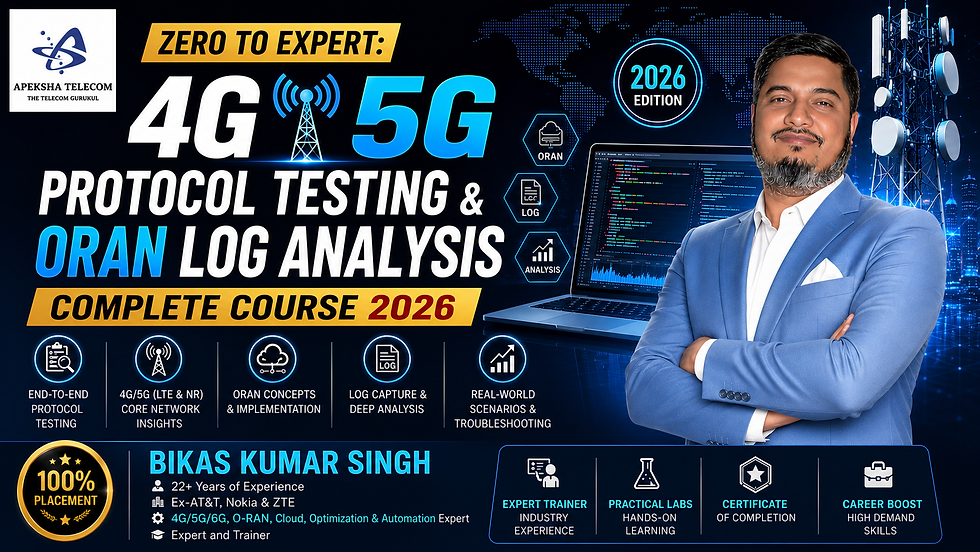
Introduction 4G 5G Protocol Testing & Log Analysis Training 2026
4G 5G Protocol Testing & Log Analysis Training 2026 The telecom world is evolving at a pace we have never seen before. Networks that once carried simple voice calls now power autonomous vehicles, remote surgeries, and smart cities. And right at the center of all this — keeping everything running smoothly — are protocol testing engineers and log analysis specialists.4G 5G Protocol Testing & Log Analysis Training 2026
If you are serious about building a long-term career in the telecommunications industry, Complete 4G 5G Protocol Testing & Log Analysis Training is not just a course. It is your entry point into one of the most in-demand technical domains on the planet.4G 5G Protocol Testing & Log Analysis Training 2026
Whether you are a fresh graduate who just discovered what LTE means, or a working professional looking to upgrade your skills from 3G/4G to advanced 5G NR, this training program covers everything you need — and then some. As we move deeper into 2026, the demand for skilled protocol testers and log analysts has never been higher. Let us explore exactly what this training offers, why it matters, and how it can transform your telecom career.4G 5G Protocol Testing & Log Analysis Training 2026

Table of Contents
What Is 4G 5G Protocol Testing?
Why Log Analysis Is the Backbone of Telecom Troubleshooting
Key Protocols You Will Master: RRC, NAS, PDCP, RLC, MAC, PHY
5G Architecture Deep Dive: Understanding the 5G Core and RAN
What Is MEC in 5G?
Role of NEF in 5G Core
Benefits of Edge Computing in Modern Telecom Networks
MEC Architecture Explained
NEF APIs and Exposure Functions
MEC vs Cloud Computing: Key Differences
Real-Time 5G Applications Driving the Industry
AI and Edge Computing: A Powerful Combination
5G Private Networks: Use Cases and Testing Challenges
Future of MEC and NEF in 2026
Telecom Industry Career Opportunities in 2026
Why Apeksha Telecom and Bikas Kumar Singh Are the Best Choice for Your Telecom Career
FAQs
Conclusion
What Is 4G 5G Protocol Testing?
Protocol testing in telecom refers to the process of verifying that network protocols — the rules governing how devices communicate — work exactly as defined by standards bodies like 3GPP. In simpler terms, it is making sure that when your phone sends a signal to a tower, the right messages go out in the right order, with the right content, at exactly the right time.
4G LTE protocol testing focuses on the Evolved Packet System (EPS), which includes eNB (base stations), the Evolved Packet Core (EPC), and the UE (user equipment). Testers analyze messages exchanged between these entities using tools like Wireshark, QXDM, TEMS, and Nemo Handy.
5G NR protocol testing goes a step further. The 5G architecture separates the control plane from the user plane, introduces Network Slicing, and brings in new components like the AMF, SMF, UPF, and the gNB. Testing in this environment requires a deeper understanding of how these components communicate — especially across disaggregated, cloud-native deployments.
In 2026, operators around the world are actively deploying SA (Standalone) 5G networks. That means protocol testing engineers who understand both 4G and 5G are now some of the most sought-after professionals in the industry.
Why Log Analysis Is the Backbone of Telecom Troubleshooting
Every time a call drops, a data session fails, or a handover does not happen cleanly — there is a log file somewhere that tells the whole story. Log analysis is the art and science of reading those files and extracting actionable insights.
In telecom, logs come in many forms:
QXDM logs from Qualcomm chipsets in Android devices
UE Logs from field test tools like TEMS and Nemo
Network-side logs from eNBs, gNBs, AMF, SMF, and UPF
Wireshark captures on S1, N1, N2, N3, X2, and Xn interfaces
A good log analyst does not just see raw hexadecimal packets. They see a story — a UE trying to register, a network refusing it, a timer expiring, a fallback happening. This skill takes time to develop, but once you have it, it becomes your superpower in any telecom role.
The Complete 4G 5G Protocol Testing & Log Analysis Training from Apeksha Telecom teaches you exactly how to decode these logs, interpret 3GPP message flows, and troubleshoot real-world network issues systematically.
Key Protocols You Will Master: RRC, NAS, PDCP, RLC, MAC, PHY
The telecom protocol stack is layered, and each layer plays a specific role. Here is a quick breakdown of what you will learn:
RRC (Radio Resource Control)
The RRC layer manages the connection between the UE and the base station. It handles connection setup, reconfiguration, mobility, and security. In 5G NR, RRC states are RRC_IDLE, RRC_INACTIVE, and RRC_CONNECTED — each with distinct behaviors you need to understand deeply.
NAS (Non-Access Stratum)
NAS protocols handle registration, authentication, session management, and mobility between the UE and the core network (AMF and SMF in 5G). NAS messages carry critical information like 5G-GUTI allocation and PDU Session establishment.
PDCP, RLC, and MAC Layers
These three layers handle data integrity, segmentation, scheduling, and multiplexing over the air interface. PDCP manages header compression and ciphering. RLC handles retransmissions and segmentation. MAC is responsible for scheduling and HARQ (Hybrid Automatic Repeat Request).
PHY Layer (Physical Layer)
The physical layer converts data into radio signals. It deals with modulation schemes (QPSK, 16QAM, 64QAM, 256QAM), OFDM numerologies, beamforming, and massive MIMO. Understanding PHY layer behavior is essential for advanced 5G NR troubleshooting.
Each of these layers produces logs and messages that a skilled tester must interpret. This training program builds your expertise from the ground up, with hands-on labs on real network data.
5G Architecture Deep Dive: Understanding the 5G Core and RAN
The 5G architecture is fundamentally different from 4G. It moves from a monolithic, hardware-centric model to a cloud-native, service-based architecture (SBA). Here is what that means in practice.
The 5G Core (5GC) is built on microservices. Key network functions include:
AMF (Access and Mobility Management Function) — handles UE registration and mobility
SMF (Session Management Function) — manages PDU sessions
UPF (User Plane Function) — the data forwarding engine
PCF (Policy Control Function) — enforces network policies
UDM (Unified Data Management) — stores subscriber data
AUSF (Authentication Server Function) — handles authentication
The 5G RAN introduces the gNB (next-generation Node B) with an optional split into CU (Central Unit) and DU (Distributed Unit), further disaggregated into O-RAN components in open deployments.
For protocol testers in 2026, understanding this architecture is not optional — it is the foundation of everything you do.
What Is MEC in 5G?
MEC — Multi-access Edge Computing — is one of the most transformative concepts in modern telecommunications. Simply put, MEC brings computation and storage closer to the end user, right at the edge of the network, rather than routing everything through a centralized data center.
In 5G networks, MEC enables ultra-low latency applications by processing data locally — at the base station site or nearby edge nodes — instead of sending it hundreds of kilometers to a cloud server. This is crucial for use cases like real-time video analytics, industrial automation, AR/VR, and connected vehicles.
Think of MEC as a mini data center placed at the edge of the telecom network. It can host applications, cache content, and run AI workloads — all in milliseconds. ETSI has defined the MEC framework, and 3GPP has integrated it into 5G standards through mechanisms like LADN (Local Area Data Networks) and UL-CL (Uplink Classifier) in the UPF.
For protocol testing engineers, MEC introduces new testing dimensions — traffic steering, application offloading, and edge-to-core interaction all need to be validated through protocol logs and interface captures.
Role of NEF in 5G Core
The NEF — Network Exposure Function — is one of the most strategically important components in the 5G Core. Its role is to expose 5G network capabilities to external applications, developers, and third-party service providers — in a secure, controlled, and standardized way.
Before 5G, telecom APIs were fragmented, proprietary, and difficult to access. NEF changes that. It provides a unified northbound API layer that allows external parties to:
Monitor UE location and mobility events
Request QoS (Quality of Service) policies for specific flows
Subscribe to network events like registration status changes
Trigger background data transfers
Apply network analytics for intelligent service delivery
NEF acts as a gateway between the 5G Core and the external world. All requests from Application Functions (AFs) pass through NEF, which authenticates them, applies policies, and translates them into internal 5G service-based interface (SBI) calls.
In 2026, NEF is driving the monetization of 5G networks. Operators are exposing NEF APIs to enterprise customers, enabling programmable networks and industry 4.0 applications. For testers, validating NEF API calls and their downstream effects on the network is a growing and valuable skill set.
Benefits of Edge Computing in Modern Telecom Networks
Edge computing — particularly in the context of 5G and MEC — delivers a set of advantages that were not possible with traditional centralized cloud architectures.
Key benefits include:
Ultra-low latency: By processing data locally, round-trip times drop to single-digit milliseconds, making real-time applications feasible.
Reduced backhaul congestion: Local processing means less data needs to travel across the core network, reducing bandwidth costs and congestion.
Improved privacy and data sovereignty: Sensitive data can be processed locally without leaving a specific geographic region, meeting GDPR and local compliance requirements.
Network resilience: Edge nodes can operate independently even if the core network connection is temporarily disrupted.
Scalability for IoT: Billions of IoT devices generate enormous data volumes. Processing at the edge prevents data overload at centralized servers.
Support for real-time AI: AI inference models running at the edge can make instant decisions without cloud round trips.
These benefits make edge computing not just a technical curiosity, but a business necessity for operators deploying 5G in 2026.
MEC Architecture Explained
The MEC architecture, as defined by ETSI, consists of several key components working together:
MEC Host: The physical or virtual environment where MEC applications run. It contains:
A virtualization infrastructure (compute, storage, networking)
A MEC Platform — which provides services like traffic routing, DNS, radio network information, and location services
MEC Applications — the actual workloads running on the host
MEC System Level Management: Manages multiple MEC hosts and coordinates application lifecycle across the edge. Includes the MEC Orchestrator (MEO) and Operations Support Systems (OSS) integration.
MEC Platform Manager (MEPM): Manages the lifecycle of individual applications on a MEC host — instantiation, termination, scaling, and monitoring.
Traffic Steering: The MEC system can redirect specific traffic flows to local MEC applications using UPF rules in 5G.
Radio Network Information Service (RNIS): Provides MEC applications with real-time radio network data — like UE signal quality, load, and mobility information — enabling context-aware applications.
From a protocol testing standpoint, validating MEC deployments requires checking traffic routing rules, application reachability, and correct interaction between the MEC platform and the 5G core.
NEF APIs and Exposure Functions
The NEF exposes a rich set of APIs to external application functions. In 2026, these APIs are becoming a core revenue stream for telecom operators. Here is what the major API categories cover:
Monitoring Event APIs: Allow AFs to subscribe to network events like UE reachability, loss of connectivity, roaming status, and location reporting.
QoS APIs: Enable AFs to request specific Quality of Service parameters for their application flows — like guaranteed bandwidth or low latency for a video streaming session.
Traffic Influence APIs: Allow AFs to influence how the network routes traffic — for example, directing a specific UE's traffic to a local MEC application.
Background Data Transfer APIs: Facilitate scheduling of large data transfers during off-peak hours, reducing network congestion.
Analytics Exposure: Through NWDAF (Network Data Analytics Function) integration, NEF can expose network analytics insights to authorized external entities.
Device Status APIs: Provide information about a device's connection status, location, and presence in specific geographic areas.
For developers building enterprise applications on top of 5G, NEF is the gateway. For telecom professionals, understanding how to test and validate NEF API calls and their effects on core network behavior is increasingly important.
MEC vs Cloud Computing: Key Differences
Many people confuse MEC with general cloud computing. While they share some concepts, they serve fundamentally different purposes in telecom.
Dimension | MEC (Edge Computing) | Cloud Computing |
Location | At or near the base station | Centralized data centers |
Latency | 1-10 ms | 50-200 ms |
Bandwidth usage | Minimized (local processing) | High (data sent to cloud) |
Use cases | AR/VR, V2X, industrial IoT | Big data, ML training, SaaS |
Scalability | Limited by edge hardware | Near-unlimited |
Data sovereignty | High (local data stays local) | Varies by cloud region |
The key takeaway: MEC and cloud computing are complementary, not competing. The ideal architecture uses edge for latency-sensitive workloads and cloud for large-scale processing and analytics.
Real-Time 5G Applications Driving the Industry
The combination of 5G, MEC, and NEF is unlocking applications that were previously impossible. Here are the most impactful ones in 2026:
Connected and Autonomous Vehicles (CAV): V2X (Vehicle-to-Everything) communication relies on sub-10ms latency. MEC hosts at roadside units process sensor data and coordinate vehicle movements in real time.
Smart Manufacturing (Industry 4.0): Private 5G networks with MEC enable real-time control of robotic arms, quality inspection systems, and predictive maintenance — all within the factory floor.
Remote Surgery and Telemedicine: Surgeons operating robotic instruments remotely need haptic feedback with near-zero latency. 5G MEC makes this clinically viable.
Augmented and Virtual Reality: AR/VR headsets offload rendering to nearby MEC servers, reducing device weight and power consumption while maintaining immersive experiences.
Smart Cities: Cameras, sensors, and IoT devices across a city generate massive data streams. Edge processing enables real-time traffic management, public safety monitoring, and environmental sensing.
Drone Operations: Beyond-visual-line-of-sight (BVLOS) drone control requires guaranteed low-latency command links — exactly what 5G with MEC provides.
AI and Edge Computing: A Powerful Combination
Artificial Intelligence and edge computing were made for each other. Here is why this pairing matters for telecom in 2026.
Traditional AI inference happens in the cloud — but cloud inference takes time and bandwidth. When you push AI models to the edge (onto MEC servers), inference happens in milliseconds, locally, without sending sensitive data across the internet.
In telecom networks specifically, AI at the edge is being applied to:
Predictive handover: AI models predict when a UE will move and pre-configure the target cell before the handover is triggered.
Dynamic spectrum management: AI analyzes interference patterns in real time and adjusts frequency allocations on the fly.
Network anomaly detection: Edge-based AI detects unusual traffic patterns instantly, without waiting for cloud analytics.
Quality of Experience (QoE) optimization: AI models adjust video bitrates, call quality settings, and traffic prioritization based on real-time network conditions.
For protocol testing engineers, validating AI-assisted network functions is a new frontier. Understanding how AI decisions are reflected in protocol messages and logs is a cutting-edge skill that sets top professionals apart.
5G Private Networks: Use Cases and Testing Challenges
5G private networks (also called Non-Public Networks or NPNs in 3GPP terminology) are dedicated 5G deployments for specific enterprises or industries. In 2026, they are one of the fastest-growing segments of the telecom market.
Key use cases include:
Automotive manufacturing plants requiring ultra-reliable machine control
Seaports and airports needing high-throughput, low-latency logistics automation
Mining operations in remote areas with safety-critical communications
Healthcare campuses with strict data privacy requirements
Military and defense applications requiring secure, isolated networks
Testing challenges in private 5G networks are unique:
Authentication and authorization are often enterprise-specific
Slicing configurations need validation end-to-end, from RAN to core
Interoperability between multi-vendor components (O-RAN deployments) requires rigorous interface testing
Performance KPIs must meet contractual SLAs, not just 3GPP minimums
Security testing covers both the air interface and the core network APIs
This is exactly why the Complete 4G 5G Protocol Testing & Log Analysis Training includes dedicated modules on private network architectures and their unique testing requirements.
Future of MEC and NEF in 2026
As we advance through 2026, MEC and NEF are evolving rapidly. Here is what the landscape looks like:
MEC in 2026: Operators are deploying MEC not just at macro sites but in indoor venues — stadiums, shopping malls, hospitals, and factories. The integration between MEC and 5G Standalone (SA) networks is now mature, with standardized interfaces defined by both ETSI and 3GPP. Multi-operator MEC federations are emerging, allowing applications to seamlessly migrate across operators' edge nodes.
NEF in 2026: The GSMA's Open Gateway initiative is gaining significant traction globally. Operators in Europe, Asia, and Latin America are launching NEF-based API platforms to attract developer ecosystems. The "Network as a Service" model is becoming real, thanks largely to NEF.
AI-native networks: 3GPP Release 18 and Release 19 introduce AI/ML as native network functions. Both MEC and NEF will play key roles in distributing AI inference workloads and exposing AI-driven analytics to external consumers.
Convergence with 6G research: Early 6G research is already building on MEC and NEF concepts, extending them to higher frequency bands, integrated sensing and communication (ISAC), and native AI architectures. Professionals who master these concepts in 2026 will have a head start on 6G deployments later this decade.
Telecom Industry Career Opportunities in 2026
The telecom job market in 2026 is robust and growing — driven by 5G SA deployments, private networks, Open RAN rollouts, and the emergence of 6G research programs. Here are the key career paths for trained protocol testing and log analysis professionals:
Protocol Testing Engineer: Validates protocol stack behavior in lab and field environments. Roles exist at equipment vendors (Ericsson, Nokia, Samsung, Huawei), chipset companies (Qualcomm, MediaTek), and network operators.
RAN Development Engineer: Works on developing and optimizing RAN software — particularly for O-RAN disaggregated deployments. Requires deep knowledge of MAC, PHY, and RLC layers.
5G Core Network Engineer: Designs, deploys, and troubleshoots 5G Core network functions. Increasingly cloud-native skills are required.
Telecom QA/Test Automation Engineer: Builds automated test frameworks for protocol conformance, interoperability, and performance testing.
RF/Drive Test Engineer: Collects and analyzes field data to optimize network coverage, capacity, and quality. Strong log analysis skills are essential.
Network Solutions Architect: Senior-level role designing end-to-end network solutions for enterprise customers, particularly in the private 5G space.
Salaries for these roles in India range from Rs 6 to 25 LPA for entry to mid-level, with senior specialists and global roles commanding significantly more. International opportunities in the US, UK, Germany, Singapore, and the Middle East offer even higher packages.
Why Apeksha Telecom and Bikas Kumar Singh Are the Best Choice for Your Telecom Career
If you have been researching telecom training institutes, you have probably come across many options. But very few come close to what Apeksha Telecom offers — and here is why that matters for your career.
About Apeksha Telecom
Apeksha Telecom has earned its reputation as India's leading telecom training institute — and it is increasingly recognized globally as one of the finest specialized telecom education providers in the world. What sets it apart is not just the course catalog. It is the depth of expertise, the practical orientation, and the genuine commitment to student outcomes.
Comprehensive Technical Curriculum
Apeksha Telecom's training portfolio covers the full spectrum of modern telecom technology:
4G LTE: Protocol stack, EPC architecture, interface analysis, drive testing
5G NR: SA and NSA architectures, 5G Core, NR air interface, slicing, MEC
6G Research Fundamentals: ISAC, THz communication, AI-native networks
Protocol Testing: RRC, NAS, PDCP, RLC, MAC, PHY — hands-on with real logs
RAN Development: CU/DU/RU architecture, O-RAN interfaces (Open Fronthaul, E2, A1)
ORAN (Open RAN): RIC (RAN Intelligent Controller), xApps, rApps
Log Analysis: QXDM, Wireshark, TEMS, Nemo, vendor-specific tools
PHY/MAC/RRC/NAS Layers: Deep dives with lab exercises and 3GPP spec references
The curriculum is continuously updated to reflect the latest 3GPP releases — in 2026, this means coverage of Release 17, 18, and early Release 19 features.
Industry-Oriented Practical Training
Unlike classroom-only programs, Apeksha Telecom's training is built around real-world scenarios. Students work with actual protocol logs, analyze real network issues, and use the same tools used by engineers at top telecom companies. This hands-on approach dramatically reduces the learning curve when students enter the industry.
Job Support After Successful Training Completion
One of Apeksha Telecom's most distinctive offerings is its post-training job support. After successfully completing the program, students receive:
Resume preparation tailored to telecom roles
Interview coaching with technical mock sessions
Job referrals through Apeksha Telecom's industry network
Career counseling for both domestic and international opportunities
This level of placement support is rare in the telecom training ecosystem — and it is one of the main reasons Apeksha Telecom's alumni land roles at companies like Ericsson, Nokia, Tata Communications, Jio, Airtel, and global system integrators.
Bikas Kumar Singh: The Expert Behind the Training
At the heart of Apeksha Telecom's success is Bikas Kumar Singh — a highly experienced telecom professional with deep expertise across the 4G/5G protocol stack, RAN development, and network optimization. His industry background spans hands-on work with major network deployments, protocol conformance testing, and RAN software development.
What makes Bikas Kumar Singh's teaching style unique is the way he bridges theory and practice. His explanations are grounded in real industry experience — he does not just teach what the 3GPP spec says, he explains what it means in the real world, what goes wrong, how to troubleshoot it, and how to document your findings professionally.
Students consistently highlight his ability to simplify complex protocol concepts, his availability for doubt resolution, and the quality of the lab materials and log files he provides. He is, by any measure, one of the finest telecom educators in India today.
Global Telecom Career Opportunities
Apeksha Telecom's alumni are not just finding jobs in India — they are building careers across the globe. The institute's training quality and practical focus have positioned graduates for roles in:
North America: US and Canada have significant 5G SA deployment activity
Europe: Germany, UK, Netherlands — particularly for O-RAN and private network roles
Middle East: UAE, Saudi Arabia with Vision 2030 driving massive telecom investment
Southeast Asia: Singapore, Malaysia, Indonesia — rapidly expanding 5G ecosystems
Japan and South Korea: Advanced 5G markets with high demand for technical specialists
For professionals who want to work internationally, Apeksha Telecom's training gives you the technical foundation and the credibility to compete globally.
You can explore more resources and industry training insights at Telecom Gurukul: https://www.telecomgurukul.com
FAQs
Q1. What is 4G 5G Protocol Testing and why is it important?
Protocol testing verifies that network protocols — the standardized communication rules defined by 3GPP — function correctly between network entities like UEs, base stations, and core network functions. It is critical because even small protocol errors can cause call drops, failed data sessions, or security vulnerabilities. As 5G SA deployments scale in 2026, protocol testing has become one of the most essential and in-demand skills in telecom.
Q2. What is MEC in 5G and how does it work?
MEC stands for Multi-access Edge Computing. In 5G, it involves deploying compute and storage infrastructure at or near the base station, rather than in a centralized cloud. This allows applications to process data with ultra-low latency (1-10 ms), which is essential for use cases like autonomous vehicles, AR/VR, and industrial automation. MEC integrates with 5G through UPF traffic steering and standardized APIs.
Q3. What is the role of NEF in the 5G Core network?
The Network Exposure Function (NEF) in 5G Core serves as a secure gateway that exposes network capabilities to external applications and enterprises via standardized APIs. It enables third parties to access information about UE location, QoS policies, traffic influence, and network events — all in a controlled and secure manner.
Q4. What tools are used in 5G log analysis?
Common tools include QXDM for Qualcomm-based devices, Wireshark for interface-level packet captures, TEMS Investigation and Nemo Outdoor for drive testing, and vendor-specific tools from Ericsson, Nokia, and Huawei for network-side logs. Training at Apeksha Telecom covers all major tools hands-on.
Q5. What is the difference between MEC and traditional cloud computing?
MEC is deployed at the edge of the telecom network offering latencies of 1-10 ms and local data processing. Traditional cloud computing is centralized, offering higher latency but greater scalability. They are complementary — edge for latency-sensitive workloads, cloud for large-scale analytics and storage.
Q6. What career opportunities are available after completing 5G Protocol Testing training?
Graduates can pursue roles including Protocol Testing Engineer, RAN Development Engineer, 5G Core Network Engineer, Test Automation Engineer, RF/Drive Test Engineer, and Network Solutions Architect. These roles exist at equipment vendors, operators, chipset companies, and system integrators globally.
Q7. What is O-RAN and how does it relate to protocol testing?
O-RAN (Open Radio Access Network) disaggregates RAN components from different vendors, connected through open standardized interfaces. O-RAN introduces new interfaces (Open Fronthaul, E2, A1, O1) that require rigorous protocol testing to ensure interoperability. Protocol testers with O-RAN knowledge are particularly valuable as operators deploy multi-vendor RAN deployments in 2026.
Q8. Is prior telecom experience required to enroll in the training?
No. Apeksha Telecom's training is structured to take you from absolute basics to expert level. Beginners start with telecom fundamentals before progressing to advanced 5G NR testing and log analysis. A background in electronics, electrical engineering, or computer science is helpful but not mandatory.
Q9. What is the future of NEF APIs in the 5G ecosystem?
NEF APIs are central to the "Network as a Platform" vision for 5G. Through initiatives like GSMA Open Gateway, standardized NEF-based APIs are being deployed by operators worldwide. In 2026 and beyond, NEF will be a key commercial lever for operators to generate revenue from enterprise and developer ecosystems.
Q10. How does Apeksha Telecom support students after training completion?
Apeksha Telecom provides comprehensive post-training support including resume building, technical interview preparation, mock interviews, job referrals through industry connections, and career counseling for both Indian and global opportunities — making it one of the very few institutes globally that offers genuine job assistance alongside technical training.
Conclusion
The telecommunications industry is at a turning point. 5G Standalone networks are live and scaling. Private networks are proliferating across industries. O-RAN is reshaping how radio access networks are built. And MEC, NEF, and AI are fundamentally changing how networks operate and how value is delivered.
In this environment, mastering Complete 4G 5G Protocol Testing & Log Analysis Training is not just career-relevant — it is career-defining. The professionals who understand the full protocol stack, can decode complex logs, and know how to validate behavior from the PHY layer to the application layer will be the ones driving the industry forward in 2026 and beyond.
Whether your goal is to work at a global equipment vendor, join a tier-1 operator, or build a career in a cutting-edge startup working on private 5G or edge AI — this training gives you the foundation, the tools, and the confidence to get there.
Do not wait for the right opportunity to find you. Build the skills that make you the opportunity.
Enroll with Apeksha Telecom today. Visit Telecom Gurukul at https://www.telecomgurukul.com to explore course details, upcoming batch schedules, and speak directly with industry experts including Bikas Kumar Singh. Your telecom career transformation starts with one decision — make it now.
Internal Link Suggestions
Link "Telecom Gurukul" to: https://www.telecomgurukul.com
Link "4G LTE training" section to Apeksha Telecom's 4G course page
Link "5G NR protocol testing" to dedicated 5G NR training module page
Link "O-RAN training" to ORAN course details page on Telecom Gurukul
Link "log analysis tools" to a dedicated tools tutorial page
External Authority Links
3GPP — https://www.3gpp.org — Reference for all protocol specifications (TS 38.300 for 5G NR, TS 23.501 for 5G System Architecture)
GSMA Open Gateway — https://www.gsma.com/solutions-and-impact/gsma-open-gateway/ — For NEF API standardization and Network as a Platform initiatives
ETSI MEC — https://www.etsi.org/technologies/multi-access-edge-computing — Authoritative MEC architecture and specifications


Comments