
Telecom AI Training 2026: Complete Guide to AI, Machine Learning & Network Automation

Introduction Telecom AI Training 2026
The global telecommunications landscape has shifted completely from traditional configuration workflows into autonomous, zero-touch software ecosystems. For years, mobile operators managed infrastructure through manual command-line execution, static rulesets, and retrospective log analysis. Today, modern networks handle massive data loads that change instantly, making human intervention too slow to prevent service disruptions. For system engineers, protocol testing analysts, and wireless developers striving to stay relevant, enrolling in a structured Telecom AI Training 2026 program has become the definitive path to mastering intelligent cellular infrastructures.
Understanding old-school network boundaries is no longer sufficient when modern topologies rely on dynamic software environments. This technical guide breaks down the structural design of intelligent Service-Based Architectures (SBA), explores Open RAN (O-RAN) intelligent controllers, and explains how Multi-access Edge Computing (MEC) runs localized artificial intelligence models right at the network perimeter. Furthermore, we will show you how comprehensive network automation training helps engineers turn raw 3GPP data pipelines into self-healing, closed-loop production systems.
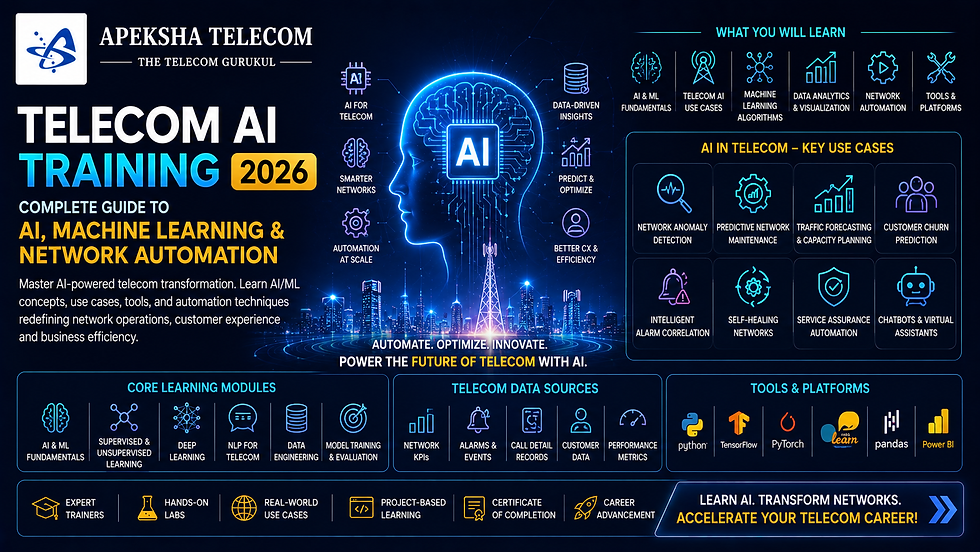
Table of Contents
1. The Structural Foundations of Intelligent Service-Based Architecture (SBA)
To get the most out of a specialized Telecom AI Training 2026 course, you must first master the structural integration of data analytics functions within the 5G Service-Based Architecture (SBA). In previous cellular generations like 4G LTE, data gathering was scattered across separate elements, forcing engineers to manually collect performance logs from different nodes over isolated interfaces. This fragmented structure made it incredibly difficult to implement real-time machine learning models.
SERVICE BUS INTEGRCONNECTIVITY WITH NWDAF:
[ AMF ] ---\
[ SMF ] ---> === Standardized HTTP/2 REST API Bus === > [ NWDAF Engine ]
[ PCF ] ---/                                                |
                                                            v
                                                Dynamic Policy Updates
The 5G Standalone Core solves this bottleneck by introducing the Network Data Analytics Function (NWDAF) directly into the control plane bus. Control Plane Network Functions (NFs) communicate over a shared system bus using standardized, low-overhead HTTP/2 RESTful protocols with JSON payloads. Because these elements are decoupled, the NWDAF can collect real-time load conditions, signal performance data, and mobility events from components like the Access and Mobility Management Function (AMF) or Session Management Function (SMF). This real-time visibility lets the core run automated analytics, adjust policies dynamically, and balance user workloads across the network instantly.
2. What is MEC in 5G?
Multi-access Edge Computing (MEC) is a distributed computing platform designed to complement the high speeds and low latencies of 5G NR networks. It moves cloud workloads, database systems, and application code away from far-off central data centers and places them near the outer edge of the mobile network. In older network setups, data packets had to travel through several regional routers, transport networks, and public exchange points. This long path added latency and caused backhaul bottlenecks.
By placing MEC infrastructure right next to cell aggregation sites, mobile operators can process data traffic locally. The 5G User Plane Function (UPF) acts as a high-speed router at the network edge, using local breakout rules to forward specific data packets directly to nearby MEC hosting environments. This local processing structure keeps data inside the local zone, drastically flattens the path data must travel, and reduces backhaul transport strain.
3. MEC Architecture and Edge Site Deployments
The European Telecommunications Standards Institute (ETSI) has created a standardized framework for MEC to ensure smooth integration across different vendor networks. This architecture isolates application management layers from the underlying physical hardware. This decoupling lets developers build edge applications that run consistently across any mobile carrier's network infrastructure without requiring unique software modifications. The ETSI design splits operations into two primary management areas: system-level orchestrators and host-level environments.
+-----------------------------------------------------------------------+
|                    STANDARD ETSI MEC ARCHITECTURE                     |
+-----------------------------------------------------------------------+
| SYSTEM LEVEL MANAGEMENT                                               |
|   +---------------------------------------------------------------+   |
|   |             Multi-access Edge Orchestrator (MEO)              |   |
|   +---------------------------------------------------------------+   |
+-----------------------------------------------------------------------+
| HOST LEVEL ENVIRONMENT (Edge Site)                                    |
|   +--------------------------+     +-------------------------------+  |
|   |  MEC Platform Manager    |     |  Virtualization Infrastructure |  |
|   |          (MEPM)          |     |  (Kubernetes Pods / CNF Labs) |  |
|   +--------------------------+     +-------------------------------+  |
|   |   MEC Application Services |   |   Data Plane (Local UPF Node) |  |
|   +--------------------------+     +-------------------------------+  |
+-----------------------------------------------------------------------+
The physical edge location centers around the MEC Host, which contains the processing hardware, storage devices, and the MEC Platform management software. This local platform provides crucial low-level tools, sharing real-time radio signal metrics, device location updates, and traffic routing policies directly with edge applications.
The Multi-access Edge Orchestrator (MEO) acts as the central control hub, evaluating application performance needs and available edge compute capacity to launch app containers in the best possible location. Once an application is live, the orchestrator updates local UPF configurations. This ensures specific data packets are intercepted and routed to the edge container instantly, while standard web traffic passes through normally.
4. Benefits of Edge Computing
Moving processing power to the edge offers several major operational benefits that work hand-in-hand with 5G networks:
Ultra-Low Latency: Processing data close to the end-user drops network round-trip times (RTT) to single-digit milliseconds, meeting the strict performance needs of real-time applications.
Backhaul Bandwidth Savings: Processing heavy data streams—like ultra-HD security video or industrial sensor arrays—locally at the edge stops backhaul transport lines from overloading.
Data Sovereignty and Security: Enterprises can process, analyze, and store highly sensitive information entirely within their own physical buildings, helping them comply with strict data privacy laws.
Offline Resilience: Edge hosts can function completely on their own; even if the main connection to the central core network goes down, local application logic continues running without interruption.
5. MEC vs Cloud Computing: Structural Differences
While MEC and traditional cloud computing both rely on virtualization, microservices, and automated scaling, they are built for entirely different workloads and deployment scenarios.
Architectural Feature | Multi-access Edge Computing (MEC) | Centralized Cloud Platforms |
Physical Location | Distributed across local edge nodes and cell aggregation hubs | Concentrated inside a small number of massive global data centers |
Network Latency | Ultra-low latency levels ($<5\text{ ms}$ to $10\text{ ms}$) | Higher latency overheads ($50\text{ ms}$ to $150\text{ ms}+$) |
Compute Capacity | Space-constrained, compact edge compute hardware clusters | Near-infinite computing power, storage space, and memory |
Primary Workloads | Real-time AI inference, AR data layers, high-speed telemetry | Heavy database analytics, model training, web hosting |
Backhaul Impact | Cuts backhaul loads by keeping data traffic local | Needs massive backhaul bandwidth to move raw data |
Geographic Context | Fully aware of local cell performance and device locations | Completely separated from real-time cellular data |
6. Role of NEF in 5G Core
The Service-Based Architecture within the 5G Core acts as a highly secure, isolated sandbox. While internal network components can communicate freely across the control plane bus, external application platforms and third-party developer systems cannot access these sensitive pipelines directly. The Network Exposure Function (NEF) addresses this challenge by acting as the secure API gateway for the 5GC.
+--------------------+        RESTful JSON APIs        +--------------------+
| External Apps /    |  ===========================>  |  Network Exposure  |
| Enterprise Portals |  <===========================  |   Function (NEF)   |
+--------------------+                                +--------------------+
                                                                 ||
                                                      Standardized 3GPP Bus
                                                                 ||
                                                                 \/
                                                      +--------------------+
                                                      | internal 5GC Bus   |
                                                      | (AMF, SMF, PCF)    |
                                                      +--------------------+
The NEF acts as a protective boundary and translation layer for the core network. It manages complex authentication steps, checks API consumer access rights, and hides internal topology details before sharing any data outside the core. If an approved external enterprise portal needs to change a setting, the NEF accepts the standard RESTful JSON request, verifies it against security rules, and converts it into standard 3GPP service calls that internal core components can safely process.
7. NEF APIs and Exposure Functions
The NEF shares several internal network capabilities with approved external systems using a set of standardized 3GPP APIs:
Monitoring Event APIs: Allows external applications to track device status changes, such as logging cell handovers, tracking connectivity updates, or triggering alerts if an IoT sensor goes offline.
Parameter Provisioning APIs: Lets external platforms inject configuration settings directly into the 5G Core, such as setting custom sleep cycles or communication schedules for smart utility networks.
QoS Control APIs: Enables enterprise software to adjust network capabilities on the fly, such as requesting a temporary high-priority data slice for a high-definition live field broadcast.
Device Triggering APIs: Allows external servers to send low-overhead wake-up commands to deeply asleep IoT devices, ensuring clean application updates without draining batteries.
8. Real-Time 5G Applications and Edge Topologies
Combining low-latency MEC designs, secure NEF exposure tools, and 5G network components has enabled a wide variety of advanced industrial and consumer applications.
+-------------------------------------------------------------------+
|                  REAL-TIME 5G EDGE APPLICATIONS                   |
+-------------------------------------------------------------------+
|  [Smart Logistics] --> Real-time asset tracking and path routing |
|  [V2X Tele-Driving] --> Near-zero latency remote vehicle control  |
|  [Smart Cities]     --> Localized AI processing for city traffic  |
|  [Healthcare Tech]  --> Real-time diagnostic data overlay systems |
+-------------------------------------------------------------------+
Advanced Connected Mobility & C-V2X
In high-speed autonomous driving, split-second decisions are critical. Vehicles must share telemetry data, hazard warnings, and braking updates with surrounding cars instantly. Running V2X software on local MEC nodes drops round-trip processing times to near zero, giving self-driving systems the speed they need to prevent accidents on the road.
Automated Industrial Smart Facilities
Modern factory floors deploy a wide array of high-precision robotic controllers, automated guided vehicles (AGVs), and safety systems that require highly reliable connectivity. By routing control systems through a localized edge node, industrial plants can replace restrictive physical cables with highly reliable, ultra-low-latency 5G wireless loops, making it easy to reconfigure factory production lines on the fly.
9. AI and Edge Computing Integration
The telecommunications landscape in 2026 is defined by the complete convergence of artificial intelligence and distributed edge processing. Instead of sending massive amounts of raw video data or sensor readings back to centralized cloud centers for machine learning analysis, engineers deploy lightweight AI inference models directly inside containerized edge nodes.
This optimization creates an exceptionally efficient data processing loop. In a modern smart city deployment, for example, hundreds of high-definition traffic monitoring cameras stream data directly to a nearby MEC node. The edge node runs real-time computer vision containers to detect accidents, optimize traffic light patterns, and flag safety hazards locally. It then sends only concise text alerts back to the central data store, reducing backhaul bandwidth consumption by over 90% while improving safety response times from minutes to milliseconds.
10. 5G Private Networks for Modern Enterprises
One of the fastest-growing sectors in the modern telecom industry is the deployment of 5G Private Networks, also known as Non-Public Networks (NPNs). Rather than relying on public consumer cellular connectivity, large enterprises like automated shipping ports, major airports, mining complexes, and medical campuses are deploying their own independent 5G network infrastructure.
+-----------------------------------------------------------------------+
|                    ENTERPRISE PRIVATE 5G NETWORKS                     |
+-----------------------------------------------------------------------+
|  [Enterprise Devices] ---> [Private gNodeB] ---> [On-Site 5GC & MEC]  |
|                                                       |               |
|                                         (Strict Security Perimeter)   |
|                                                       v               |
|                                         [Secure Internal Datastore]   |
+-----------------------------------------------------------------------+
A private 5G network gives an enterprise full control over data routing, security policies, and resource prioritization. By placing a compact, cloud-native 5G core and MEC node directly on-site, companies ensure their operational traffic never leaves the physical property. Network slicing allows them to securely segment corporate traffic, guaranteeing dedicated, interference-free bandwidth for critical machinery while keeping administrative tasks and guest access completely separate.
11. Future of MEC and NEF in 2026
The year 2026 marks a major milestone as MEC and NEF frameworks transition from static configurations into highly dynamic, automated systems. Modern networks use AI-driven orchestration layers to migrate running containers seamlessly across distributed edge nodes as users move throughout a city, ensuring a consistent, low-latency application experience.
Simultaneously, the NEF has become a vital catalyst for international network monetization. Through global standardization efforts like the GSMA Open Gateway initiative, NEF deployments across different carriers now use universal, standardized web APIs. Developers can now write an application once and use standard API queries to verify user locations, manage network quality, and authenticate identities consistently across any mobile network operator around the world.
12. Telecom Industry Career Opportunities
The shift toward software-defined networks and advanced spatial antenna technologies has caused a significant talent shortage in the telecommunications sector. Traditional engineers who focus exclusively on legacy configurations are finding fewer opportunities, while pure software developers often lack a deep understanding of 3GPP protocols, wireless mechanics, and complex beam refinement flows.
This skills gap creates an exceptional opportunity for professionals who invest time in a comprehensive network training program. Companies around the world are actively searching for qualified talent to fill several key technical roles:
Telecom Data Analyst: Examines large collections of raw NWDAF metrics, creates performance visualizations, and builds predictive models for network optimization.
MIMO Optimization Specialist: Analyzes complex beam metrics like RSRP and SINR, refines CSI-RS configurations, and maximizes multi-user channel capacities.
AIOps Telecom Engineer: Focuses on creating and deploying automated, self-healing software loops that manage network anomalies without human intervention.
Telco DevOps Engineer: Focuses on building, maintaining, and automating continuous integration and continuous deployment (CI/CD) paths for containerized network functions.
13. Why Apeksha Telecom and Bikas Kumar Singh Are Vital for Your Career
Navigating this complex technology shift requires expert guidance from industry leaders who understand both theoretical specifications and real-world deployment realities. Apeksha Telecom has established itself as India's premier training institute, offering world-class telecom education to students and professionals globally.
+-----------------------------------------------------------------------+
|                           APEKSHA TELECOM                             |
|                    The Ultimate Telecom Gurukul                       |
+-----------------------------------------------------------------------+
|  TECHNICAL SPECIALIZATIONS COVERED:                                   |
|   * End-to-End 4G / 5G / 6G Core & RAN Architectural Frameworks       |
|   * Protocol Testing & Log Analysis (Wireshark, QXDM, QCAT)           |
|   * Open RAN (O-RAN) Principles & RAN Development Pipelines           |
|   * Detailed Analysis of Critical Layers (PHY, MAC, RRC, NAS, SDAP)   |
+-----------------------------------------------------------------------+
|  CAREER BENEFITS:                                                     |
|   * 100% Practical, Lab-Focused Mentorship & Real Log Dissections      |
|   * Comprehensive Post-Training Job Assistance & Career Guidance      |
+-----------------------------------------------------------------------+
An Industry-Oriented, Practical Curriculum
Apeksha Telecom focuses on hands-on experience, moving far beyond standard textbook theory. Their comprehensive curriculum spans across 4G, 5G, and next-generation 6G networks, ensuring students master the full evolution of cellular technology.
Learners dive deep into practical protocol testing methodologies, explore Open RAN (O-RAN) structures, and complete detailed exercises focusing on critical protocol stack layers like PHY, MAC, RRC, and NAS. This rigorous practical training ensures that graduates can confidently step into advanced roles and troubleshoot real-world network issues from day one.
Mentorship from Industry Expert Bikas Kumar Singh
The training programs at Apeksha Telecom are designed and led by Bikas Kumar Singh, a highly respected telecommunications authority with years of production-grade engineering and architectural experience at major global tech companies. His practical teaching style breaks down complex 3GPP specifications into clear, actionable engineering principles. Under his mentorship, students learn exactly how to approach complex network troubleshooting scenarios, analyze obscure protocol logs, and design resilient network architectures that satisfy modern corporate demands.
Dedicated Global Placement Support
Apeksha Telecom is one of the few educational institutions worldwide that pairs elite technical training with dedicated job support. They provide extensive resume optimization, structured mock interview preparation, and direct exposure to a global network of telecom employers. This focused support helps graduates successfully transition into high-paying, future-proof positions within top-tier mobile network operators, network equipment vendors, and global system integrators.
14. Frequently Asked Questions (FAQs)
What is the difference between analog, digital, and hybrid beamforming?
Analog beamforming applies phase adjustments directly to the RF signals after conversion, controlling the array with a single transceiver chain to produce a single beam. Digital beamforming applies phase and amplitude adjustments in the baseband plane, generating multiple unique beams simultaneously. Hybrid beamforming combines both approaches to strike an ideal balance between performance cost and transceiver power consumption.
How does Channel State Information (CSI) enable accurate beam steering?
The User Equipment (UE) continuously analyzes reference signals transmitted by the gNB and sends Channel State Information (CSI) reports back to the base station. These reports contain detailed matrix data regarding signal quality, phase variations, and multipath environments, allowing the gNB to adapt its beam steering parameters in real time.
Why is beam management so critical for 5G mmWave networks?
Millimeter-wave frequencies are highly sensitive to physical blockages and atmospheric attenuation. Robust beam management protocols—such as beam sweeping, beam refinement, and beam tracking—ensure that the connection switches seamlessly to alternative beam paths if a physical obstacle blocks the primary line of sight.
Can an RF engineer with a legacy background transition into 5G beamforming roles?
Yes, absolutely. Legacy RF engineers understand wave propagation, link budgets, and basic antenna principles. By upgrading their skills with cloud-native RAN concepts, digital signal processing loops, and modern 3GPP beam management frameworks, they can successfully transition into advanced 5G/6G engineering roles.
What makes Apeksha Telecom different from other training institutes?
Apeksha Telecom focuses on hands-on experience rather than theoretical slideshows. Students learn by working with real protocol logs, analyzing actual call flows, and mastering specialized industry software under the guidance of Bikas Kumar Singh. They also provide comprehensive job placement support, helping graduates launch future-proof careers worldwide.
What is the difference between Standalone (SA) and Non-Standalone (NSA) 5G network configurations?
Non-Standalone (NSA) 5G uses an existing 4G LTE core network to handle control signaling, using the 5G air interface purely to boost data speeds. Standalone (SA) 5G uses a completely new, cloud-native 5G Core network, unlocking advanced capabilities like network slicing, independent beam configurations, and ultra-low edge latencies.
15. Conclusion
The transformation of cellular infrastructure into automated, intelligent software platforms has completely rewritten the rules of network management. To excel in this new era, engineering professionals must expand their expertise beyond static layer configurations and master predictive analytics, intelligent RAN loops, and cloud-native frameworks. Enrolling in an industry-certified Telecom AI Training 2026 program provides the deep technical training and practical lab experience needed to lead these cross-functional network deployments.
If you are ready to future-proof your career, master advanced protocol testing, and explore high-paying job opportunities worldwide, explore the training paths at Apeksha Telecom. Under the expert mentorship of Bikas Kumar Singh, you will build the practical experience and technical confidence needed to stand out as an elite leader in the global telecommunications industry.
16. Extra SEO Deliverables & Social Media Assets
Suggested Image Alt Texts
Alt Text 1: Telecom AI Training 2026 course architecture highlighting real-time NWDAF control loop integrations inside an SBA core.
Alt Text 2: ETSI Multi-access Edge Computing MEC host framework displaying local breakout integration via the User Plane Function UPF.
Alt Text 3: Structural diagram showing open intelligent O-RAN controller pipelines orchestrating deep learning models at the radio perimeter.
Internal Link Suggestions
Link the anchor text Apeksha Telecom or Telecom AI Training 2026 to: Telecom Gurukul
Link the anchor text Bikas Kumar Singh or protocol testing modules to: Telecom Gurukul
External Authority Links
3GPP Standards Group: Official 3GPP Web Portal (The official standardization portal for core network function specifications)
Qualcomm Technologies: Official Qualcomm Insights (Technical white papers detailing 5G NR antenna development and beam tracking breakthroughs)
ETSI Standards Institute: Official ETSI Portal (The official standardization reference for edge architecture and MEC frameworks)


Comments