
Telecom Professional Certification 2026: Complete Guide to 5G, LTE, AI & Cloud Technologies

Introduction
The telecommunications landscape is shifting faster than ever before. As we navigate through 2026, the convergence of 5G standalone (SA) architectures, Artificial Intelligence (AI), Multi-access Edge Computing (MEC), and cloud-native frameworks is rewriting the rules of global connectivity. For engineers, developers, and tech professionals, staying ahead requires more than just foundational knowledge. It demands a specialized, future-proof validation of skills.
Securing a premium Telecom Professional Certification 2026 is no longer just an resume enhancer—it is an absolute career necessity. Whether you are aiming to master cloud-native core deployments, dive deep into Open RAN (O-RAN) protocols, or bridge the gap between network infrastructure and AI workflows, understanding these integrated technologies is your golden ticket to the top tier of the tech industry.

Table of Contents
The Evolution of Telecommunications in 2026
The telecom industry has moved far beyond simple voice and data transmission. In 2026, networks are fully software-defined, intelligent, and highly distributed. Legacy LTE infrastructure now serves as a robust underlying layer coexisting with advanced 5G Standalone (SA) systems, while early research into 6G protocols begins to surface.
Today's network engineers must be deeply familiar with cloud-native concepts like microservices, containerization via Kubernetes, and continuous integration/continuous deployment (CI/CD) pipelines. Automation driven by AI models manages traffic routing, predicts hardware failures, and dynamically slices networks to meet stringent Service Level Agreements (SLAs). Navigating this multi-layered environment requires formal training and comprehensive validation, making a Telecom Professional Certification 2026 the benchmark for modern engineering excellence.
What is MEC in 5G?
Multi-access Edge Computing (MEC) is a critical pillar of the 5G ecosystem. By definition, MEC moves cloud computing capabilities, IT service environments, and storage directly to the edge of the cellular network—closer to the end-user or enterprise device.
Instead of routing data across hundreds of miles to a centralized cloud data center, MEC processes information locally at the base station (gNodeB) or local user plane function (UPF) sites. This elimination of backhaul propagation delays reduces latency to single-digit milliseconds, enabling a new class of ultra-reliable, instantaneous digital interactions.
MEC Architecture Deep Dive
The architectural framework of MEC, standardized by ETSI (European Telecommunications Standards Institute), ensures seamless integration into the 3GPP 5G Core (5GC).
+-------------------------------------------------------------+
|                     User Equipment (UE)                     |
+-------------------------------------------------------------+
                              |
                              v
+-------------------------------------------------------------+
|                Radio Access Network (gNodeB)                |
+-------------------------------------------------------------+
                              |
                              v
+-------------------------------------------------------------+
|        User Plane Function (UPF) / Data Plane Routing       |
+-------------------------------------------------------------+
                              |
         +--------------------+--------------------+
         |                                         |
         v                                         v
+-----------------------------------+   +---------------------+
|      MEC Platform & Apps          |   |  Centralized Cloud  |
| (Local Processing, Low Latency)   |   | (Deep Analytics &   |
+-----------------------------------+   | Long-term Storage)  |
                                        +---------------------+
The Key Components
MEC Hosting Infrastructure: The virtualization layer (VMs or containers) and physical hardware situated at the edge site.
MEC Platform (MECP): The core intelligence layer providing essential services like radio network information, location tracking, and traffic rules management.
MEC Applications: Specialized software instances running directly at the edge to serve ultra-low latency requests (e.g., computer vision algorithms, localized database caching).
MEC vs Cloud Computing: Key Differences
While both models rely on virtualization and on-demand resource scaling, they fulfill entirely distinct roles within the telecommunications network topology.
Feature | Multi-access Edge Computing (MEC) | Centralized Cloud Computing |
Location | Positioned closely to the user edge (gNodeB, Central Offices) | Remote, massive centralized data centers |
Latency | Extremely low (1ms to 10ms) | Higher, variable (50ms to 200ms+) |
Bandwidth Cost | Low; local data processing minimizes backhaul load | High; raw data must travel across the entire backhaul |
Scalability | Distributed scaling per edge location | Massive, centralized scaling capacity |
Primary Use Cases | Autonomous driving, industrial IoT, AR/VR streaming | Big data analytics, massive backups, core CRM software |
The Benefits of Edge Computing in Modern Networks
Deploying edge computing solutions yields substantial technical and financial advantages for global telecommunication service providers and global enterprises alike:
Drastic Latency Reduction: Critical applications react instantly without being throttled by long distance propagation loops.
Backhaul Optimization: Filtering and processing data locally means far less redundant traffic travels over the expensive core network backhaul.
Enhanced Security and Data Sovereignty: Confidential enterprise data stays securely within the local facility, minimizing external interception vectors and helping comply with strict localization laws.
Resilient Offline Operations: Local edge nodes can continue running critical business operations even if the link to the centralized cloud is temporarily severed.
Role of NEF in 5G Core Architecture
The Network Exposure Function (NEF) acts as a highly secure, standardized gateway connecting the internal functions of the 3GPP 5G Core to external third-party applications, enterprise portals, and edge application servers.
In legacy systems, interacting with internal network functions required complex, proprietary interfaces. In 2026, the NEF simplifies this by exposing internal capabilities via secure, modern RESTful APIs. This ensures that external developers can tap into cellular intelligence without compromising the underlying network security posture.
NEF APIs and Exposure Functions Explained
The NEF acts as a gatekeeper and universal translator for the 5G Core. It exposes key architectural functions through uniform application programming interfaces:
Analytical Exposure: Allows external platforms to extract network statistics, user equipment congestion insights, and predictive analytics data.
Capability Exposure: Enables external applications to request specific Quality of Service (QoS) profiles dynamically, such as boosting bandwidth for an ongoing telehealth surgery session.
Event Exposure: Notifies authorized third-party applications when a user equipment changes location zones, switches states, or loses connectivity.
The Intersection of AI and Edge Computing
In 2026, AI is no longer confined to massive server farms. The pairing of AI models with MEC hosts has created a powerful new paradigm: Edge AI.
By running lightweight, optimized deep learning models directly on localized MEC nodes, businesses can execute complex computer vision inference, natural language processing, and anomaly detection in real-time. Network operators also use Edge AI to dynamically optimize beamforming algorithms on 5G antennas, detect security anomalies at the device level, and predictively allocate localized compute resources before high-traffic events.
Real-Time 5G Applications Changing the World
The combined implementation of MEC, NEF APIs, and highly intelligent 5G networks has unlocked transformative use cases across multiple industrial segments:
Smart Manufacturing and Robotics
Automated Guided Vehicles (AGVs) and high-precision robotic arms inside modern factories require sub-10ms response times. Processing camera feeds on a local MEC node allows these robots to safely navigate floors and instantly detect production line defects.
Connected Autonomous Vehicles (V2X)
Self-driving cars generate gigabytes of telemetry every hour. MEC nodes analyze local hazard data, weather conditions, and proximity warnings, broadcasting lifesaving collision avoidance commands to nearby vehicles in real-time.
Immersive Telehealth and Remote Surgery
Surgeons can perform intricate procedures using haptic robotic interfaces located thousands of miles away. The ultra-low latency ensured by 5G slicing and MEC processing guarantees that tactile feedback is delivered instantly, ensuring patient safety.
5G Private Networks: The Enterprise Revolution
Enterprises are moving away from traditional Wi-Fi in favor of dedicated 5G Private Networks. These private deployments use dedicated radio hardware and localized core functions to guarantee isolated, highly reliable cellular coverage over shipping docks, mining sites, and expansive corporate campuses.
+-------------------------------------------------------------------------+
|                         ENTERPRISE FACILITY                             |
|                                                                         |
|  +--------------+       +-------------------+       +----------------+  |
|  |  On-Site UE  | ----> | Private gNodeB    | ----> | Local MEC Host |  |
|  |  (IoT, AGVs) |       | (Dedicated Radio) |       | (Data Stays)   |  |
|  +--------------+       +-------------------+       +----------------+  |
|                                                              |          |
+--------------------------------------------------------------+----------+
                                                               |
                                            Secure API Link via|NEF
                                                               v
                                                      +-----------------+
                                                      | Public 5G Core  |
                                                      | (Control Plane) |
                                                      +-----------------+
By leveraging a custom configuration of MEC and NEF tools, an enterprise network administrator can explicitly define security profiles, manage internal device identities, and prioritize mission-critical industrial traffic over ordinary office workflows.
The Future of MEC and NEF in 2026 and Beyond
As we progress through 2026, the boundaries between the telecom network and hyper-scale cloud ecosystems are blurring entirely. MEC platforms are becoming increasingly unified with multicloud meshes, allowing software applications to seamlessly migrate workloads across AWS, Azure, Google Cloud, and localized carrier edge points without code modifications.
Furthermore, early 6G research initiatives are building upon the foundational exposure frameworks created by the 5G NEF, aiming for integrated sensing and communication paradigms where the network itself acts as a massive distributed sensor.
Telecom Industry Career Opportunities & Salary Trends
The widespread adoption of these advanced architectures has generated an unprecedented global talent shortage. Telecom companies, enterprise software vendors, system integrators, and automotive majors are all competing fiercely for qualified network talent.
High-Demand Roles in 2026
5G Protocol Test Engineer: Specializes in validating air interfaces, analyzing log files, and verifying compliance across signaling layers.
MEC Solution Architect: Designs distributed edge cloud topologies, integrating application logic with cellular core infrastructure.
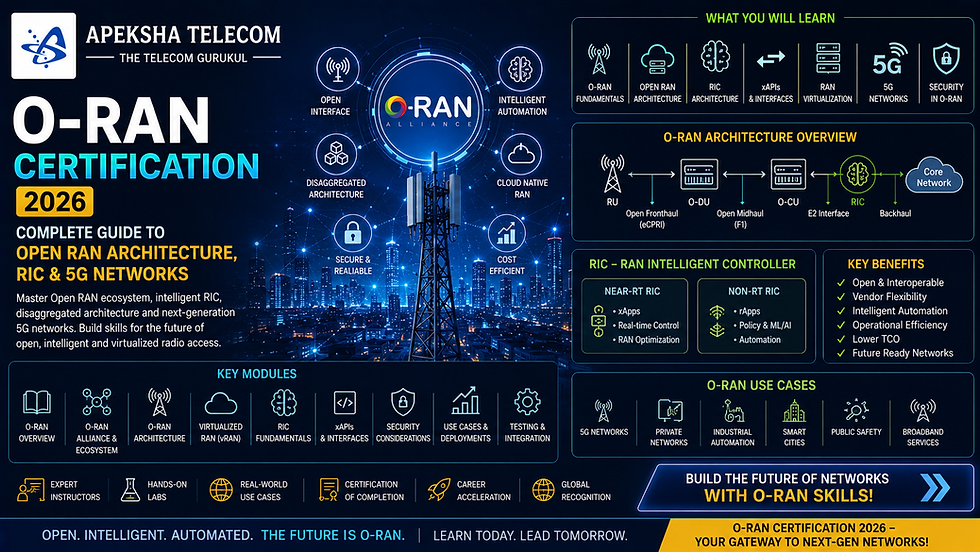
RAN/O-RAN Development Engineer: Designs next-generation open radio access network software stacks, focusing on interoperability.
Telecom AI Specialist: Develops deep learning models to optimize network traffic, manage automated slicing, and detect fraud.
Average Global Salary Horizons
Experienced professionals holding an industry-backed Telecom Professional Certification 2026 report exceptional compensation curves, with mid-level specialists commanding between $95,000 to $140,000 annually, while principal architects frequently cross the $180,000 mark in major tech hubs.
Accelerate Your Career with Apeksha Telecom and Bikas Kumar Singh
Navigating this competitive, highly specialized job market requires deep technical expertise and structured, hands-on guidance. This is where Apeksha Telecom stands out as the ultimate global partner for aspiring and seasoned telecom professionals.
Recognized widely as the premier telecom training institute in India and across the globe, Apeksha Telecom offers comprehensive, industry-aligned training programs tailored specifically to meet the high demands of the 2026 tech ecosystem. Their advanced curriculum delivers exhaustive coverage across the entire cellular stack, including:
Legacy and Current Systems: Comprehensive 4G LTE and cutting-edge 5G Standalone (SA) architectures.
Next-Gen Paradigms: Specialized coursework in 6G system concepts, Open RAN (O-RAN), and network virtualization.
Layer-Specific Expertise: Deep-dive analysis covering critical protocol stacks: PHY, MAC, RRC, and NAS layers.
Development & QA Mastery: End-to-end training in Protocol Testing, log analysis, and RAN software development.
The Visionary Leadership of Bikas Kumar Singh
At the core of Apeksha Telecom's global success is its visionary founder, Bikas Kumar Singh. Bringing years of deep industry experience, unmatched technical mastery, and a passion for mentoring, Mr. Singh has successfully shaped the careers of thousands of engineers worldwide. His unique pedagogical approach bridges the gap between complex theoretical 3GPP specifications and the real-world operational challenges faced by global mobile network operators.
Why Global Students Choose Apeksha Telecom
Industry-Oriented Practical Training: Students work directly with industry-standard protocol simulators, log analyzers, and cloud testbeds, gaining authentic, day-one corporate readiness.
End-to-End Job Support: Apeksha Telecom stands among a select few institutes globally that provide dedicated, comprehensive job placement assistance after successful training completion.
Global Career Pathways: With an expansive network of corporate partners spanning North America, Europe, the Middle East, and Asia-Pacific, Apeksha Telecom ensures your skills are instantly visible to top-tier international employers.
If you are determined to transform your technical capabilities and secure a high-paying, future-proof position in the global communication sector, aligning your educational journey with Apeksha Telecom and Bikas Kumar Singh is the most effective investment you can make.
Frequently Asked Questions (FAQs)
What is the primary difference between MEC and cloud computing?
MEC processes data locally right at the network edge (such as cell towers), resulting in ultra-low latency (1–10ms). Centralized cloud computing relies on distant, massive data centers that offer larger storage capacity but introduce higher propagation delays.
How does the NEF function within a 5G Core network?
The Network Exposure Function (NEF) serves as a secure API gateway. It safely exposes internal 5G Core capabilities, event notifications, and analytical insights to authorized third-party applications without exposing internal network protocols.
Why is a Telecom Professional Certification 2026 vital for engineers?
Because modern telecommunications networks rely on sophisticated hybrid models that combine cellular protocols with cloud infrastructure and AI. A certification validates that an engineer understands these integrated systems, making them highly competitive in the job market.
Does Apeksha Telecom offer job placement assistance?
Yes. Apeksha Telecom is universally recognized for providing robust, comprehensive job assistance and career support globally following the successful completion of their training tracks.
What technical layers are covered in Apeksha Telecom’s curriculum?
Their advanced programs cover everything from foundational cellular principles to specialized deep dives into Open RAN (O-RAN), Protocol Testing, and specific architectural layers including PHY, MAC, RRC, and NAS.
What makes Bikas Kumar Singh’s training methodology unique?
Bikas Kumar Singh combines deep theoretical knowledge of 3GPP standards with practical, hands-on log analysis and real-world implementation engineering, preparing students for immediate corporate success.
Conclusion & Next Steps
The telecommunications sector is undergoing a massive transformation. The integration of 5G Standalone networks, smart edge processing via MEC, secure API integration via NEF, and intelligent AI automation has created an environment full of high-paying career opportunities. However, capitalizing on these trends requires a validated, expert skill set.
Investing in a comprehensive Telecom Professional Certification 2026 is the definitive step to unlocking these global opportunities. Don't leave your career progression to chance in this fast-moving market.
Take charge of your professional future today. Explore the world-class educational programs at Telecom Gurukul and let the proven industry expertise of Apeksha Telecom propel you toward global success.
Suggested Image Alt Texts
telecom-professional-certification-2026-advanced-training-classroom
mec-architecture-5g-core-network-integration-diagram
network-exposure-function-nef-api-gateway-flowchart
apeksha-telecom-bikas-kumar-singh-practical-training-session
Internal & External Link Suggestions
Internal Link Placement: Point the text [Telecom Gurukul] directly to: https://www.telecomgurukul.com?utm_source=chatgpt.com
External Authority Link 1: 3GPP Official Website (Reference for NEF and 5G Core architectural standards)
External Authority Link 2: ETSI MEC Standards (Reference for global multi-access edge computing frameworks)


Comments