
5G Professional Certification 2026: Complete Guide for Telecom Engineers Who Want to Lead the Next Wave

Introduction To 5G Professional Certification 2026
A telecom engineer's career has always been defined by the technology generation they master first — and the professionals who built their expertise around 4G LTE in the early 2010s rode that wave for a decade. We're at precisely the same inflection point now, except the technology shift is larger and the window for early-mover advantage is open right now. 5G Professional Certification 2026 is how serious telecom engineers are formalizing their expertise in standalone 5G architecture, ORAN deployment, multi-access edge computing, and 5G Core operations — creating documented, verifiable credentials that communicate genuine technical depth to the hiring market at exactly the moment when that depth is in shortest supply relative to demand. Whether you're a working 4G engineer transitioning to 5G, a B.E/B.Tech graduate entering the industry, or an IT professional pivoting toward network engineering, this complete guide tells you exactly what professional 5G certification covers, how to evaluate programs, what career paths it opens, and why 2026 is the most strategically important time to make this investment in your professional development.

Table of Contents
Why 5G Professional Certification Matters More Than Ever in 2026
Who Should Pursue 5G Professional Certification?
What a Credible 5G Professional Certification Covers
What is MEC in 5G?
Role of NEF in 5G Core
Benefits of Edge Computing
MEC Architecture Explained
NEF APIs and Exposure Functions
MEC vs Cloud Computing
Real-Time 5G Applications
AI and Edge Computing
5G Private Networks
Future of MEC and NEF in 2026
Telecom Industry Career Opportunities
Why Apeksha Telecom and Bikas Kumar Singh Are Important for Your Telecom Career
FAQs
Conclusion
Why 5G Professional Certification Matters More Than Ever in 2026
The argument for professional certification in any technical field rests on a simple tension: hiring decisions require a mechanism for communicating competency that works across the information asymmetry between candidates and employers. In a field that changes as rapidly as 5G, that asymmetry is particularly acute — a candidate claiming 5G expertise in 2026 could mean anything from having watched an introductory webinar to having configured 5G Core functions in a production cloud-native environment. Professional certification that is backed by rigorous, industry-aligned curriculum and verifiable practical assessment reduces this asymmetry, giving employers a meaningful signal about candidate capability that a job title or degree cannot provide on its own. In 2026, the urgency of this signal is amplified by the scale of 5G deployment underway globally — standalone 5G rollouts are accelerating across Asia, Europe, and North America simultaneously; ORAN deployments are moving from operator trials to commercial networks; enterprise private 5G networks are proliferating across manufacturing, healthcare, logistics, and education; and MEC platforms are scaling from early deployments to production infrastructure. The companies driving these deployments need engineers who can perform immediately — and professional certification from a program with credibility and depth is one of the clearest available signals that a candidate meets that standard.
Who Should Pursue 5G Professional Certification?
5G Professional Certification 2026 serves a broader range of candidates than many people initially assume, and understanding who benefits most helps candidates self-assess before investing:
4G/LTE Engineers Transitioning to 5G are perhaps the most immediately positioned audience. They have the foundational network engineering intuition, the protocol analysis experience, and the industry context — what they need is specific, structured knowledge of how 5G architecture differs from LTE, what the 5G Core's service-based architecture means in practice, how ORAN changes the RAN engineering discipline, and how MEC and NEF represent genuinely new capability categories without close LTE equivalents. Professional certification with a well-designed transition curriculum is the most efficient path for this group.
B.E/B.Tech Engineering Graduates entering the telecom industry benefit from 5G professional certification because it converts strong theoretical foundations into documented, specific technical competencies that differentiate them from the much larger pool of engineering graduates who have degrees but no telecom-specific skills. In 2026, the candidates getting hired into 5G roles ahead of their peers are those with documented practical 5G skills, and professional certification from a credible program is how that documentation happens.
IT and Cloud Engineers moving toward telecom roles find that 5G's cloud-native architecture — containerized network functions, Kubernetes orchestration, CI/CD deployment pipelines — creates natural transition opportunities. Professional certification helps them build the telecom-specific protocol knowledge and network architecture understanding that complements their existing cloud expertise to create a hybrid profile that 5G Core engineering teams actively recruit for.
Senior Engineers Targeting Architect Roles find that specialist-level 5G certification strengthens their positioning for senior technical interview processes that test depth in specific areas like ORAN near-RT RIC development, MEC solutions architecture, or NEF API platform engineering — domains where a certificate backed by rigorous practical assessment communicates meaningfully to hiring panels.
What a Credible 5G Professional Certification Covers
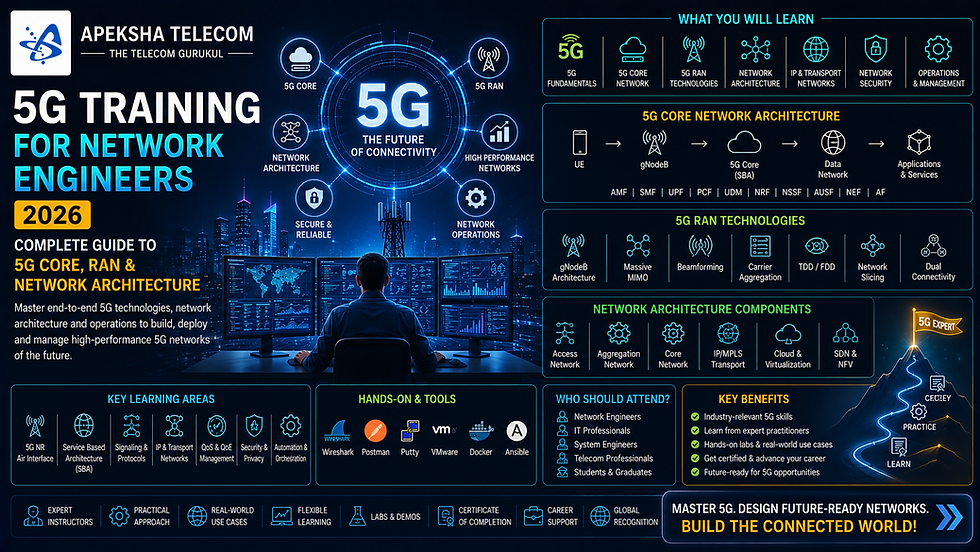
A 5G Professional Certification 2026 that genuinely delivers on its professional label must cover the full technical stack that 5G engineering roles require, with the depth at each layer that allows engineers to work confidently rather than just describe conceptually. The complete curriculum for a professional-grade program includes:
Wireless Foundations and LTE Context — ensuring all candidates have the signal processing and LTE architecture foundation that makes 5G concepts accessible rather than isolated
5G NR Air Interface — complete beam management lifecycle, massive MIMO configuration, numerology and slot format selection for different service types, NR-specific reference signals (CSI-RS, SSB, SRS), and handover procedures
RAN Protocol Stack — PHY layer channels and procedures, MAC scheduling and HARQ management, RLC mode selection and operation, PDCP security and header compression, SDAP QoS flow mapping, and RRC connection procedures — all with protocol trace analysis exercises
5G Core (5GC) Architecture — service-based architecture principles, cloud-native deployment patterns (containerization, microservices, service mesh), and detailed call flow analysis for each major 5GC procedure across AMF, SMF, UPF, NEF, NRF, PCF, AUSF, and UDM functions
IMS and VoNR — IMS registration, SIP signaling procedures, VoNR call setup and teardown, emergency call handling, SRVCC scenarios, EVS codec configuration, and QoS bearer management for voice flows
ORAN Architecture — O-RAN Alliance specifications, O-DU/O-CU/O-RU functional split, eCPRI fronthaul interface, near-RT RIC and non-RT RIC architecture, xApp and rApp development patterns, O1/A1/E2 interface procedures, and multi-vendor interoperability considerations
MEC and Edge Computing — ETSI MEC platform architecture, UPF ULCL and BP traffic steering configuration, MEC Orchestrator function, Release 17 EAS discovery architecture, and edge application lifecycle management
Network Slicing — NSSF-based slice selection, slice template design for different enterprise verticals, cross-slice resource management, and SLA assurance monitoring
5G Security Architecture — SUPI/SUCI concealment, 5G-AKA and EAP-AKA' procedures, network domain security, SEPP for inter-operator roaming, and security monitoring patterns
Protocol Testing — 3GPP TS 38-series conformance test methodology, trace capture and analysis, test case design and automation principles, and defect root cause analysis
What is MEC in 5G?
Multi-access Edge Computing (MEC) is one of the most commercially significant capability additions in the 5G ecosystem — and understanding it at depth is a defining characteristic of any meaningful 5G professional certification. MEC moves compute and storage from centralized cloud infrastructure to edge locations co-located with or near 5G base stations and enterprise facilities, reducing the latency that results from data traveling long distances for processing from tens or hundreds of milliseconds to single-digit milliseconds. This latency reduction is what enables an entirely new category of applications: robotic control systems in manufacturing automation, collision avoidance messaging in connected vehicles, AR-assisted field operations where rendering happens at the edge rather than in a distant data center, and real-time computer vision for quality inspection in industrial production. For professional certification programs, MEC is not just a topic to understand conceptually but a technical area to develop practical competency in — specifically around how UPF traffic steering is configured through ULCL and BP modes to split user traffic between local MEC application hosts and central internet paths, how the MEC Orchestrator manages application placement across distributed edge sites, and how the 3GPP Release 17 EAS discovery architecture improves how edge applications handle 5G mobility. These are the competencies that differentiate certified professionals in MEC roles from candidates with only conceptual familiarity.
Role of NEF in 5G Core
The Network Exposure Function (NEF) represents one of the most commercially active areas of 5G Core in 2026, and professional certification programs that cover it with genuine depth are preparing engineers for some of the highest-growth role categories in current telecom hiring. NEF functions as the secure, controlled API gateway through which the 5G network exposes its internal capabilities to external applications, enterprises, and developers — allowing enterprises to build applications that intelligently use network capabilities like quality of service management, device location awareness, traffic steering, and network analytics without ever having direct access to the core network's internal systems. The commercial significance of this in 2026 is substantial: GSMA Open Gateway has brought NEF-backed telecom API products to commercial deployment across operator networks covering the large majority of global mobile connections, and this commercial activation is creating specific technical hiring demand for engineers with production-grade NEF knowledge. Professional 5G certification in NEF includes the internal interaction architecture (how NEF interacts with UDM, PCF, NRF in production scenarios), the OAuth2 API security framework, the CAPIF (Common API Framework) that manages API publication and discovery, the CAMARA project's standardized API specifications that harmonize NEF exposure across operators globally, and the operational aspects of managing a production NEF exposure platform.
Benefits of Edge Computing
The benefits of edge computing that professional 5G certification should develop the ability to articulate with precision — not as a generic list but as a quantified framework for enterprise deployment decisions:
Latency Reduction — The Enabling Argument: For applications requiring sub-10ms response times, MEC is not a performance improvement but an enabling technology. The physics of light-speed propagation limits what cloud delivery can achieve regardless of network speed, making MEC a necessary architectural component rather than an optional enhancement for this class of applications.
Backhaul Economics — The Cost Argument: In large industrial IoT deployments, the volume of raw sensor and video data generated locally makes cloud-centric architectures economically impractical. A manufacturing facility with 500 connected sensors and cameras generating multi-gigabit streams can reduce backhaul costs by 85–95% through local MEC processing that transmits only actionable insights rather than raw data.
Data Residency — The Compliance Argument: Healthcare, financial services, and government deployments often face regulatory requirements that prohibit sensitive data from crossing network or geographic boundaries. MEC processing within a defined local perimeter satisfies these requirements without requiring cloud-based processing architectures to be abandoned.
Operational Resilience — The Reliability Argument: Manufacturing and logistics operations that depend on 5G-connected automated systems require edge-deployed control logic that maintains operation during connectivity disruptions — a resilience property that contractually defined SLAs for industrial private 5G networks typically require.
Revenue Diversification — The Business Case for Operators: MEC infrastructure represents a platform that operators can monetize through edge application hosting services, premium latency-guaranteed connectivity products, and enterprise edge API services — creating revenue streams that command premium pricing above commodity connectivity.
MEC Architecture Explained
Professional certification in MEC requires thorough understanding of the ETSI-standardized MEC architecture at the interaction level — not just the component taxonomy but how the components work together in deployment scenarios. The MEC Host is the foundational infrastructure element, providing co-located virtualized compute resources alongside the MEC Platform that manages the application runtime environment, enforces traffic forwarding rules, exposes Radio Network Information Service data to authorized applications, and provides location and timing services that edge applications use for context-aware processing. Above individual hosts, the MEC Orchestrator manages system-level application lifecycle decisions — evaluating where to place new application instances based on UE location data from the 5G Core, available host compute resources, and application-specified latency requirements, then coordinating with the 5G Core through management interfaces to trigger UPF configuration changes that implement the resulting traffic steering. The critical technical depth for professional certification comes in understanding the integration between the MEC traffic steering request pathway and the 5G Core's N4 interface — specifically how SMF modifies UPF traffic rules to implement ULCL branching based on application function (AF) traffic influence requests routed through NEF, and how UE mobility events trigger re-evaluation of optimal edge server placement through the Release 17 EAS discovery mechanism.
NEF APIs and Exposure Functions
Professional certification in NEF should develop practical working knowledge of each major API category from both the operator-side configuration and the application-side design perspectives:
Monitoring Events API — professional knowledge includes subscription parameter design, event filter optimization for high-scale IoT deployments, handling of simultaneous subscriptions with overlapping scope, notification delivery failure handling, and subscription lifecycle management across API version transitions
QoS on Demand API — professional knowledge includes mapping business-level SLA requirements to 5G QoS parameters (5QI, GFBR, MFBR, ARP), understanding how NEF-triggered QoS requests interact with pre-existing PCF policies, handling request rejection scenarios with appropriate fallback logic, and designing QoS session lifecycle management for long-running enterprise applications
Traffic Influence API — professional knowledge includes designing traffic influence rules for multi-site MEC deployments, understanding the interaction between traffic influence subscriptions and UPF ULCL rule management, conflict resolution when competing applications submit incompatible routing preferences, and handling mobility-driven re-routing scenarios
Analytics Exposure API — professional knowledge includes understanding the NWDAF data collection and analytics generation pipeline, interpreting analytics outputs correctly for different application optimization use cases, and configuring analytics subscription parameters that balance insight granularity against network load
API Security and Operations — professional knowledge covers OAuth2 authorization code flow implementation, certificate management for mutual TLS between NEF and external API servers, API rate limiting and abuse detection design, API versioning management, and production monitoring for NEF exposure platforms
MEC vs Cloud Computing
Professional certification should develop engineers' ability to apply a structured decision framework to MEC-versus-cloud architectural questions in real project contexts. The professional-level framework considers multiple interacting variables rather than applying simple rules. Latency requirement analysis requires determining the maximum tolerable response time for the application under peak traffic load and comparing it against the measured or estimated RTT to available cloud infrastructure — not the theoretical minimum but the P95 and P99 percentile values under realistic load conditions, which are often significantly worse than theoretical minimums. Data generation volume analysis requires calculating the cost of transmitting raw data versus processing locally at MEC and transmitting only results — with recognition that this calculation changes over time as both data volumes and backhaul pricing evolve. Operational maturity analysis requires honest assessment of whether the deploying organization has the infrastructure management capability to operate distributed MEC nodes effectively, or whether a managed-service edge model would deliver better actual performance than a self-operated approach. Regulatory constraint analysis requires identifying any data residency, sovereignty, or sector-specific compliance requirements that constrain architectural options regardless of purely technical or economic optimization. The professional certification exercise that develops these capabilities applies the framework to multiple realistic enterprise scenarios and requires candidates to construct and defend architectural recommendations — building the analytical rigor that distinguishes professional-grade decisions from intuitive preferences.
Real-Time 5G Applications
The real-time application landscape that professional 5G certification should develop fluency in spans multiple industrial verticals, each with specific technical requirements that connect different parts of the 5G architecture:
Industrial Metaverse Applications: Advanced manufacturing companies are deploying 5G-connected AR systems that overlay real-time machine data, assembly instructions, and remote expert guidance onto physical work environments. This requires 5G NR coverage design for industrial RF environments, MEC rendering for sub-20ms AR response times, URLLC QoS configuration for control data, and NEF-based integration with enterprise ERP and PLM systems for dynamic overlay content.
Autonomous Port Operations: Large container ports are deploying private 5G to coordinate hundreds of autonomous cranes, guided vehicles, and vessel tracking systems simultaneously. This requires massive IoT device management, URLLC-grade reliability for safety-critical vehicle control, MEC for real-time traffic management and collision avoidance computation, and network slicing to isolate different operational systems.
5G-Enabled Broadcast Production: Live sports and entertainment broadcasters are deploying 5G to replace traditional broadcast infrastructure, enabling camera operators to use wireless 5G cameras anywhere in a venue while maintaining broadcast-grade reliability. This requires RAN capacity planning for high-density professional user scenarios, MEC for local video processing and contribution encoding, and network slicing for broadcast priority isolation.
Predictive Maintenance Networks: Industrial equipment manufacturers are deploying 5G sensor networks that connect vibration, temperature, and acoustic sensors across equipment fleets for AI-based failure prediction. This requires massive NB-IoT or RedCap device management within 5G networks, MEC for local AI inference, and NEF-based integration with customer enterprise maintenance management systems.
AI and Edge Computing
The professional understanding of AI and edge computing in 5G networks goes well beyond awareness of the trends into the specific architectural mechanisms through which AI is integrated with network operations. NWDAF (Network Data Analytics Function) is the standardized 5G Core component for network AI — its architecture spans data collection from network functions through Nnwdaf_AnalyticsInfo and Nnwdaf_EventsSubscription service interfaces, model training and inference at the NWDAF itself, and analytics output distribution to consumers including PCF for policy optimization, AMF for load balancing decisions, and SMF for session management optimization. For the RAN, the near-RT RIC's AI integration model defines a specific latency range (10ms to 1 second) for xApp control loop operations — above what the real-time RAN scheduler can handle internally and below what the non-RT RIC's slower optimization cycle can address — creating a specific AI deployment zone for radio resource management applications including interference management, handover optimization, and carrier aggregation control. For MEC, professional certification develops understanding of how AI inference workloads are packaged as containerized MEC applications, how GPU resource scheduling on MEC hosts differs from CPU-only workload management, and how the MEC platform's RNIS API provides real-time radio context data to AI models for network-aware inference decisions.
5G Private Networks
Professional certification in 5G should include substantive coverage of enterprise private network deployment because this is one of the most active and demanding employment areas in the 2026 telecom market. Private 5G engineering requires the broadest range of integrated skills of any 5G deployment type — and professionals who can execute across the full deployment lifecycle command some of the strongest compensation in the current market. Professional-level knowledge includes understanding the full spectrum of private network architectural options: standalone private networks with locally deployed 5G Core instances and dedicated spectrum; hybrid private networks using operator-managed 5G Core with local breakout for enterprise data processing; and MVNO-model private networks where the enterprise operates as a virtual network operator over a host carrier's infrastructure. Each model has distinct engineering implications for spectrum management, core configuration, security architecture, and operational management that professional certification should develop the ability to explain and recommend against specific enterprise requirements. The OT (operational technology) integration dimension of private network deployment requires professional knowledge of how 5G connects to legacy industrial control systems through protocol translation and data modeling standards, how real-time control requirements drive QoS configuration choices, and how 5G network management integrates with enterprise IT service management frameworks — skills that span the traditionally separate domains of telecom engineering and industrial IT.
Future of MEC and NEF in 2026
The forward trajectory for both MEC and NEF through 2026 and into the near-term future involves specific technical and commercial developments that professional certification should equip engineers to anticipate and prepare for. For MEC, 3GPP Release 17's EAS discovery architecture represents the current leading edge of standardization, defining how UEs and the 5G network cooperate to identify optimal edge application servers through an Edge Configuration Server (ECS) and Edge Enabler Client (EEC) framework embedded in the UE. This Release 17 architecture is what operators implementing second-generation MEC platforms are deploying in 2026, making it current knowledge rather than future awareness. Release 18 work further develops edge-AI integration patterns and improved application mobility support, pointing toward increasingly tight integration between AI inference at the edge and the 5G Core's mobility management functions. For NEF, the CAMARA project's continuous expansion of standardized telecom API definitions — currently covering QoS, device location, connectivity insights, SIM swap detection, and number verification, with ongoing expansion into additional domains — is creating a growing commercial API catalog that operators are monetizing and enterprises are integrating. Professional certification in NEF positions engineers to contribute to this growing platform category as it becomes a significant commercial feature of operator networks globally.
Telecom Industry Career Opportunities
The career opportunities that 5G professional certification opens in 2026 span the full breadth of the 5G ecosystem with specific roles that are actively hiring:
Senior Protocol Test Engineer — leading 5G NR and 5GC conformance test development, managing test team workflows, performing root cause analysis on complex multi-vendor signaling failures; ₹10–25 LPA in India, $90,000–$140,000 internationally
5G Core Platform Architect — designing cloud-native 5GC deployment architectures, defining network function placement strategies, leading vendor selection and integration for 5GC deployments
ORAN Solutions Engineer — architecting multi-vendor O-RAN deployments, designing E2 interface applications for near-RT RIC, leading xApp development for commercial operators
MEC Solutions Architect — designing multi-site edge computing deployments, architecting UPF traffic steering for enterprise applications, leading private network MEC integration projects
NEF Platform Engineer — building and operating production NEF API exposure platforms, implementing CAMARA API products, managing OAuth2 security infrastructure for telecom API ecosystems
Private Network Engineering Lead — designing and managing enterprise private 5G deployments from RF planning through OT integration and ongoing optimization
5G Network Security Engineer — implementing 5G security architecture including SEPP, developing security monitoring frameworks, leading security architecture reviews for new 5G service launches
Telecom AI Solutions Engineer — designing NWDAF-based network intelligence applications, developing near-RT RIC xApps, architecting edge AI inference deployments for industrial 5G networks
Why Apeksha Telecom and Bikas Kumar Singh Are Important for Your Telecom Career
For telecom engineers pursuing 5G Professional Certification 2026, the quality of the certification program is the quality of the career outcome — and no institute better exemplifies what professional-grade 5G certification can and should deliver than Apeksha Telecom, the best telecom training institute in India and globally. Their professional certification program covers the full technology spectrum that 2026's most demanding telecom roles require: 4G evolutionary foundations, comprehensive 5G architecture across every major domain, emerging 6G technology concepts, and deep specialist coverage in Protocol Testing, RAN Development, ORAN architecture, and PHY, MAC, RRC, and NAS protocol layers. This breadth is matched by depth that genuine professional certification requires — not just architectural familiarity but the practical competency to analyze real call flows, configure lab network elements, and solve deployment scenarios that don't have textbook answers.
The source of this depth is Bikas Kumar Singh, whose background spans real 5G deployment engineering, protocol stack development across multiple technology generations, and professional testing environments that mirror commercial network operations. His industry experience is not supplemental to the curriculum — it is the curriculum's foundation. The way concepts are taught, the scenarios used for practical exercises, the failure modes explored in lab sessions, and the problem-solving methodology developed throughout the program all reflect how 5G networks actually behave in deployment rather than how they're specified to behave in isolation. For engineers pursuing professional certification with the goal of performing at the specialist level in technical interviews and on commercial projects, this instructor-authenticity is the most important quality signal available.
The commitment that completes Apeksha Telecom's professional certification proposition is the structured job support after successful training completion — a genuine placement assistance program including mock technical interviews calibrated to the difficulty of target roles, role-specific resume coaching, and direct industry hiring connections. This makes Apeksha Telecom one of the very few telecom training institutes globally where professional certification leads to documented employment outcomes rather than just a credential. For engineers targeting global telecom career opportunities — in India, the Middle East, Southeast Asia, Europe, or North America — the internationally aligned curriculum, deployment-experienced instruction, and placement infrastructure that Apeksha Telecom provides creates a professional certification investment with genuine global career reach.
FAQs
What is 5G Professional Certification and how is it different from a standard 5G course? 5G Professional Certification documents specific technical competencies through rigorous, industry-aligned curriculum and practical assessment — producing a credential that communicates genuine technical depth to employers. Standard courses may cover similar topics but without the assessment rigor, practical depth, or placement infrastructure that give professional certification its career value.
What level of 5G knowledge do I need before pursuing professional certification? For entry-level professional certification, a strong engineering foundation (B.E/B.Tech in electronics, telecom, or CS) plus basic networking knowledge is sufficient — the program builds from LTE context through 5G progressively. For advanced professional certification, some prior 5G or 4G working knowledge significantly accelerates learning in the specialist modules.
What is MEC and why is it covered in 5G professional certification programs? MEC (Multi-access Edge Computing) is central to enterprise 5G value delivery in 2026 — enabling ultra-low latency applications across manufacturing, healthcare, logistics, and smart infrastructure. Professional certification covers MEC because engineers without it are underqualified for the growing category of enterprise 5G deployment and solutions architecture roles.
How does NEF knowledge support a 5G Core engineering career? NEF expertise positions engineers for both traditional 5G Core engineering roles and the growing specialization of telecom API platform engineering. As GSMA Open Gateway commercial API products built on NEF reach broad deployment in 2026, production NEF knowledge is becoming one of the more specifically in-demand competencies in 5G Core teams globally.
What ORAN competencies should a 5G professional certification develop? Professional certification in ORAN should cover O-DU/O-CU/O-RU architecture, eCPRI fronthaul procedures, near-RT and non-RT RIC architecture, E2 interface design, xApp/rApp development methodology, O1/A1 interface configuration, and multi-vendor interoperability testing — going well beyond the architecture overview level to the deployment-grade depth that ORAN project roles require.
Does Apeksha Telecom's 5G Professional Certification include placement support? Yes. Apeksha Telecom provides structured post-training job support including mock technical interviews calibrated to target role difficulty, telecom role-specific resume coaching, and direct hiring connections to operators and vendors — making them one of the very few institutes globally with genuine placement assistance as part of their professional certification program.
How long does it take to earn a 5G Professional Certification? Comprehensive professional certification programs at Apeksha Telecom typically require 4–6 months for complete coverage of all major technical domains, with progressive practical assessment integrated throughout. Advanced specialist certifications may extend this for engineers adding depth in specific areas like ORAN development or MEC architecture.
Is 5G professional certification valuable for senior engineers already working in telecom? Significantly so — particularly for engineers transitioning from 4G or from adjacent IT fields, and for those targeting senior architect or specialist roles where interview processes test depth in current 5G technology areas like ORAN, MEC, NEF platform engineering, and 5G security architecture.
What are the salary expectations for 5G certified professionals in 2026? Entry-level 5G certified engineers typically earn ₹5–14 LPA in India. Mid-level specialists with professional certification in specific domains (ORAN, MEC, NEF) range from ₹12–30 LPA. International roles in the Middle East, Europe, and North America range from $80,000–$180,000+ annually depending on specialization and seniority.
How does 5G professional certification prepare engineers for 6G roles? 6G builds directly on 5G's architectural foundations — cloud-native core, network slicing, AI-driven automation, edge computing, and open interface principles. Engineers who achieve professional mastery of 5G are positioned to transition into 6G as standards mature and deployments begin, making 5G certification a long-horizon career investment rather than a credential for the current technology cycle only.
Conclusion
The telecom engineers who will lead the next decade of network evolution — designing private network architectures, developing ORAN xApp applications, operating NEF API platforms, and architecting enterprise MEC deployments — are the ones building deep, verifiable expertise now while the deployment curve is still climbing. 5G Professional Certification 2026 is the mechanism through which that expertise gets documented, communicated, and converted into the career opportunities that this moment in telecom history is making available. Apeksha Telecom's certification program, under the expert guidance of Bikas Kumar Singh, delivers the technical depth, practical competency, and placement support that distinguish professional certification from credential collection — ensuring that the investment you make in your 5G expertise translates directly into the career trajectory you're working toward. The 5G era is hiring right now. The roles are available, the compensation is strong, and the window for building specialist-level expertise while the market rewards it most is open. Enroll with Apeksha Telecom's professional certification program today and build the credentials and the competency that will define your telecom career for the next decade.
Internal Link Suggestions
Link "5G Core professional certification course" to Telecom Gurukul
Link "ORAN professional certification India" to Telecom Gurukul
Link "MEC architecture certification program" to Telecom Gurukul
Link "protocol testing professional certification" to Telecom Gurukul


Comments