
Enhanced QoS for NTN: 5QI, Packet Delay Budget and GEO Satellite Communication in 5G

Introduction Enhanced QoS for NTN
Enhanced QoS for NTN is an important development in 5G Non-Terrestrial Networks (NTN), enabling satellite communication systems to support different application requirements while considering the unique propagation characteristics of satellite networks.Enhanced QoS for NTN
The evolution of 5G technology is not limited to terrestrial cellular networks. With the integration of satellite communication, 5G NTN is becoming an important part of providing connectivity in remote areas, oceans, aircraft, rural regions and locations where traditional cellular infrastructure is unavailable.
However, satellite communication introduces several technical challenges, particularly high propagation delay, extended scheduling time and different network operating conditions.Enhanced QoS for NTN
To address these challenges, 3GPP introduced enhancements to the 5G Quality of Service (QoS) framework in Release 17.
One important enhancement is the introduction of 5QI = 10, which supports an extended Packet Delay Budget (PDB) of 1100 ms for GEO satellite-based NTN communication.Enhanced QoS for NTN
In this blog, we will explore the 5G QoS framework, 5QI, Packet Delay Budget, GEO satellite propagation delay and the role of Enhanced QoS in supporting satellite communication.
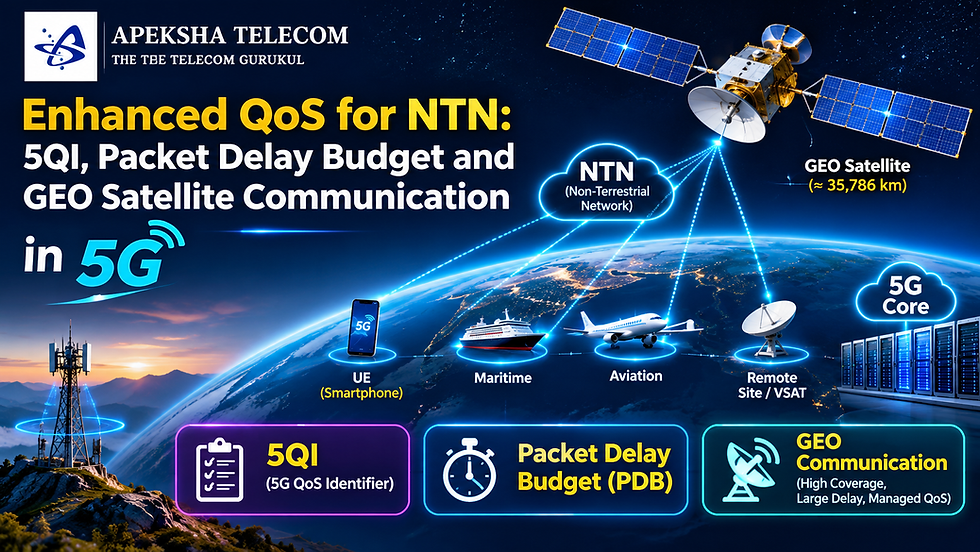
Table of Contents
What Is Quality of Service (QoS) in 5G NTN?
Understanding the 5G QoS Framework
What Is 5QI in 5G?
Understanding Packet Delay Budget (PDB)
Why Does NTN Require Enhanced QoS?
GEO Satellite Propagation Delay
Introduction of 5QI = 10 in 3GPP Release 17
QoS Characteristics of 5QI = 10
Comparison of 5QI 8, 9, 74, 76 and 10
How Enhanced QoS Supports NTN Applications
Role of 5G Core Network Functions in QoS Management
Practical Example of QoS in GEO Satellite Communication
Challenges in NTN QoS Optimization
Importance of Enhanced QoS for Future 5G and 6G Networks
Conclusion
Frequently Asked Questions
What Is Quality of Service (QoS) in 5G NTN?
Quality of Service (QoS) is a fundamental mechanism in 5G networks that allows the network to manage different types of traffic according to their application requirements.
Not every application requires the same network performance.
For example, video streaming requires sufficient bandwidth and acceptable packet delivery delay, while online gaming requires responsive communication and low latency.
Similarly, industrial automation applications may require predictable latency and high reliability, whereas IoT applications may prioritize efficient communication and low power consumption.
The 5G QoS framework enables network operators to provide different traffic-handling treatments according to these requirements.
In Non-Terrestrial Networks, QoS becomes even more important because satellite communication introduces additional propagation delay and different network operating conditions.
Enhanced QoS for NTN helps the 5G system accommodate these satellite-specific characteristics while maintaining a standardized QoS framework.
Why Is QoS Important in NTN?
The major objectives of QoS management in NTN include:
Supporting different application requirements.
Managing packet delivery delay.
Improving network resource allocation.
Supporting satellite broadband communication.
Providing appropriate traffic prioritization.
Maintaining service quality across terrestrial and non-terrestrial networks.
Therefore, QoS is not only about increasing data speed. It is about providing appropriate network treatment for different applications.
Understanding the 5G QoS Framework
The 5G QoS framework is designed to support different communication requirements through QoS Flows.
Three major usage scenarios in 5G include:
Enhanced Mobile Broadband (eMBB)
eMBB supports high-data-rate applications such as:
Video streaming.
Broadband internet.
Cloud applications.
High-speed data communication.
Ultra-Reliable Low-Latency Communication (URLLC)
URLLC supports applications that require low latency and high reliability.
Examples include industrial automation, mission-critical communication and selected real-time control applications.
Massive Machine-Type Communication (mMTC)
mMTC supports large numbers of connected devices, particularly IoT applications.
Examples include smart meters, environmental monitoring and remote sensing.
These usage scenarios represent broad application categories. They are not direct one-to-one mappings to individual 5QI values.
What Is a QoS Flow?
A QoS Flow is the finest granularity of QoS differentiation in the 5G System.
Each QoS Flow is identified by a QoS Flow Identifier (QFI).
The network associates QoS characteristics with the flow to determine how its packets should be handled.
For example, a UE connected to a 5G NTN network may simultaneously use video streaming, web browsing, email and messaging applications.
Each application may have different QoS requirements.
The 5G system can classify the traffic into appropriate QoS Flows and provide different forwarding treatment.
This enables the network to support multiple applications over the same satellite connection.
What Is 5QI in 5G?
The 5G QoS Identifier (5QI) is an important component of the 5G QoS framework.
It identifies a standardized or pre-configured set of QoS characteristics associated with a QoS Flow.
In simple terms, 5QI helps the network determine the appropriate packet forwarding treatment for a particular traffic flow.
A standardized 5QI is associated with important parameters such as:
Resource Type.
Priority Level.
Packet Delay Budget (PDB).
Packet Error Rate (PER).
Averaging Window, where applicable.
Maximum Data Burst Volume, where applicable.
These characteristics help the network manage traffic according to its requirements.
Role of 5QI in Network Operation
The gNB uses QoS information to support appropriate radio scheduling and link-layer configuration.
For example:
The Priority Level influences the relative priority of traffic.
The Packet Delay Budget provides a delay target for QoS configuration.
The Packet Error Rate represents a packet delivery reliability target.
The Resource Type determines whether the flow uses GBR, Non-GBR or Delay-Critical GBR characteristics.
Therefore, 5QI provides a standardized reference for QoS handling across the 5G system.
Understanding Packet Delay Budget (PDB)
Packet Delay Budget (PDB) is one of the most important characteristics of 5G QoS.
It defines an upper bound for the time a packet may be delayed between the UE and the N6 termination point at the UPF.
The PDB helps the network determine appropriate scheduling and link-layer configurations.
Different applications have different latency requirements.
For example:
Voice communication requires relatively low delay.
Online gaming requires responsive packet delivery.
Buffered video streaming can tolerate higher delay.
Web browsing and email can generally tolerate comparatively longer packet delivery times.
The PDB allows the network to accommodate these different requirements.
Examples of Standardized 5QI Values
5QI | Example Service | Packet Delay Budget |
5QI 8 | Internet applications | 300 ms |
5QI 9 | Internet applications | 300 ms |
5QI 74 | Live uplink streaming | 500 ms |
5QI 76 | Live uplink streaming | 500 ms |
5QI 10 | GEO NTN-related delay requirements | 1100 ms |
These examples demonstrate how different 5QI values can support different packet delay requirements.
However, conventional PDB values can create challenges when applied to GEO satellite communication.
This is where Enhanced QoS for NTN becomes important.
Why Does NTN Require Enhanced QoS?
Terrestrial 5G networks generally operate with shorter propagation distances than GEO satellite networks.
In terrestrial communication, the distance between the UE and gNB is relatively limited.
In GEO satellite communication, the satellite is located approximately 35,786 km above the Earth's equator.
This creates significantly longer propagation delay.
Traditional PDB values such as 300 ms or 500 ms may not adequately represent the delay requirements of GEO satellite access.
Major QoS Challenges in NTN
High Propagation Delay
The long communication distance between the UE, satellite and network infrastructure introduces substantial propagation delay.
Extended Uplink Scheduling Delay
In transparent payload architectures, the gNB may need to receive a scheduling request through the satellite before generating an uplink grant.
This process introduces additional propagation delay.
HARQ and Retransmission Timing
Satellite propagation delay affects acknowledgement timing, retransmission procedures and buffer requirements.
Application Performance
Applications designed around terrestrial network latency may experience slower response times over GEO satellite links.
Radio Resource Scheduling
The gNB must consider satellite-specific timing characteristics when configuring scheduling and radio resource management.
Therefore, NTN requires QoS configurations that account for its unique propagation environment.
GEO Satellite Propagation Delay
Geostationary Earth Orbit (GEO) satellites operate approximately 35,786 km above the Earth's equator.
They orbit at the same angular velocity as the Earth's rotation, allowing them to appear relatively stationary from a fixed location on Earth.
GEO satellites are commonly used for satellite broadband, broadcasting, maritime communication, aviation connectivity and remote-area communication.
However, their orbital altitude introduces significant propagation delay.
GEO Satellite Delay Characteristics
Parameter | Approximate Value |
GEO Orbital Altitude | 35,786 km |
Worst-Case One-Way Propagation Delay | 270 ms |
Approximate Round-Trip Propagation Delay | 540 ms |
5QI 10 Packet Delay Budget | 1100 ms |
The approximate round-trip propagation delay is:
270 ms + 270 ms = 540 ms
This is particularly important for uplink scheduling in transparent payload satellite architectures.
Why Does Uplink Scheduling Require More Time?
In a transparent payload GEO NTN:
The UE sends an uplink scheduling request.
The request travels through the satellite to the ground-based gNB.
The gNB processes the request and generates an uplink grant.
The grant travels back through the satellite to the UE.
The UE receives the grant and transmits uplink data.
The satellite propagation delay affects both directions.
Consequently, the scheduling process can involve approximately 540 ms of round-trip propagation delay under the relevant worst-case GEO assumptions.
This does not include all additional processing and transmission delays.
These characteristics explain why traditional terrestrial QoS configurations may not be sufficient for GEO satellite communication.
Introduction of 5QI = 10 in 3GPP Release 17
To address the extended delay requirements of GEO satellite communication, 3GPP introduced a new standardized 5QI value: 5QI = 10.
This enhancement was introduced in Release 17 as part of the evolution of 5G NR support for Non-Terrestrial Networks.
The primary objective was to accommodate the extended Packet Delay Budget required by GEO satellite-based NTN deployments.
Before this enhancement, conventional standardized PDB values such as 300 ms and 500 ms could not adequately represent the worst-case delay requirements associated with GEO satellite access.
3GPP therefore introduced an extended PDB of 1100 ms for 5QI = 10.
Why Was 1100 ms Selected?
The selection of 1100 ms is associated with the extended propagation and scheduling delays in GEO satellite deployments.
Consider the following:
Worst-case one-way GEO propagation delay: approximately 270 ms.
Two-way propagation delay affecting uplink scheduling: approximately 540 ms.
Additional time required for network processing and packet forwarding.
The 1100 ms PDB provides an extended delay budget to accommodate GEO satellite access.
It is important to understand that 1100 ms is a QoS budget, not a guarantee that every packet will experience exactly 1100 ms of delay.
It is also not a statement that every application using GEO satellites must have 1100 ms latency.
Actual performance depends on satellite architecture, network configuration, propagation conditions and processing paths.
QoS Characteristics of 5QI = 10
The new 5QI value comes with specific QoS characteristics designed for Non-Guaranteed Bit Rate services.
The important parameters are:
Parameter | 5QI = 10 |
5QI Value | 10 |
Resource Type | Non-GBR |
Default Priority Level | 90 |
Packet Delay Budget | 1100 ms |
Packet Error Rate | 10⁻⁶ |
Let's understand each parameter.
Resource Type: Non-GBR
5QI = 10 uses a Non-Guaranteed Bit Rate (Non-GBR) resource type.
Non-GBR means the network does not guarantee a specific bit rate for the QoS Flow.
Instead, resources are allocated according to network conditions, scheduling policies and available capacity.
This resource type is suitable for applications that require appropriate QoS treatment but do not need a guaranteed minimum data rate.
Default Priority Level: 90
The default priority level associated with 5QI = 10 is 90.
Priority levels help determine the relative priority of QoS Flows when network resources are constrained.
A numerically higher priority level generally represents a lower priority.
Therefore, priority level 90 indicates relatively low priority compared with many other standardized 5QI profiles.
It is important to distinguish priority from PDB.
A longer PDB does not automatically mean that a traffic flow receives higher scheduling priority.
Packet Delay Budget: 1100 ms
The PDB of 1100 ms is the major enhancement associated with 5QI = 10.
It accommodates the extended delay requirements of GEO satellite-based NTN deployments.
This enables the 5G QoS framework to represent services that operate over satellite links with significantly longer propagation delays.
Packet Error Rate: 10⁻⁶
The Packet Error Rate (PER) represents an upper bound on the rate of packets that are not successfully delivered.
A PER of 10⁻⁶ means a target packet error rate of one packet error per million packets under the specified measurement conditions.
This provides a packet delivery reliability target for the QoS profile.
Actual packet delivery performance depends on radio conditions, network implementation and operating conditions.
Comparison of 5QI 8, 9, 74, 76 and 10
The introduction of 5QI = 10 demonstrates how the 5G QoS framework evolved to support satellite communication.
Let's compare the relevant delay budgets.
QoS Parameter | 5QI 8 | 5QI 9 | 5QI 74 | 5QI 76 | 5QI 10 |
Resource Type | Non-GBR | Non-GBR | Non-GBR | Non-GBR | Non-GBR |
Priority Level | 80 | 90 | 56 | 56 | 90 |
Packet Delay Budget | 300 ms | 300 ms | 500 ms | 500 ms | 1100 ms |
Packet Error Rate | 10⁻⁶ | 10⁻⁶ | 10⁻⁶ | 10⁻⁶ | 10⁻⁶ |
The comparison highlights an important difference.
The 1100 ms PDB of 5QI = 10 is substantially higher than the 300 ms and 500 ms examples used by conventional QoS profiles.
This extended delay budget helps accommodate the propagation characteristics of GEO satellite communication.
It is important to remember that 5QI values represent standardized service profiles, not simply terrestrial and satellite labels.
The appropriate 5QI must be selected according to actual service and network requirements.
How Enhanced QoS Supports NTN Applications
Enhanced QoS enables 5G NTN systems to support different applications with more appropriate delay expectations.
Satellite Broadband Internet
Satellite broadband enables internet connectivity in remote regions where terrestrial infrastructure is limited.
Applications include web browsing, email communication, file downloads, cloud services and general internet connectivity.
The extended PDB of 5QI = 10 helps accommodate the longer delay characteristics of GEO satellite access.
Maritime Communication
Ships operating in oceans and remote maritime regions often depend on satellite connectivity.
Enhanced QoS can help support onboard internet access, communication services and operational applications.
Aviation Connectivity
Aircraft operating over oceans and remote regions may use satellite networks to maintain communication connectivity.
The QoS framework helps the network manage different traffic requirements over satellite links.
Remote Enterprise Connectivity
Businesses, research facilities and industrial operations in remote locations can use NTN connectivity to access cloud platforms, enterprise applications and communication services.
IoT and Remote Monitoring
Satellite-based IoT connectivity can support environmental monitoring, asset tracking, agricultural monitoring and remote infrastructure management.
The appropriate QoS profile depends on the application's latency, reliability, data-rate and power requirements.
Role of 5G Core Network Functions in QoS Management
Enhanced QoS for NTN is not managed by a single network component.
It requires coordination between the 5G Core, radio access network and satellite communication infrastructure.
Policy Control Function (PCF)
The PCF supports policy decisions related to QoS and network resource management.
It helps determine the policy rules that should be applied to different services and traffic flows.
Session Management Function (SMF)
The SMF manages PDU sessions and QoS Flow configuration.
It coordinates relevant QoS information and establishes appropriate user-plane rules.
User Plane Function (UPF)
The UPF handles user-plane packet processing and forwarding.
It acts as the anchor for user-plane connectivity between the 5G Core and external data networks.
gNB
The gNB provides radio access and applies QoS-related scheduling and radio resource management.
It uses the QoS characteristics associated with the relevant flows to support appropriate radio treatment.
User Equipment (UE)
The UE generates and receives application traffic and participates in 5G QoS procedures.
Together, these components enable the 5G system to manage QoS across terrestrial and non-terrestrial access networks.
Practical Example of QoS in GEO Satellite Communication
Let's consider a practical scenario.
A user located in a remote region is connected to a 5G NTN network through a GEO satellite.
The user accesses a web application hosted in a data centre connected to the 5G Core.
Network Scenario
Communication Path:
UE → GEO Satellite → NTN Gateway → gNB / 5G Network → UPF → Internet Application
Assume the following characteristics:
Parameter | Value |
Satellite Type | GEO |
Satellite Altitude | Approximately 35,786 km |
One-Way Propagation Delay | Up to approximately 270 ms |
Approximate Round-Trip Propagation Delay | 540 ms |
Assigned QoS Identifier | 5QI = 10 |
Packet Delay Budget | 1100 ms |
Resource Type | Non-GBR |
How Does It Work?
Step 1: Application Traffic Generation
The UE generates application traffic, such as web browsing or internet data.
Step 2: QoS Flow Identification
The 5G system identifies the applicable QoS Flow and its associated QoS characteristics.
Step 3: QoS Policy Application
The 5G Core applies the relevant policy and session-management configuration.
Step 4: Satellite Communication
The packets travel through the satellite communication path, introducing propagation delay.
Step 5: Radio Resource Scheduling
The gNB uses the QoS information to manage scheduling and radio resource allocation while accounting for NTN-specific timing constraints.
Step 6: Packet Delivery
The packets are forwarded towards the UPF and the external data network.
The extended PDB associated with 5QI = 10 allows the QoS framework to accommodate the longer GEO satellite delay characteristics.
This example demonstrates why satellite-specific QoS enhancements are important for practical 5G NTN deployments.
Challenges in NTN QoS Optimization
Although 5QI = 10 addresses an important GEO satellite requirement, several engineering challenges remain.
High Round-Trip Time
GEO satellite links introduce high round-trip times that affect scheduling, acknowledgements and retransmission procedures.
Network configurations must account for these delays.
Buffer Management
Longer packet delivery times can increase the need for appropriate buffering at different network layers.
Poor buffer configuration may result in packet drops, congestion or unnecessary latency.
HARQ and RLC Optimization
HARQ timing and RLC retransmission behavior must be designed to operate effectively under satellite propagation conditions.
QoS Flow Mapping
The network must correctly map QoS Flows to Data Radio Bearers (DRBs).
Incorrect mapping can result in traffic receiving inappropriate forwarding treatment.
Satellite Architecture
Transparent and regenerative payload architectures have different delay characteristics and network-function placement.
The QoS design must consider the selected architecture.
End-to-End Latency
PDB alone does not determine the complete application experience.
Engineers must also consider satellite propagation delay, gateway processing, core network processing, transport network delay, radio scheduling, retransmission overhead and application server response time.
Effective NTN QoS optimization therefore requires end-to-end network analysis rather than focusing on a single parameter.
Importance of Enhanced QoS for Future 5G and 6G Networks
The integration of satellite and terrestrial networks is an important part of the evolution towards ubiquitous connectivity.
Enhanced QoS provides a foundation for supporting services with different latency and reliability requirements across satellite-based communication systems.
As NTN technology evolves, engineers will need to understand:
5G QoS architecture.
5QI and QoS Flow management.
Packet Delay Budget.
Packet Error Rate.
Satellite propagation characteristics.
Transparent and regenerative payload architectures.
5G Core Network functions.
RAN scheduling and protocol optimization.
End-to-end protocol testing.
Future 6G systems are also expected to further integrate terrestrial, aerial and satellite communication technologies.
This will increase the importance of flexible QoS management and intelligent network resource allocation.
For telecom professionals, understanding the relationship between QoS parameters and satellite propagation characteristics will be an important technical skill.
Conclusion
Enhanced QoS for NTN represents an important development in the evolution of 5G satellite communication.
Traditional terrestrial QoS configurations were not designed to accommodate every propagation-delay condition associated with satellite communication, particularly GEO-based deployments.
To address this challenge, 3GPP introduced 5QI = 10 in Release 17 with an extended Packet Delay Budget of 1100 ms.
This enhancement allows the 5G QoS framework to accommodate the longer propagation and scheduling delays associated with GEO satellite access.
The key takeaway is that 5G NTN requires QoS configurations that consider satellite-specific latency, scheduling behavior and packet delivery requirements.
For telecom engineers, understanding 5QI, PDB, PER and QoS Flow management is essential for designing, testing and optimizing next-generation satellite communication networks.
At Apeksha Telecom – The Telecom Gurukul, we focus on practical telecom knowledge covering 4G, 5G, 5G Core, protocol testing, log analysis, O-RAN and emerging NTN technologies.
As satellite and terrestrial networks become increasingly integrated, professionals with strong protocol and network engineering skills will play an important role in the future of telecommunications.
Frequently Asked Questions (FAQs)
What is Enhanced QoS for NTN?
Enhanced QoS for NTN refers to improvements in the 5G Quality of Service framework that accommodate the unique communication requirements of satellite-based networks, including extended propagation delay.
What is 5QI in 5G NTN?
5QI stands for 5G QoS Identifier. It identifies standardized QoS characteristics such as resource type, priority level, packet delay budget and packet error rate.
Why did 3GPP introduce 5QI = 10?
3GPP introduced 5QI = 10 in Release 17 to accommodate the extended Packet Delay Budget requirements of GEO satellite-based NTN deployments.
What is the Packet Delay Budget of 5QI = 10?
The standardized Packet Delay Budget associated with 5QI = 10 is 1100 ms.
What is the GEO satellite propagation delay?
The worst-case one-way propagation delay associated with GEO satellite access is approximately 270 ms under the relevant 3GPP assumptions.
What is the round-trip propagation delay of a GEO satellite?
The approximate round-trip propagation delay is 540 ms, calculated using a one-way delay of 270 ms.
What is the resource type of 5QI = 10?
5QI = 10 uses Non-Guaranteed Bit Rate (Non-GBR) resource type.
What is the default priority level of 5QI = 10?
The default priority level is 90.
What is the Packet Error Rate of 5QI = 10?
The standardized Packet Error Rate is 10⁻⁶.
Which 3GPP release introduced 5QI = 10 for NTN?
The enhancement was introduced in 3GPP Release 17.
Does a PDB of 1100 ms mean every GEO satellite packet takes 1100 ms?
No. PDB is an upper-bound delay characteristic used for QoS configuration. Actual packet delay varies depending on the satellite path, network architecture, processing and operating conditions.
Is 5QI = 10 applicable to every NTN architecture?
It is particularly relevant to the extended PDB requirements of GEO satellite access. The actual QoS configuration must consider the satellite orbit, payload architecture and application requirements.
References
3GPP TS 23.501 – System Architecture for the 5G System
3GPP TS 23.501 – 5G QoS Framework
3GPP TR 38.811 – Study on NR to Support Non-Terrestrial Networks
3GPP Release 17 – NR NTN Enhancements
Learn 5G, NTN and Telecom Protocol Engineering
Want to build your career in 4G, 5G, 5G Core, Protocol Testing, Log Analysis, O-RAN and emerging satellite communication technologies?
Join Apeksha Telecom – The Telecom Gurukul and gain practical knowledge of next-generation telecom technologies.Website: https://www.telecomgurukul.com/


Comments