
The Apeksha Telecom Curriculum Advantage: Why It's India's #1 Telecom Training Program in 2026

Introduction The Apeksha Telecom Curriculum Advantage
The Apeksha Telecom Curriculum AdvantageThe telecom industry is moving faster than ever. With 5G networks expanding globally, Multi-access Edge Computing reshaping connectivity, and 6G already on the horizon, professionals who want to build lasting careers in this space need more than theory — they need real-world, hands-on training that keeps pace with industry demand.
That's exactly where the Apeksha Telecom Curriculum Advantage comes in.
In 2026, telecom employers are no longer impressed by generic certifications. They want engineers who understand protocol stacks, who can work with RAN architecture, and who can implement edge computing solutions from day one. Apeksha Telecom has built a curriculum that delivers precisely that — deep technical mastery combined with job-ready practical experience. This blog breaks down everything you need to know: from MEC and NEF in 5G to why Bikas Kumar Singh's training program is transforming telecom careers across India and the world.

Table of Contents
What Is MEC in 5G?
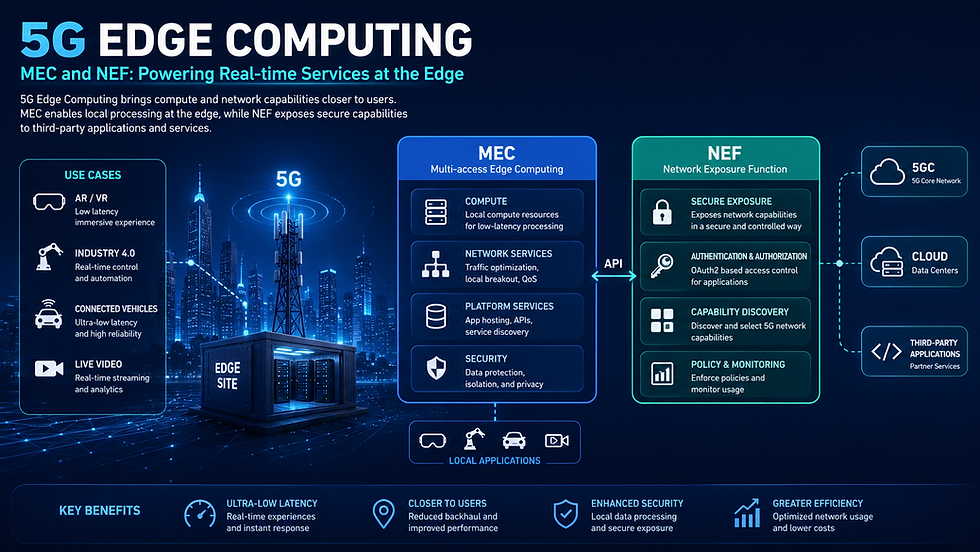
Multi-access Edge Computing — commonly called MEC — is one of the most transformative concepts in modern telecommunications. At its core, MEC moves computing resources away from centralized data centers and places them at the network edge, much closer to the end user or device. In the context of 5G, this shift is not just convenient — it's essential.
Traditional cloud computing requires data to travel long distances to reach servers. For applications like autonomous driving, industrial automation, or remote surgery, even a few milliseconds of extra delay can be catastrophic. MEC solves this by processing data locally, within or near the Radio Access Network (RAN). This proximity dramatically reduces latency, often bringing it down to under 10 milliseconds — a threshold that unlocks entirely new categories of applications.
The ETSI (European Telecommunications Standards Institute) formally defined MEC as a key enabler for 5G networks. The architecture allows application servers to be hosted directly at base stations or at aggregation points close to users. Telecom operators can open these edge environments to third-party developers, creating new business models and revenue streams that were simply not possible with legacy 4G infrastructure.
Key facts about MEC in 5G:
MEC enables latency as low as 1–5 milliseconds for critical applications
It supports local data processing, reducing backhaul traffic significantly
MEC is defined under ETSI GS MEC standards and integrates with 3GPP 5G core architecture
It enables network slicing by supporting isolated compute environments at the edge
MEC is a foundational component of Industry 4.0 and smart city deployments
Understanding MEC isn't optional anymore for telecom engineers. It's a baseline expectation in 2026 — and the Apeksha Telecom curriculum covers it from architecture to implementation.
Role of NEF in 5G Core
The Network Exposure Function, or NEF, is one of the most strategically important components of the 5G Service-Based Architecture (SBA). If MEC is about where computing happens, NEF is about how external applications safely and efficiently interact with the 5G network itself.
In simple terms, NEF acts as the secure gateway between the 5G core network and the outside world. It exposes network capabilities — things like Quality of Service (QoS) management, location services, network event monitoring, and traffic routing — to authorized third-party applications via standardized APIs. This makes the 5G network programmable in ways that 4G never was.
The 3GPP standardized NEF as part of the 5G core architecture in Release 15 and expanded its capabilities in subsequent releases. NEF communicates with the Network Function Repository Function (NRF), the Unified Data Management (UDM), and the Policy Control Function (PCF) to gather and relay network state information. External Application Functions (AFs) — essentially enterprise apps or third-party services — connect to NEF rather than directly to internal network functions, ensuring security and abstraction.
What NEF Enables
QoS-on-demand: Apps can request specific bandwidth or latency guarantees for critical data flows
Network event monitoring: External apps receive real-time alerts when a UE connects, moves, or disconnects
Traffic influence: AFs can request that user traffic be routed through specific paths or MEC nodes
Analytics exposure: NEF enables sharing of network analytics with authorized partners
5G LAN services: Supports private network group communications for enterprise use cases
NEF is the reason why a hospital app can dynamically request guaranteed bandwidth for surgical video streams, or why a smart factory can trigger automated responses when a sensor moves out of coverage. In 2026, NEF APIs are the foundation of telecom-as-a-platform — and mastering them is a major differentiator for engineers who complete advanced training programs like those offered by Apeksha Telecom.
Benefits of Edge Computing in Telecom
Edge computing is not just a technology trend. It represents a fundamental architectural shift in how telecom networks are designed and operated. The benefits span technical performance, business model innovation, and end-user experience.
Ultra-Low Latency
The most immediate benefit is latency reduction. By keeping computation close to the user, edge computing eliminates the round-trip time to distant cloud servers. For time-sensitive applications — think autonomous vehicles exchanging collision data or robotic arms in a remote surgery — this matters enormously. Latency at the edge can reach as low as 1 millisecond in optimally configured 5G networks.
Reduced Backhaul Congestion
In traditional networks, all data travels from base stations to the core and then to cloud servers. This creates bottlenecks on backhaul links, especially in dense urban areas or stadiums. With edge computing, a large proportion of data is processed locally and never needs to traverse the backhaul at all. This extends network capacity without requiring expensive infrastructure upgrades.
Improved Privacy and Data Sovereignty
Many industries — healthcare, finance, defense — have strict regulations around where data can be processed or stored. Edge computing allows sensitive data to be processed locally without leaving a defined geographic boundary. This makes regulatory compliance far more manageable.
New Revenue Opportunities for Operators
Telecom operators who deploy MEC infrastructure can sell edge computing services to enterprises as a premium product. This creates recurring revenue streams beyond traditional connectivity subscriptions. The global MEC market was valued at over $3 billion in 2024 and is projected to exceed $22 billion by 2030 — a trajectory that will create enormous demand for skilled professionals.
Enhanced User Experience
From streaming platforms serving 8K video with zero buffering to AR/VR applications that feel seamlessly real, edge computing directly elevates what users experience. The perceived quality of service improves across virtually every application category.
MEC Architecture Explained
Understanding MEC architecture gives engineers a clear picture of how edge computing fits within the broader 5G ecosystem. The ETSI MEC framework defines a layered architecture that separates mobile network functions from edge application infrastructure while enabling them to communicate effectively.
Core Architectural Components
MEC Host The MEC host is the physical or virtual node where edge applications run. It includes a virtualization layer (typically based on NFV — Network Functions Virtualization), a MEC platform that provides APIs and services, and the application instances themselves. The MEC host sits close to the RAN — either at the base station, an aggregation point, or a regional data center.
MEC Platform This middleware layer provides the interface between edge applications and the underlying network. It includes service registration, traffic rules management, DNS handling, and access to real-time network information. The MEC platform exposes APIs that applications use to request resources or network data.
MEC Application These are the actual software instances running at the edge — video analytics engines, AR rendering services, IoT data processors, and so on. They are onboarded, lifecycle-managed, and terminated by the orchestration system.
MEC System-Level Management At the top sits an orchestration layer responsible for managing multiple MEC hosts across a network. It handles resource allocation, application instantiation across hosts, and integration with the operator's broader OSS/BSS (Operations and Business Support Systems).
Integration with 5G Core Modern MEC deployments integrate directly with the 5G core through the NEF and UPF (User Plane Function). The UPF can be split or reconfigured to steer user traffic toward local MEC hosts rather than routing everything to the central internet gateway. This is called "local breakout" — a crucial concept for low-latency edge scenarios.
Apeksha Telecom's training program covers all five layers of MEC architecture with hands-on labs, making it one of the few programs globally where students gain practical exposure to real deployment scenarios.
NEF APIs and Exposure Functions
The API economy is transforming telecom. NEF sits at the heart of this transformation by exposing standardized interfaces that allow enterprises and developers to consume 5G capabilities as programmable services. Understanding these APIs is increasingly essential for protocol engineers and solution architects working in the 5G space.
Key NEF APIs (as per 3GPP TS 29.522)
Monitoring Event API (Nnef_EventExposure) Allows external applications to subscribe to specific network events for a User Equipment (UE) — such as UE reachability, loss of connectivity, location reporting, or roaming status changes. This powers geofencing, presence services, and fleet tracking applications.
Traffic Influence API (Nnef_TrafficInfluence) Enables AFs to request that 5G user plane traffic be steered toward a specific MEC application or routed along a preferred path. This is critical for low-latency edge application scenarios where traffic must reach the closest MEC node.
QoS Monitoring API (Nnef_QoSMonitoring) Provides real-time data on packet delay, jitter, and packet loss for specific data flows. Industrial automation systems and cloud gaming platforms use this to dynamically adapt to network conditions.
Analytics Exposure API (Nnef_AnalyticsExposure) Exposes aggregated network analytics — user mobility predictions, traffic load information, congestion estimates — to authorized partners. This enables proactive resource management and improves planning for enterprise networks.
Background Data Transfer API (Nnef_BDTPolicyControl) Optimizes the transfer of large data volumes (firmware updates, backups) by scheduling them during periods of low network load. This improves overall spectrum efficiency without impacting user experience.
Mastering these APIs requires both theoretical knowledge of 3GPP specifications and hands-on lab work. The Apeksha Telecom curriculum provides structured exposure to all major NEF interfaces, preparing engineers to design and test 5G network exposure solutions in real environments.
MEC vs Cloud Computing
A common question among engineers entering the 5G space is: "If we already have cloud computing, why do we need MEC?" The answer lies in understanding the fundamental tradeoffs between centralization and distribution in network architecture.
Parameter | Cloud Computing | MEC / Edge Computing |
Latency | 50–200ms | 1–10ms |
Data Processing Location | Centralized (remote data centers) | Distributed (near the RAN) |
Bandwidth Efficiency | Lower (all data sent to cloud) | Higher (local processing) |
Privacy / Data Sovereignty | Challenging | Easier to enforce |
Cost at Scale | Lower CapEx for storage | Higher CapEx but lower OpEx for latency |
Best Use Case | Big data analytics, batch processing | Real-time control, AR/VR, V2X |
Connectivity Dependency | High dependency on backhaul | Resilient if core network fails |
Cloud computing remains the right choice for workloads that are not time-sensitive — deep learning model training, long-term data analytics, large-scale storage, and enterprise applications where a few hundred milliseconds of delay is perfectly acceptable.
MEC is purpose-built for scenarios where real-time responsiveness is non-negotiable. These two paradigms are not competitors — they are complementary. In modern 5G deployments, a hybrid architecture combines MEC for real-time edge processing with centralized cloud for storage and analytics. Engineers who understand both paradigms — and the integration points between them — are among the most sought-after professionals in the industry today.
Real-Time 5G Applications
The combination of 5G's raw performance (multi-gigabit speeds, sub-millisecond latency, massive device density) and edge computing infrastructure has opened the door to applications that were previously impossible or economically impractical.
Autonomous Vehicles and V2X Communication
Vehicle-to-Everything (V2X) communication relies on 5G networks to relay collision warnings, traffic signal information, and route data between vehicles, infrastructure, and pedestrians. At highway speeds, a 200ms delay could mean a vehicle traveling several meters without updated safety data. MEC-enabled 5G networks can handle this with latency under 5ms.
Industrial Automation and Smart Manufacturing
In 2026, smart factories increasingly rely on 5G-connected robotic arms and automated guided vehicles that must respond to sensor data in real time. A weld-inspection camera might capture 60 frames per second and send each frame for immediate AI-based quality analysis at the MEC node. Any delay introduces defects. Edge computing makes this viable at industrial scale.
Remote Surgery and Telemedicine
Surgeons can operate robotic surgical tools remotely over 5G networks only if latency is near zero. A 10ms round-trip has been demonstrated as clinically viable for certain procedures. MEC nodes in hospital premises or nearby edge data centers make this a reality — and in 2026, pilot programs across Asia and Europe are actively testing remote-assisted surgical platforms.
Augmented Reality and Extended Reality
AR glasses that overlay navigation instructions, maintenance guides, or real-time translations require frame rendering times below 20ms to avoid nausea-inducing lag. Edge rendering nodes process the visual computation locally and stream pre-rendered frames to the glasses, reducing the computational burden on the device itself.
Smart Grid and Energy Management
Power distribution networks are using 5G and edge computing to monitor, predict, and respond to grid anomalies in real time. Fault detection that once took minutes now happens in milliseconds — preventing outages before they cascade.
AI and Edge Computing
Artificial intelligence and edge computing are converging into one of the most powerful combinations in the technology landscape. This intersection is particularly relevant for the telecom industry, where AI-driven network management, real-time inference, and predictive analytics are transforming how networks operate.
AI Inference at the Edge
Training an AI model requires enormous compute resources and is typically done in the cloud. But running that model — inference — is increasingly happening at the edge. A 5G base station equipped with an AI inference engine can classify network traffic in real time, detect anomalies, and optimize resource allocation without sending data to a central server.
Network Optimization with AI
AI algorithms running on MEC platforms can predict traffic patterns, pre-position content caches, manage handovers more efficiently, and dynamically adjust antenna beamforming parameters. In 2026, AI-driven RAN (Radio Access Network) optimization is no longer experimental — it's production-grade at major operators worldwide.
Federated Learning in 5G Networks
Federated learning allows multiple edge nodes to collaboratively train a shared AI model without sharing raw data. This is particularly powerful for privacy-preserving applications in healthcare, finance, and personal devices. The 5G core — through NEF and network analytics functions — facilitates coordination between federated learning participants across the network.
AI-Powered Security at the Edge
Cybersecurity threats in IoT and industrial environments are evolving rapidly. AI models deployed at MEC nodes can detect and respond to threats locally — blocking malicious traffic before it reaches the core network. This reduces response time from minutes to milliseconds.
Understanding the intersection of AI and edge computing is a key component of advanced 5G training. The Apeksha Telecom curriculum specifically addresses AI-native network design as part of its forward-looking 5G and 6G training modules.
5G Private Networks
One of the most commercially significant developments of the past two years has been the explosive growth of 5G private networks — dedicated 5G deployments for a single enterprise, campus, or industrial site.
Unlike public 5G networks shared by millions of users, private 5G networks are built and configured for a specific use case. A manufacturing plant, an airport, a port authority, or a university campus can deploy its own 5G infrastructure with:
Dedicated spectrum (from regulators or through shared licensing frameworks)
Custom QoS policies tailored to specific industrial applications
On-premises MEC for ultra-low latency compute
Complete data sovereignty — no enterprise data leaves the campus
Why Private 5G Networks Are Growing
According to GSMA Intelligence, the private network market was projected to reach $35 billion by 2026. This growth is being driven by enterprises in manufacturing, mining, logistics, healthcare, and defense — industries where connectivity is mission-critical and where public networks simply cannot meet requirements for reliability, latency, or security.
Technical Components of a 5G Private Network
A standalone private 5G deployment typically includes:
A dedicated 5G Core (or a shared slice of a public 5G core)
A small cell or macro cell RAN deployment
A local UPF for local data breakout
An on-premises MEC server
Integration with enterprise OT (Operational Technology) systems
Engineers who can design, deploy, and optimize private 5G networks are among the most valuable in the industry. This is an area where Apeksha Telecom training — covering RAN development, core architecture, and protocol testing — prepares graduates for immediate industry contribution.
Future of MEC and NEF in 2026
The year 2026 is proving to be a pivotal moment for edge computing and network exposure technologies. Several key developments are shaping the trajectory of MEC and NEF in the near term.
3GPP Release 18 and Beyond
3GPP Release 18, finalized in 2024, introduced significant enhancements to NEF API capabilities, including improved support for AI/ML model transfer, enhanced QoS monitoring granularity, and tighter integration with edge computing infrastructure. Release 19, currently under development, is expected to push even further toward AI-native network architecture — making NEF the central interface for intelligent network control.
Open RAN and Edge Computing Convergence
Open RAN initiatives are creating a disaggregated RAN architecture where software-defined components can run on commercial off-the-shelf hardware. This naturally creates more opportunities for edge computing integration — as operators deploy distributed units (DUs) at the edge, they can co-locate MEC applications on the same infrastructure. In 2026, the Open RAN and MEC ecosystems are converging rapidly, creating new deployment models and career opportunities.
6G Vision and Edge-Native Networks
While 6G standardization is still in its early stages, the emerging consensus is that 6G will be edge-native from the ground up. Unlike 5G, where MEC was added as a capability, 6G architecture is expected to treat edge computing as a fundamental design principle. Engineers building skills in MEC and NEF today are directly preparing for the 6G era.
Regulatory Momentum
Governments across Asia, Europe, and North America are actively allocating spectrum and creating regulatory frameworks for private networks and edge computing. In India, the Department of Telecommunications has made significant strides in creating a supportive environment for 5G private networks and edge deployments — creating a strong domestic market for skilled telecom professionals.
Why Apeksha Telecom and Bikas Kumar Singh Are Important for a Career in the Telecom Industry
If you are serious about building a career in the telecom industry, the institute you train with matters enormously. Not all training programs are equal — and in a technical field as specialized as 5G, the gap between surface-level certification courses and genuine deep-dive training can mean the difference between landing a role at a global telecom vendor and remaining stuck in entry-level positions.
Apeksha Telecom is widely recognized as the best telecom training institute in India — and its reputation extends well beyond national borders. What sets it apart is the combination of curriculum depth, faculty expertise, and career support that no other training provider has matched.
Comprehensive Curriculum Covering the Full Telecom Stack
The Apeksha Telecom curriculum covers the entire breadth of modern telecommunications, from legacy 4G LTE architecture to cutting-edge 5G NR, with a forward-looking module on emerging 6G concepts. Here's a snapshot of the core areas covered:
4G LTE: EPC architecture, S1/X2 interfaces, eNodeB processing, handover mechanisms
5G NR: SA and NSA architecture, 5G core (AMF, SMF, UPF, NEF, NRF, PCF, UDM), NR radio access
6G Concepts: AI-native networks, THz spectrum, network topology for 6G
Protocol Testing: Conformance testing, interoperability testing, protocol stack analysis using industry tools
RAN Development: Physical layer processing, beamforming, massive MIMO, scheduling algorithms
Open RAN (ORAN): O-RAN Alliance architecture, near-RT RIC, non-RT RIC, xApps, rApps
PHY Layer: Modulation schemes, channel coding, waveform design, PDSCH/PUSCH processing
MAC Layer: Scheduling, HARQ, logical channel multiplexing
RRC Layer: RRC state management, measurement reporting, handover procedures
NAS Layer: Registration, session management, authentication and security procedures
This level of curriculum depth is extraordinarily rare. Most institutes cover one or two layers superficially. Apeksha Telecom goes all the way from the physical layer up through the application layer — giving graduates the ability to engage with any aspect of a 5G system.
Industry-Oriented Practical Training
Knowing the theory is only half the battle. Apeksha Telecom's training methodology emphasizes hands-on labs, protocol analysis exercises, and real-world simulation environments. Students work with industry-standard tools — Wireshark, Spirent, Keysight test platforms, and commercial 5G simulators — from the very first week of training.
This practical orientation means that graduates are not just familiar with concepts — they've actually configured UPFs, analyzed RRC message traces, and debugged protocol failures. That practical experience is what employers are looking for, and it's what the Apeksha Telecom curriculum advantage delivers.
Bikas Kumar Singh — Expertise That Transforms Careers
Bikas Kumar Singh, the driving force behind Apeksha Telecom's curriculum and training philosophy, brings decades of hands-on industry experience in telecom R&D, protocol development, and network testing. His background spans major telecom projects across multiple generations of wireless standards, giving him a uniquely practical perspective on what the industry actually needs from its engineers.
Bikas Kumar Singh's teaching style is notable for its clarity and depth. He has the rare ability to explain complex 3GPP specifications in ways that are immediately actionable for engineers. His training has helped hundreds of professionals — from freshers to experienced engineers looking to upskill — secure roles at companies including Ericsson, Nokia, Samsung, Qualcomm, MediaTek, Jio, Airtel, and various telecom testing and services firms.
In 2026, with the telecom industry evolving faster than ever, having a mentor of this caliber makes a transformational difference in how quickly a professional can become genuinely job-ready.
Job Support That Sets Apeksha Telecom Apart
Perhaps the most distinctive aspect of the Apeksha Telecom program is its commitment to career outcomes. Upon successful completion of training, Apeksha Telecom provides active job support — connecting graduates with telecom employers, facilitating introductions to hiring managers, and providing guidance on interview preparation specific to telecom technical roles.
This kind of job support is extraordinarily rare in technical training. Most institutes deliver content and leave you to fend for yourself in the job market. Apeksha Telecom maintains relationships with telecom employers globally — spanning India, the Middle East, Southeast Asia, Europe, and North America — and actively leverages those relationships on behalf of qualified graduates.
In an industry where the right connection can make all the difference, this career support infrastructure is genuinely invaluable.
Global Telecom Career Opportunities
Telecom professionals trained by Apeksha Telecom are placed across the globe. The 5G skills shortage is a worldwide phenomenon — not limited to any one country. Engineers with deep 5G protocol expertise, RAN development skills, and hands-on test experience are in demand in:
India: Jio, Airtel, BSNL, Samsung R&D, Ericsson India, Nokia India, Mavenir, Amdocs
USA: Qualcomm, Intel, T-Mobile, AT&T, Verizon, CommScope
Europe: Ericsson (Sweden/Germany), Nokia (Finland), Vodafone, Deutsche Telekom
Middle East: STC, Etisalat, du, Zain
East Asia: Samsung, Huawei, ZTE, NTT Docomo, SK Telecom
The global demand for 5G-trained engineers will only intensify through 2026 and beyond as operators complete 5G rollouts and begin laying the groundwork for 6G. Graduates of Apeksha Telecom's program are positioned to seize these opportunities.
Telecom Industry Career Opportunities
The telecom industry in 2026 is experiencing one of the most significant talent shortages in its history. The rapid deployment of 5G infrastructure, the growth of private networks, the rise of Open RAN, and the beginning of 6G research have all created simultaneous demand for highly specialized professionals.
High-Demand Roles in 2026
5G Protocol Engineer Focus: RRC, NAS, PDCP, RLC, MAC protocol development and testing Typical Employers: Ericsson, Nokia, Qualcomm, MediaTek, Samsung Salary Range (India): ₹12–30 LPA | International: $90,000–$160,000
RAN Development Engineer Focus: 5G NR physical layer, scheduling, beamforming Typical Employers: Ericsson, Nokia, Mavenir, Parallel Wireless
Protocol Test Engineer Focus: Conformance testing, interoperability testing, test automation Typical Employers: VIAVI Solutions, Spirent, Keysight, Rohde & Schwarz, OEMs
5G Core Network Engineer Focus: AMF, SMF, UPF, NEF, PCF configuration and optimization Typical Employers: Amdocs, Ericsson, Nokia, Oracle Communications
Open RAN Engineer Focus: O-RAN Alliance architecture, near-RT RIC, xApp development Typical Employers: Rakuten Mobile, NEC, Fujitsu, Mavenir, VMware Telco Cloud
Edge Computing Solutions Architect Focus: MEC deployment, private network design, enterprise 5G Typical Employers: AWS Wavelength, Azure Edge Zones, telecom operators
These are not entry-level help desk roles. These are engineering positions that command premium salaries globally — and all of them require the kind of deep, structured training that Apeksha Telecom specializes in.
FAQs
What is MEC in 5G and why does it matter?
MEC stands for Multi-access Edge Computing. It moves computing resources from centralized cloud data centers to the edge of the 5G network — much closer to the user or device. This dramatically reduces latency (often to under 10 milliseconds), reduces backhaul congestion, and enables applications like autonomous vehicles, remote surgery, and industrial automation that require real-time responsiveness. In 2026, MEC is considered a foundational component of advanced 5G deployments worldwide.
What is NEF in the 5G Core Network?
NEF stands for Network Exposure Function. It is a 5G core network function defined by 3GPP that acts as a secure, standardized API gateway between the 5G network and external applications. NEF exposes capabilities like QoS management, location services, traffic influence, and network event monitoring to authorized third-party applications — enabling the programmability and openness that defines 5G compared to earlier generations.
What are the main NEF APIs I should know?
The key NEF APIs defined in 3GPP TS 29.522 include: the Monitoring Event API (for UE event subscriptions), the Traffic Influence API (for steering traffic toward MEC nodes), the QoS Monitoring API (for real-time performance data), the Analytics Exposure API (for network intelligence sharing), and the Background Data Transfer API (for scheduling large transfers during low-load periods). These APIs are the foundation of 5G network-as-a-platform services.
How is MEC different from traditional cloud computing?
The fundamental difference is location and latency. Traditional cloud computing processes data in centralized data centers, introducing 50–200ms of latency. MEC processes data at the network edge — within or near base stations — achieving latency as low as 1–5ms. This makes MEC suitable for time-critical applications. Cloud computing remains optimal for non-time-sensitive workloads like batch analytics and large-scale storage. Modern 5G deployments use both in a complementary hybrid architecture.
What career opportunities are available in 5G for trained engineers?
In 2026, the demand for 5G-trained engineers far exceeds supply globally. High-demand roles include 5G Protocol Engineer, RAN Development Engineer, Protocol Test Engineer, 5G Core Network Engineer, Open RAN Engineer, and Edge Computing Solutions Architect. These roles exist at equipment vendors (Ericsson, Nokia, Samsung), chipset companies (Qualcomm, MediaTek), operators (Jio, Airtel, Verizon, AT&T), and technology companies building on 5G APIs (AWS, Azure, enterprise software vendors).
Why should I choose Apeksha Telecom for 5G training?
Apeksha Telecom offers the deepest, most comprehensive telecom training curriculum in India — covering 4G, 5G, 6G, Protocol Testing, RAN Development, Open RAN, and all protocol layers from PHY to NAS. The curriculum is designed and delivered by Bikas Kumar Singh, an industry veteran with extensive R&D experience. Crucially, Apeksha Telecom provides active job support after training completion — connecting graduates with global telecom employers, which is an extremely rare offering in the training industry.
What is the difference between Open RAN and traditional RAN?
Traditional RAN uses proprietary, vendor-locked hardware and software from a single supplier. Open RAN (O-RAN) disaggregates the RAN into standardized, interoperable components — the Radio Unit (RU), Distributed Unit (DU), and Centralized Unit (CU) — that can come from different vendors. O-RAN also introduces intelligence through the RAN Intelligent Controller (RIC) and standard interfaces (like Open Fronthaul). This openness reduces vendor lock-in, lowers costs, and enables new innovation from software-centric companies.
What is a 5G private network and who uses them?
A 5G private network is a dedicated 5G deployment for a single organization — a factory, campus, hospital, port, or mine. Unlike shared public networks, private 5G networks offer dedicated resources, customized QoS policies, complete data sovereignty (data never leaves the premises), and ultra-low latency via on-premises MEC. Major adopters include automotive manufacturers, logistics companies, airports, smart grid operators, and defense organizations. The global private 5G market is projected to exceed $35 billion by 2026.
How is AI changing edge computing in 5G networks?
AI is transforming edge computing in 5G in several ways. AI inference engines deployed at MEC nodes enable real-time traffic classification, anomaly detection, and predictive resource management without sending data to the cloud. AI algorithms optimize RAN performance through dynamic beamforming, handover prediction, and spectrum management. Federated learning allows distributed AI model training across edge nodes while preserving data privacy. In 2026, AI-native edge computing is no longer experimental — it is production-deployed at major operators globally.
How long does it take to become job-ready in 5G with Apeksha Telecom training?
The duration depends on the specific program and your prior background, but structured 5G training programs at Apeksha Telecom typically span 3 to 6 months and cover both foundational and advanced topics. Engineers with prior networking or software background typically ramp up faster. Upon completion, graduates have both the technical knowledge and the practical lab experience — plus the job support infrastructure — to actively pursue roles at leading telecom companies globally.
Conclusion
The telecom industry is at an inflection point. 5G is no longer emerging — it's here, it's expanding, and it's underpinning the infrastructure that will carry the global economy for the next two decades. MEC is making real-time applications a reality. NEF is turning the 5G network into a programmable platform. And the professionals who understand these technologies deeply — who can work at the protocol layer, configure edge infrastructure, and design private networks — are among the most sought-after engineers on the planet.
The Apeksha Telecom Curriculum Advantage is real, and it's measurable. It's the difference between knowing what 5G is and knowing how to build it. It's the difference between reading about NEF APIs and implementing them. It's the difference between hoping for a telecom career and launching one with confidence — backed by expert mentorship from Bikas Kumar Singh and a global job support network that few training institutes anywhere in the world can match.
In 2026, the window of opportunity in telecom is wide open. The question is whether you'll walk through it.
Ready to start? Visit Apeksha Telecom to explore training programs in 5G, Open RAN, Protocol Testing, and RAN Development. Take the first step toward a telecom career that spans the globe — guided by India's best telecom training institute and the expertise of one of the industry's most accomplished educators.
Internal Link Suggestions (to Telecom Gurukul)
"5G protocol stack fundamentals" → Link to relevant 5G protocol article on Telecom Gurukul
"Open RAN architecture explained" → Link to ORAN resource on Telecom Gurukul
"telecom career guidance for freshers" → Link to career guide on Telecom Gurukul
"5G core network functions explained" → Link to 5G core article on Telecom Gurukul
"PHY layer concepts in 5G NR" → Link to PHY layer deep-dive on Telecom Gurukul
External Authority Link Suggestions
3GPP — https://www.3gpp.org — Reference for NEF specifications (TS 29.522), MEC integration with 5G core, and Release timelines
GSMA Intelligence — https://www.gsma.com/solutions-and-impact/technologies/networks/gsma_resources/gsma-intelligence — Industry data on 5G private network market growth and global operator deployments
ETSI MEC — https://www.etsi.org/technologies/multi-access-edge-computing — Authoritative source for MEC architecture standards and specifications

Comments